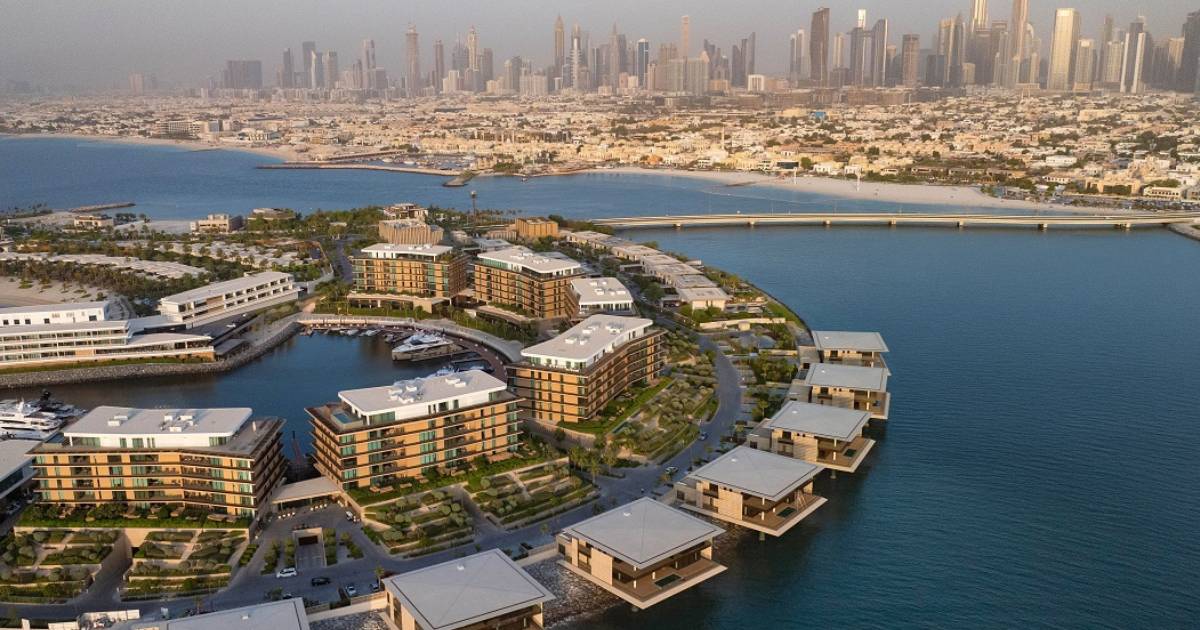

Palace Group Dubai Mansions: 12 Beachfront Homes Across Jumeirah Bay Island and La Mer Due by 2027
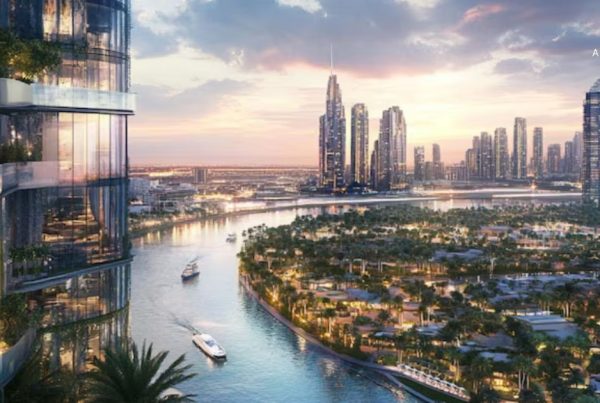
Palace Group is progressing a collection of 12 bespoke beachfront mansions across Jumeirah Bay Island and La Mer, with delivery targeted through 2027. The residences are being positioned at the highest end of Dubai’s residential market, with reported individual values ranging from approximately US$50 million to US$135 million — roughly AED 184 million to almost AED 496 million per home.
The number of homes is small, but that is precisely the point. Palace Group is not presenting the programme as a conventional villa community built around repeated layouts. Each residence is intended to function as an individual architectural project developed with international architects, designers and artisans, giving the collection a scarcity-led proposition aimed at buyers who value waterfront land, privacy and design differentiation more than conventional rental yield.
For ultra-high-net-worth buyers, the relevant question is therefore not simply whether Dubai’s luxury market remains active. It is whether an individual mansion has the location, architecture, land characteristics and eventual resale depth required to justify a price approaching half a billion dirhams.
Palace Group Mansion Collection at a Glance
Developer: Palace Group
Founder: Wissam Damaa
Residences: 12 bespoke beachfront mansions
Locations: Jumeirah Bay Island and La Mer
Reported value per mansion: US$50 million–US$135 million
Approximate AED range: AED 184 million–AED 496 million
Target delivery: Through 2027
Why Jumeirah Bay Island Matters at This Price Level
Jumeirah Bay Island already occupies a distinct position within Dubai’s ultra-prime residential market. The island combines a limited physical land supply with private waterfront plots, marina access and the presence of Bulgari Resort Dubai, creating a micro-market in which individual plot quality can carry more weight than broad community averages.
At this level, buyers are not evaluating property in the same way as a conventional apartment investor. Rental yield may be secondary to privacy, beach frontage, architecture, view protection, plot orientation and long-term scarcity. A one-of-one mansion with a protected waterfront position cannot be compared directly with a standard luxury villa simply because both have similar internal square footage.
This is also why price discovery becomes difficult. Transactions involving unique homes are naturally less frequent, while design specifications and plot characteristics can vary dramatically. A buyer should therefore look beyond price per square foot and examine the land component, replacement cost, architectural provenance and comparable transactions involving genuinely similar trophy assets.
Aurantius’ broader Dubai luxury real estate market 2026 analysis explains why premium properties operate differently from mass-market residential investment, particularly where global wealth flows and scarcity influence pricing.
La Mer Gives Palace Group a Different Waterfront Proposition
La Mer gives the collection a different geographic profile. Rather than reproducing the same investment thesis across two identical locations, Palace Group is spreading the mansion portfolio between an established ultra-prime island and a waterfront district undergoing further residential repositioning.
That distinction matters. Jumeirah Bay Island benefits from an already established scarcity narrative, while La Mer’s investment case is more closely connected to how the broader coastline matures, how surrounding luxury projects are delivered and whether the district develops sufficient transaction depth at the highest price bands.
For a buyer, this means the address alone is not enough. Beach orientation, privacy from neighbouring plots, future construction, road access, shoreline configuration and the relationship between the mansion and nearby developments should all be assessed independently.
Investors comparing premium districts can use the Aurantius Dubai location guide to compare the characteristics of established waterfront, central and family-oriented communities before narrowing the analysis to an individual asset.
The “One-of-One” Design Model: Why Architecture Becomes Part of the Asset Value
Palace Group describes the 12 residences as individually conceived homes rather than standardised villas. The developer’s approach involves collaboration with international architects, interior designers and specialist artisans, with each property treated as its own architectural assignment.
That approach can create genuine differentiation, but buyers should separate design ambition from investment evidence. Bespoke architecture can support scarcity and emotional buyer appeal, yet it can also narrow the resale audience if the design is highly personalised. The strongest trophy homes usually combine individuality with layouts and materials that remain desirable to a broad enough pool of global buyers.
Architecture also affects replacement cost. Complex façades, specialist stonework, oversized glazing, custom joinery and imported finishes can materially increase construction costs. For a future buyer, the quality of execution and long-term maintainability matter almost as much as the original design concept.
Aurantius has examined another interpretation of the ultra-luxury mansion market in Dubai Mansions at Emaar Hills. The comparison is useful because large master-planned luxury communities and one-of-one beachfront residences serve very different buyer motivations despite occupying the same broad premium segment.
Palace Group’s Integrated Development Model
Palace Group says it maintains oversight of its residences from early architectural development through construction and completion. For a highly customised property, that level of continuity can be important because each mansion may involve unusual engineering, imported finishes and substantial coordination between design consultants and construction teams.
The potential advantage is tighter control over design intent and execution. The limitation is that internal oversight does not make a construction programme immune to delays, specification changes or procurement challenges. Buyers considering a residence scheduled for 2027 should still review contractual completion terms, snagging procedures, warranty provisions and any permitted extension clauses.
At the super-prime level, due diligence should also extend beyond the house itself. Landscaping maturity, shoreline works, access arrangements, neighbouring construction and privacy protection can significantly influence the lived experience of a mansion even when the residence itself is completed to a high standard.
What Does a US$50 Million to US$135 Million Price Actually Mean?
The reported value range places every residence firmly within Dubai’s trophy-home category. At the upper end, a mansion valued at US$135 million would approach AED 496 million. That makes conventional investment metrics such as gross rental yield less useful as a primary decision tool.
A buyer at this level may be purchasing for permanent residence, international diversification, generational wealth storage or lifestyle reasons rather than maximising annual income. Even so, capital discipline still matters. A large absolute purchase price magnifies transaction costs, maintenance requirements and the financial impact of a weak resale outcome.
Liquidity also deserves specific attention. Scarcity can support value, but extreme pricing reduces the number of potential buyers. A property may be highly desirable while still taking considerably longer to sell than a mainstream villa. Investors should therefore distinguish scarcity from liquidity rather than assuming the two always move together.
The Aurantius Dubai Property Investment Guide 2026 explains why prestige assets should be evaluated using different criteria from conventional yield-led residential property.
How These Mansions Compare With Other Luxury Property Formats
Dubai’s luxury market now covers several very different property formats. A bespoke Jumeirah Bay mansion may appeal to a buyer seeking land, privacy and complete architectural individuality. A branded residence may instead offer managed services, brand association and amenity density. A high-rise penthouse can deliver skyline views and central access without the operational requirements of maintaining a large private estate.
For example, Armani Beach Residences on Palm Jumeirah represents a design-led branded waterfront proposition, while Palace Group’s mansions compete on privacy, land scarcity and individual architecture. Neither format is automatically superior; they serve different buyer priorities.
Dubai Maritime City projects such as Breez by Danube demonstrate another waterfront segment altogether, with apartment-led inventory and much lower entry prices. Comparing these categories illustrates why “waterfront property” is too broad a label for serious investment analysis.
Palace Group Is Also Expanding Beyond the Coast
The 12 beachfront mansions form part of a wider Palace Group portfolio that also includes additional ultra-luxury homes at Dubai Hills Estate and AYA, a boutique residential development in Jumeirah Garden City.
Dubai Hills is strategically different from Jumeirah Bay and La Mer. Its appeal is based more on golf, landscaping, schools, retail, family infrastructure and central road access than direct beachfront scarcity. Buyers considering the developer’s inland mansion portfolio can therefore assess Dubai Hills Estate separately rather than assuming the same pricing logic applies across every Palace Group residence.
The expansion into multiple high-end districts may broaden Palace Group’s buyer reach, but each project should still be evaluated independently. Developer reputation can reduce some execution uncertainty; it does not automatically make every asset appropriately priced.
What Buyers Should Verify Before Committing
The supplied project information does not provide a complete public breakdown of plot areas, bedroom counts, individual mansion prices, payment schedules or the exact split of the 12 homes between Jumeirah Bay Island and La Mer. Those details should not be guessed.
A serious buyer should request the exact plot plan, built-up area, shoreline frontage, architectural specification, construction status, legal ownership details, payment schedule and contractual handover date for the individual residence under consideration.
Comparable evidence also needs to be highly specific. A Jumeirah Bay waterfront transaction may be more relevant than a much larger sample of luxury sales elsewhere in Dubai. The closer the comparable matches the plot position, beach access, architectural quality and completion status, the more useful it becomes.
Buyers should also budget for long-term ownership rather than focusing only on acquisition price. Large private estates can require substantial expenditure on landscaping, pools, mechanical systems, security, staff, specialist maintenance and periodic refurbishment. These costs rarely determine whether an ultra-high-net-worth buyer can afford the property, but they do affect the asset’s long-term economics.
FAQ: Palace Group Dubai Mansions
Question: How many beachfront mansions is Palace Group delivering?
Answer: The announced collection comprises 12 bespoke beachfront mansions spread across Jumeirah Bay Island and La Mer.
Question: How much are the Palace Group mansions worth?
Answer: Reported individual values range from approximately US$50 million to US$135 million, equivalent to roughly AED 184 million to AED 496 million.
Question: When are the mansions expected to be completed?
Answer: Palace Group is targeting completion and handover through 2027. Buyers should confirm the contractual delivery date for the specific residence rather than treating the portfolio-wide target as a guaranteed individual handover date.
Question: Are all 12 mansions identical?
Answer: No. The collection is positioned around individually designed “one-of-one” residences developed with different architectural and design input rather than repeated standard villa layouts.
Question: Is Jumeirah Bay Island more established than La Mer for ultra-prime mansions?
Answer: Jumeirah Bay Island already has a well-established reputation for scarce ultra-prime waterfront plots and luxury residences. La Mer is also premium waterfront real estate, but its current residential evolution gives it a different supply and pricing context.
Question: Are these mansions suitable for rental-yield investors?
Answer: They are primarily trophy residential assets. Buyers at this level are more likely to focus on scarcity, privacy, lifestyle, wealth preservation and long-term resale positioning than maximising conventional gross rental yield.
Question: What information should a buyer request before purchasing?
Answer: The exact plot and built-up area, beachfront orientation, individual price, payment schedule, architectural specification, construction progress, contractual completion date, title structure and relevant comparable transactions should all be reviewed before committing.
Conclusion: At AED 184M–496M, Scarcity Must Be Proven at the Individual Mansion Level
Palace Group’s 12-mansion programme reflects the increasingly specialised nature of Dubai’s ultra-prime residential market. Jumeirah Bay Island provides established waterfront scarcity, while La Mer offers exposure to a coastline continuing to evolve as an ultra-luxury residential district.
The principal opportunity lies in the combination of very limited inventory, beachfront land and individually commissioned architecture. For the right buyer, those characteristics can create an asset that is difficult to replicate through conventional master-community development.
The central risk is assuming that rarity alone guarantees value appreciation or easy resale. At prices reaching almost AED 500 million, the buyer pool becomes extremely narrow, making architecture, plot quality, privacy, construction execution and comparable transaction evidence critical.
A buyer considering one of these residences should therefore analyse the exact mansion rather than the portfolio headline. Two homes within the same 12-property collection could have materially different long-term value depending on beachfront orientation, plot size, design, privacy and eventual completion quality.
Aurantius Real Estate helps buyers evaluate Dubai luxury and ultra-prime property through transaction evidence, location analysis, property comparisons, developer assessment and realistic resale considerations. For trophy assets at this price level, independent comparison of the individual plot and residence is more useful than relying on a prestige address or headline valuation alone.
Ultra-prime buyer check: Before committing to a Palace Group mansion, request the exact plot plan, waterfront orientation, construction specification, payment schedule, contractual 2027 handover terms and the closest comparable transactions available for that specific micro-location.