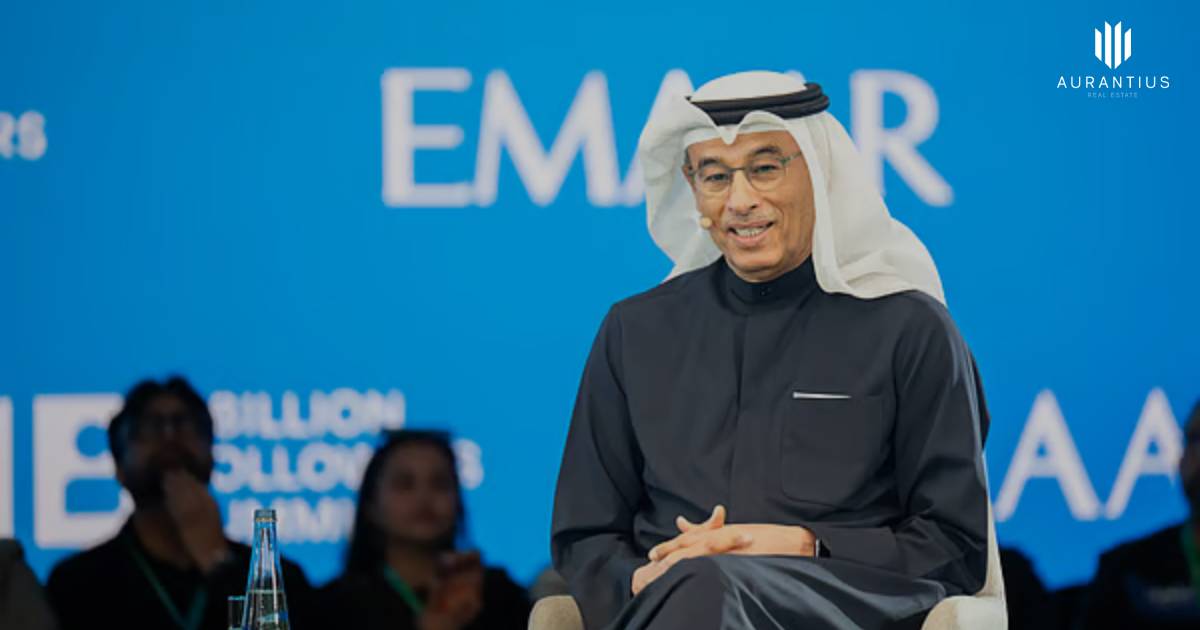

Mohamed Alabbar on Dubai Real Estate in March 2026: Why He Sees Limited Downside Risk Despite Regional Conflict and Incoming Supply
Dubai’s property market entered March 2026 facing two pressures that typically raise investor caution: heightened regional geopolitical tensions and a scheduled wave of new supply expected in 2026 and 2027. In this context, Mohamed Alabbar, founder and chief executive of Emaar Properties, has argued that Dubai real estate has “nothing to fear” because the market is structured for long-duration development rather than short-term speculation. His position frames supply increases as a normal feature of a city planning in decades, not a trigger for systemic weakness.
Alabbar’s core message is rooted in time horizon. He emphasized that Dubai’s development model is not designed for short-run cycles. It is designed for sustained economic growth, long-range planning, and continuous reinvestment into urban infrastructure. For investors, that argument matters because it defines how to interpret 2026–2027 delivery volumes. If supply arrives into a market supported by population growth, diversified demand, and functional transaction systems, the impact is more likely to be segment-specific moderation than a broad market reset.
In his assessment, a cooling period is possible. The important distinction he made is between a temporary dip in sentiment and a deeper structural disruption. Temporary dips tend to appear as slower closings, more cautious negotiations, and delayed decision-making by international buyers. Structural disruption tends to require a breakdown in financing conditions, forced selling, or a sharp deterioration in end-user demand, none of which he described as present in the underlying market architecture.
On-the-Ground Pricing Behavior: Discount Resistance as a Sentiment Indicator
Alabbar illustrated his confidence through a practical observation from his own search for a seafront apartment. He described spending two days looking and finding that sellers were unwilling to offer discounts. He framed this as a quiet signal that sentiment remains firm at the pricing level in certain segments. In investment analysis, discount resistance is not proof of future price growth. It can indicate that sellers are not under pressure to exit quickly, which reduces the probability of rapid repricing through forced discounting.
Discount resistance tends to be more visible in supply-constrained zones, assets with strong lifestyle utility, and locations where buyer demand is supported by cash purchasers and high-net-worth households. These segments can maintain stronger negotiating positions even when the broader market experiences timing-related pauses. Investors still need to segment the market because discount behavior varies by building quality, unit type, and micro-location.
Credit Structure: Why a Restricted Lending Model Can Reduce Collapse Risk
A key structural point in Alabbar’s view is the financing profile of Dubai real estate. He argued that the market is not built on expansive bank borrowing and that lending to buyers is tightly restricted. The relevance to investors is that credit-driven collapses in global markets often occur when high leverage meets rising rates, refinancing stress, or sudden liquidity withdrawal. A market where leverage is controlled tends to be less vulnerable to forced selling cascades driven by debt service failures.
Restricted lending does not remove market risk. It changes its shape. When credit is controlled, corrections can still occur through slower absorption, price moderation in oversupplied corridors, and shifts in buyer preference toward quality assets. The difference is that the probability of a system-wide liquidation cycle is lower when the market is not dependent on aggressive leverage expansion to sustain pricing.
Alabbar also framed confidence as recoverable even when sentiment dips. He suggested that policy consistency and operational continuity can restore confidence quickly after shocks. For investors, the practical implication is that shorter-term volatility may be concentrated in transaction velocity rather than in immediate price breakdowns, especially if cash-driven participation remains high.
Policy Trajectory and Safe-Haven Logic: The Signals Long-Term Capital Tracks
On the wider question of Dubai as a destination for global wealth during uncertainty, Alabbar emphasized policy trajectory. He argued that investors assessing the UAE over years and decades see consistent leadership, stable governance, and a track record of delivering security and continuity. Safe-haven positioning is not a marketing theme for institutional capital. It is a jurisdiction selection decision based on the reliability of rules, enforcement, and operational continuity in daily life and commerce.
His framing also aligns with a broader narrative that serious capital reallocates into markets where stability is durable and predictable. In this view, external uncertainty can increase the relative attractiveness of a stable jurisdiction, especially for investors who focus on capital preservation, residency planning, and long-horizon asset holding. The implication is that geopolitical tension can create a sentiment pause for some cohorts while simultaneously reinforcing safe-haven allocation for others.
Alabbar’s comments were also made alongside industry observations that large-ticket residential transactions continue to occur in Dubai during the same period. For investors, continued activity at the very top of the market is often interpreted as an indicator that confidence remains present among buyers with the highest sensitivity to jurisdictional risk.
Supply in 2026–2027: The Investor Angle on Absorption and Segmented Outcomes
The incoming supply wave remains a relevant risk variable. A high delivery pipeline can lead to moderate corrections in corridors where inventory is concentrated and where tenant demand is more price-sensitive. Investors typically manage this by underwriting absorption capacity at the community level, focusing on assets with durable leasing demand, proven building performance, and stronger resale liquidity. Mature locations with established amenity ecosystems, strong access, and diversified tenant pools tend to handle supply additions more effectively than fringe or speculative corridors.
In practical underwriting terms, supply risk is reduced when population growth, job creation, and residency inflows remain strong. It is increased when delivery volumes cluster in a narrow segment without matching demand depth. Investors can treat Alabbar’s view as a directional confidence signal, then validate it by monitoring transaction volumes, rental absorption, vacancy trends, and the pace of developer launch discipline across 2026.
Conclusion
Mohamed Alabbar’s March 2026 position on Dubai real estate is grounded in market structure: long-term planning, controlled leverage, and policy continuity. He acknowledges the possibility of a short cooling-off phase, yet he argues that systemic risk remains limited because the market is not built on aggressive bank borrowing and because sentiment on the ground continues to show discount resistance in certain segments. With new supply expected in 2026 and 2027, outcomes are likely to be segmented by location and product quality, with the strongest resilience concentrated where demand depth and liquidity remain highest.
For investor-focused Dubai market context, community-level analysis, and structured coverage designed to support decisions based on fundamentals, follow Aurantius Real Estate for ongoing research and market summaries.