
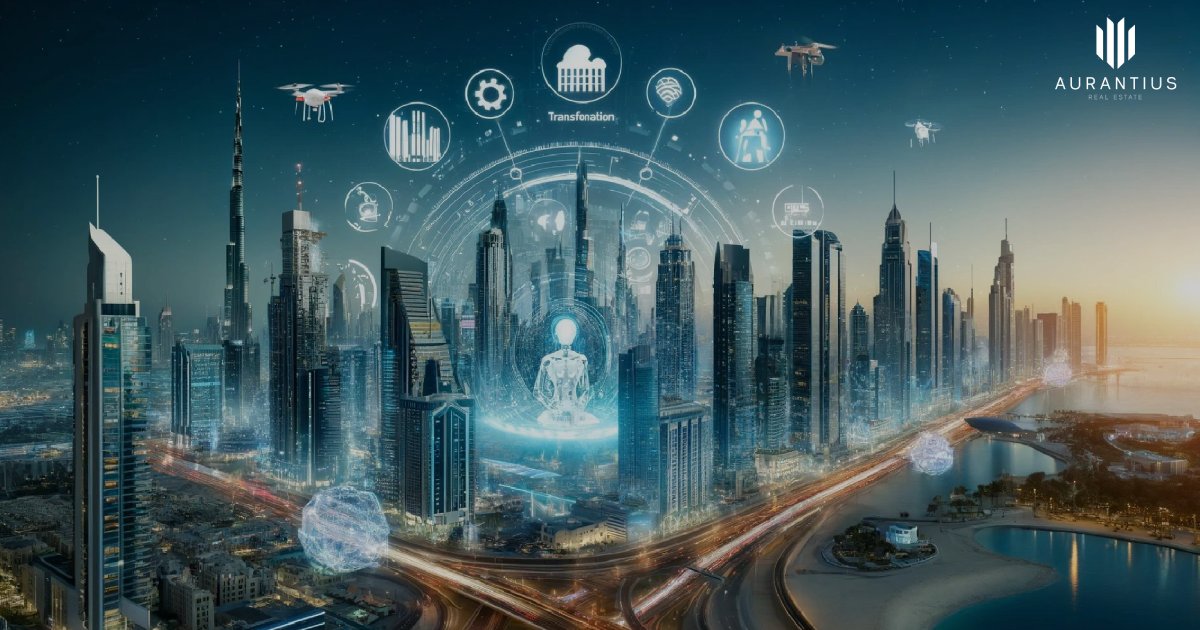

AI Set to Transform Dubai Real Estate with Smarter Valuations, Predictive Analytics and Faster Decision-Making
The global artificial intelligence (AI) in real estate market is accelerating at record speed, reaching $222.65 billion in 2024 and projected to surge to $975.24 billion by 2029, according to The Business Research Company’s AI in Real Estate Global Market Report 2025. Dubai sits at the epicentre of this transformation. As developers, investors and brokerages integrate AI into valuations, forecasting tools, customer interactions and portfolio optimisation, the emirate is moving toward a highly efficient, insight-driven property ecosystem that reflects its ambitions as a global smart city.
Dubai’s real estate market thrives on speed, scale and precision. AI amplifies all three. From predictive analytics that anticipate price movements to systems that identify demand hotspots before they emerge, the technology is reshaping how the industry evaluates opportunity and risk. Rather than replacing human expertise, AI strengthens decision-making by converting massive datasets into real-time insights that once required years of pattern tracking.
Predictive Power Meets Dubai’s Local Data Advantage
AI’s greatest impact lies in its ability to analyse mobility patterns, infrastructure spending, tourism cycles, demographic changes and upcoming supply pipelines. By combining these datasets into a unified analytical engine, AI generates forecasts that are significantly more accurate than traditional models.
“AI is becoming one of the most dependable strategic tools in Dubai’s real estate landscape,” said Blagoje Antic, Chairman and CEO of DHG. “When AI is paired with the data we already track, such as infrastructure investment, mobility patterns, tourism behaviour, demographic shifts and upcoming supply, we start to see market signals that previously took years to surface.”
This early insight enables developers to identify rising communities, avoid over-supplied segments, spot design gaps and make informed capital deployment decisions. Investors, meanwhile, gain visibility on expected yields, pricing pressure points, long-term rental trajectories and exit timelines.
AI Is Redefining Dubai’s Brokerage Model
The days when brokers simply listed properties are fading. Today, AI powers chatbots, customer scoring systems, lead qualification, virtual tours and behavioural analytics. This automation frees agents to focus on advisory roles rather than administrative follow-up.
“The future of brokerage is not about processing transactions; it is about offering advisory strength,” Antic emphasised. “AI can analyse data at a scale no human team can match, but it still needs a professional who can interpret the output, decide what truly matters and translate it into clear guidance for clients.”
The new brokerage model in Dubai will be built on interpretation, personalisation and trust. Agents will leverage AI-generated insights—from price forecasts to community comparisons—to advise clients on optimal timing, risk exposure, rental yields and long-term growth potential.
A Unified, AI-Driven Real Estate Ecosystem Is Emerging
The next wave of AI evolution in Dubai real estate will be a connected ecosystem that links developers, investors, agencies and regulators through real-time data transparency.
According to Sukesh Govindan, CEO of TENX Properties LLC: “AI will create a 360-degree collaborative ecosystem connecting developers, agencies and investors through one transparent, data-driven platform. It will pull real-time ROI data to identify top-performing projects, locations and developers based on delivery history and investment returns.”
For developers adopting fully integrated AI systems—from expression of interest to title deed—the impact could be substantial: automated compliance, reduced manual processing by up to 60%, improved trust and accelerated handovers.
Safeguards and Regulatory Evolution Will Strengthen Market Confidence
With AI now influencing valuations, listings, due diligence and transactions, industry leaders increasingly call for strong governance around data privacy, bias prevention and model transparency. Dubai already leads the region in smart city regulation, but the rapid pace of AI integration requires continuous enhancement.
Antic noted: “Investors will expect clarity on the data being used, the logic behind valuations and the safeguards protecting personal and financial information. Strengthening the governance around AI will reinforce the transparency and security that support long-term confidence.”
Developers such as Rui Liu of LEOS Developments agree that ethical management is essential. Real-time valuations, predictive models and automated recommendations must remain transparent and accountable to avoid bias and protect market stability.
A New Era of Real Estate Intelligence for Dubai
AI is not fundamentally redefining real estate—it is refining how decisions are made. It gives developers a more accurate view of the future, empowers brokers to operate as strategic advisors and gives investors confidence in a fast-changing environment where clarity is often the strongest competitive advantage.
As AI adoption grows from $301.58 billion in 2025 toward nearly $1 trillion by the end of the decade, Dubai’s forward-thinking ecosystem positions the city to lead global real estate innovation. AI will enhance efficiency, personalise customer experiences, optimise portfolios and, ultimately, strengthen investor returns in one of the world’s most dynamic property markets.
For data-driven insights, curated opportunities and expert advisory support across Dubai’s evolving real estate landscape, visit Aurantius Real Estate.