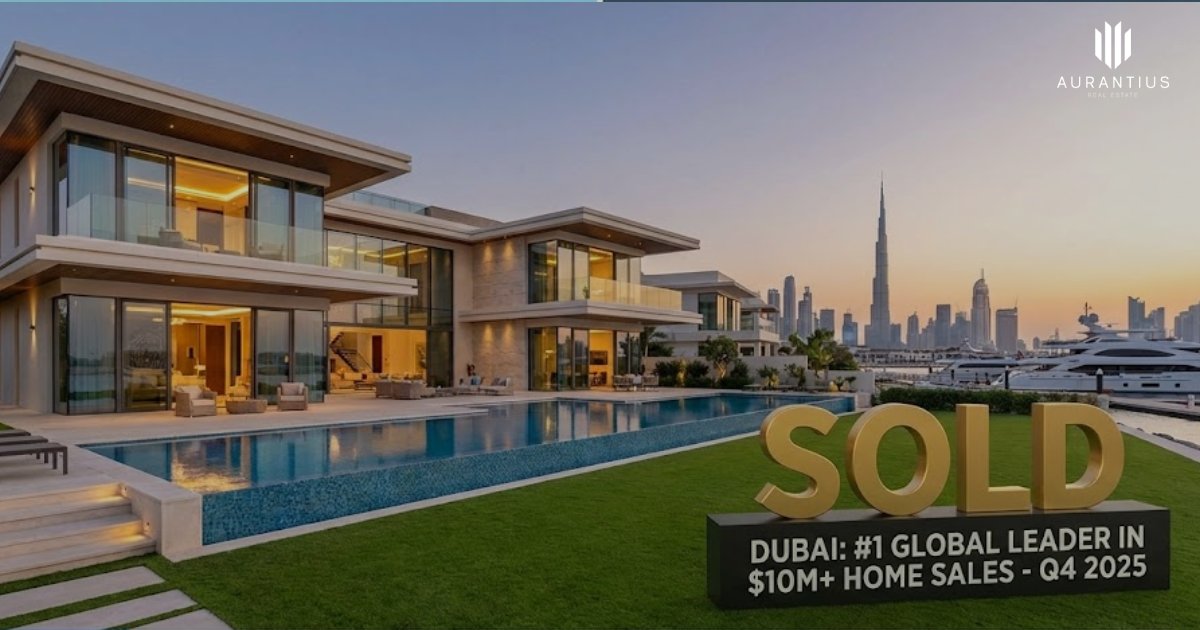

Dubai Sold More $10 Million-Plus Homes Than Any Other City Last Quarter
Dubai has once again reinforced its position as the global capital of ultra-luxury real estate. New data from Knight Frank shows that the emirate led the world in $10 million-plus home sales during the fourth quarter of 2025, outperforming every other major city tracked in the brokerage’s global super-prime index.
The figures highlight a market that is not only resilient but accelerating at the very top end, even as parts of the global housing market cool. For high-net-worth and ultra-high-net-worth individuals, Dubai continues to combine lifestyle appeal, tax efficiency, and long-term capital preservation in a way few global cities can currently match.
Record-Breaking Global Super-Prime Sales
Across 12 major international markets monitored by Knight Frank, a total of 555 homes sold for at least $10 million in Q4 2025. This represented a 17 percent increase compared to the previous quarter, with total transaction value reaching approximately $10.3 billion.
The average price per super-prime transaction rose to $18.6 million, up from $18.1 million in Q3. The increase signals not just higher deal volume, but also rising price tolerance among buyers competing for scarce trophy assets.
Despite global economic uncertainty, the ultra-luxury segment has proven far more insulated than the wider residential market. Wealth concentration, limited supply, and the strategic movement of capital continue to support demand at the very top.
Dubai Leads the World by a Wide Margin
Dubai accounted for the largest share of super-prime activity globally. The city recorded 143 transactions above $10 million in the final quarter of 2025, with a combined value of approximately $2.5 billion.
Quarter-on-quarter, this represented a 39 percent increase in deal count and a 27 percent rise in transaction value. Over the full 12-month period ending Q4 2025, Dubai recorded around 500 ultra-luxury home sales—more than three times the volume achieved in London over the same timeframe.
This performance capped what Knight Frank described as a record-setting year, reflecting a sustained multi-year influx of global wealth and a growing pipeline of high-quality, super-prime new-build inventory.
Why Global Wealth Is Flowing to Dubai
According to market analysts, Dubai’s dominance in the ultra-luxury segment is driven by a convergence of structural advantages. These include a low-tax environment, political stability, strong currency positioning, and a lifestyle offering that rivals or exceeds traditional wealth hubs.
In contrast, markets such as London have seen super-prime activity weaken following tax reforms and regulatory tightening. In Q4 2025, London fell to seventh place globally, underlining how policy shifts can quickly impact elite buyer behaviour.
Dubai, by comparison, continues to attract international buyers seeking long-term residency, wealth preservation, and global mobility. High-quality infrastructure, world-class healthcare, and expanding private banking and family office ecosystems further reinforce its appeal.
How Other Global Cities Compared
While Dubai led decisively, several other cities also posted notable performances. Hong Kong ranked second with 81 super-prime deals totaling $1.57 billion, extending a rebound that began earlier in 2025.
In the United States, New York City and Los Angeles recorded 57 and 63 transactions respectively. Both markets experienced a modest slowdown toward year-end, largely due to seasonal factors and limited availability of top-tier inventory.
Sydney delivered one of the strongest quarterly recoveries, with transaction volumes rising 58 percent to 52 sales. Miami also rebounded sharply, logging 40 deals—an 82 percent increase quarter-on-quarter.
These figures point to a global reallocation of capital rather than a contraction, with buyers selectively targeting markets that offer both lifestyle value and policy certainty.
The Bigger Picture: A Multi-Year Super-Prime Cycle
Looking beyond the quarter, Knight Frank tracked 2,164 super-prime transactions globally over the 12 months ending Q4 2025, with a combined value of $40.5 billion. This marked the second-strongest rolling annual performance since 2021.
Dubai’s growing share of that activity suggests the city is not merely participating in the global luxury cycle, but reshaping it. The depth of demand, combined with a steady pipeline of genuinely scarce waterfront and branded residences, continues to widen the gap between Dubai and legacy wealth capitals.
What This Means for Investors in 2026
As the broader housing market normalises in many regions, ultra-luxury real estate is increasingly behaving as a distinct asset class. In Dubai, limited supply in established prime locations, rising millionaire migration, and continued infrastructure investment are expected to support prices through 2026.
Rather than a short-term spike, Dubai’s performance points to a structural repositioning as a long-term global wealth hub. For investors focused on capital preservation, trophy assets, and lifestyle-driven value, the emirate remains one of the most compelling super-prime markets worldwide.
Conclusion
Dubai’s leadership in $10 million-plus home sales is not a statistical anomaly—it is the result of deliberate policy, sustained demand, and global capital migration. As other cities grapple with tax pressure and regulatory change, Dubai continues to attract the world’s wealthiest buyers at scale.
With momentum carrying into 2026, the city is no longer just competing with traditional luxury markets. It is setting the benchmark for what the future of ultra-prime real estate looks like.