

Investing in Dubai: Multi-Unit Portfolio vs. Single Luxury Asset
For global investors holding a 4,000,000 AED cash position, Dubai’s ready-to-move-in apartment market offers a serious income opportunity — if the capital is deployed with discipline. Unlike long-dated off-plan projects, ready apartments allow investors to inspect the actual unit, compare real rental data, avoid construction delays, and start leasing after transfer.
But the main decision is not simply where to buy. The real decision is how to structure the capital. Should you split AED 4 million across two or three income-producing units in high-yield communities such as JVC, Arjan, Al Furjan, Dubai Sports City or Dubai Silicon Oasis? Or should you place the full budget into one premium asset in Dubai Marina, Downtown Dubai, Business Bay or Palm Jumeirah?
Both strategies can work. The multi-unit route usually produces stronger rental diversification and higher gross income. The single luxury-asset route usually offers stronger prestige, easier oversight, better lifestyle resale value and potential capital preservation in blue-chip locations.
The correct answer depends on your investor profile. If your goal is maximum annual cash flow, a multi-unit portfolio is usually more efficient. If your goal is long-term capital preservation, liquidity, and a lower-management single asset, a premium ready apartment can make more sense.
For wider market context before allocating capital, read Dubai Real Estate Market Trends.
Why Ready-to-Move Apartments Are Attractive in 2026
Ready-to-move apartments are attractive because they reduce uncertainty. An investor can physically inspect the property, check the building condition, review the title, verify service charges, assess rentability, and compare recent transactions before buying.
This is different from off-plan investing, where the buyer depends on future delivery, developer execution, handover timing and market conditions several years later. Off-plan can still work, but it is a growth strategy, not an immediate income strategy.
A ready property allows quicker income generation, especially if the unit is vacant on transfer or already rented at a strong market rent. This is valuable for investors who want buy-to-let income rather than waiting years for completion.
In Dubai’s 2026 stabilising market, ready properties also give buyers negotiation leverage. Sellers are more realistic than they were during the peak bidding years, and serious cash buyers can move faster than mortgage buyers or hesitant investors.
The AED 4M Investor Advantage
A 4M AED budget gives you flexibility that smaller investors do not have. You can either buy one premium apartment in a prime district or diversify into multiple income-producing units across mid-market communities.
This matters because Dubai’s best rental returns are not always found in the most expensive districts. Premium communities such as Downtown Dubai, Dubai Marina and Palm Jumeirah may offer strong liquidity and prestige, but their gross yields are often lower because purchase prices are high.
Mid-market communities such as JVC, Arjan, Dubai Sports City, Dubai Silicon Oasis and Al Furjan may offer stronger gross rental yields because entry prices are lower and tenant demand is broad.
The AED 4M investor can choose between income efficiency and prestige liquidity. That is the strategic power of this budget.
Strategy 1: Multi-Unit Portfolio for Maximum Cash Flow
The multi-unit portfolio strategy means splitting AED 4M across two or three apartments instead of buying one luxury property. This is usually the stronger route for investors who want higher annual rental income and lower tenant-concentration risk.
For example, an investor may buy three modern one-bedroom apartments in JVC, Arjan or Dubai Sports City, or two larger one- to two-bedroom units in Al Furjan, Business Bay outskirts or Dubai Silicon Oasis. The exact mix depends on availability, service charges and building quality.
The advantage is diversification. If one unit becomes vacant, the other units can continue generating rent. If one building has maintenance issues, the whole portfolio is not exposed to the same risk.
The trade-off is management. Multiple units mean multiple tenants, multiple renewals, multiple maintenance requests, multiple Ejari contracts and more operational work. For overseas investors, a strong property manager becomes essential.
Why JVC Often Leads the Multi-Unit Strategy
Jumeirah Village Circle remains one of Dubai’s most practical buy-to-let markets because it combines affordability, tenant demand, central road access and high transaction activity. It attracts young professionals, couples, small families and budget-conscious tenants who want to remain connected to Dubai Marina, Business Bay, Dubai Hills and major highways.
For an AED 4M investor, JVC allows portfolio design. Instead of buying one high-end property, an investor can buy multiple units in better buildings, then rent them to different tenant profiles.
The key is building selection. JVC has a wide range of quality. Some buildings perform well, while others suffer from maintenance issues, weak facilities, poor finishing or high future supply nearby.
Investors should target buildings with clean title history, good facilities, reasonable service charges, strong occupancy, practical layouts, parking, and active rental demand.
For a wider ROI area comparison, read Top 10 Areas to Invest in Dubai Real Estate for Higher ROI.
Other Multi-Unit Communities to Consider
Arjan: Arjan is popular with investors because it offers newer buildings, mid-market pricing and access to growing communities around Dubailand, Motor City and Al Barsha South. It can work well for one-bedroom and compact two-bedroom rental assets.
Dubai Sports City: Sports City can offer strong rental yields because entry prices are lower than prime locations. It suits investors seeking income, but building selection and tenant demand must be checked carefully.
Dubai Silicon Oasis: DSO attracts technology professionals, students, small families and budget-conscious tenants. It is practical for investors who want steady demand and manageable entry prices.
Al Furjan: Al Furjan offers metro connectivity, family demand and practical access to Jebel Ali, Dubai Marina, Expo City and Sheikh Zayed Road. It may offer lower headline yields than cheaper areas, but stronger connectivity can support occupancy.
Discovery Gardens: Discovery Gardens can be attractive for yield-focused investors because of lower entry pricing and metro access. The trade-off is older stock and more careful maintenance review.
Strategy 2: Single Luxury Asset for Capital Preservation
The single luxury asset strategy means deploying most or all of the AED 4M budget into one premium apartment in an established, high-liquidity district such as Dubai Marina, Downtown Dubai, Business Bay or Palm Jumeirah.
This route usually produces lower gross rental yield than a multi-unit mid-market portfolio. However, it can offer stronger lifestyle appeal, prestige, easier management, better short-term rental potential and stronger long-term capital preservation if the unit is well selected.
A single premium unit is also simpler to operate. There is one tenant, one tenancy contract, one service-charge account, one maintenance cycle and one resale story.
The risk is concentration. If the unit becomes vacant, 100% of your rental income stops. If the building has service-charge increases or maintenance issues, the whole investment is affected.
Dubai Marina: Prime Liquidity and Waterfront Rental Demand
Dubai Marina is one of the strongest single-asset options for AED 4M investors because it combines waterfront lifestyle, international recognition, rental liquidity, tourism demand and ready infrastructure.
With AED 4M, buyers may be able to target a spacious two-bedroom or selected three-bedroom apartment depending on building age, view, size and tower quality. Marina-facing or sea-view units usually command stronger appeal.
The long-term tenancy market is strong because Dubai Marina attracts professionals, executives, couples and small families. Short-term rental potential may also be strong in the right building, especially near the Marina Walk, tram, metro, beach and tourist hotspots.
The main risks are service charges, building age, parking, congestion and competition from many similar units. Investors should avoid towers with poor maintenance history or weak common areas.
Downtown Dubai: Trophy Value, Lower Yield, Strong Recognition
Downtown Dubai is a trophy market. It is globally recognised because of Burj Khalifa, Dubai Mall, the Dubai Fountain, premium hotels and high tourist visibility.
With AED 4M, an investor may target a premium two-bedroom apartment, depending on tower, view, age and furnishing. Burj Khalifa or fountain views can materially change pricing and resale demand.
Downtown is usually not the highest gross-yield area because purchase prices are high. Its strength is liquidity, prestige, global buyer recognition and short-term rental appeal in the right building.
The risk is overpaying for the address. Investors must check service charges, view quality, tower condition, actual rent and short-term rental regulations before assuming strong returns.
Business Bay: Corporate Tenant Demand and Canal Lifestyle
Business Bay sits between corporate demand, lifestyle rental demand and Downtown spillover. It attracts professionals working near Downtown, DIFC, Sheikh Zayed Road and the wider business district.
AED 4M can target a premium two-bedroom, larger apartment or selected branded residence depending on tower and view. Canal-facing units and buildings with strong amenities usually perform better.
Business Bay can work for both long-term and short-term rental strategies, but building selection is critical. There is a major difference between a well-managed branded tower and a weaker building with poor access or high service charges.
The investor should compare actual rent, service charges, parking, building management, furnishing standards and tenant profile before buying.
Palm Jumeirah: Lifestyle Premium and Scarcity
Palm Jumeirah offers global prestige, beachfront lifestyle and scarcity. For AED 4M, buyers may target selected one-bedroom luxury units, two-bedroom apartments in older shoreline-style buildings, or units where view and building condition vary significantly.
The Palm can be strong for capital preservation and luxury tenant appeal. It can also work for short-term rentals in the right building and under the correct holiday-home framework.
However, investors must be realistic. Palm Jumeirah purchase prices are high, which compresses yield. Service charges and maintenance can also be substantial. The property must have a strong view, good access and a clear tenant or resale story.
Palm Jumeirah is not usually a pure yield play. It is a scarcity and lifestyle asset.
Multi-Unit vs Single Asset: Cash Flow Comparison
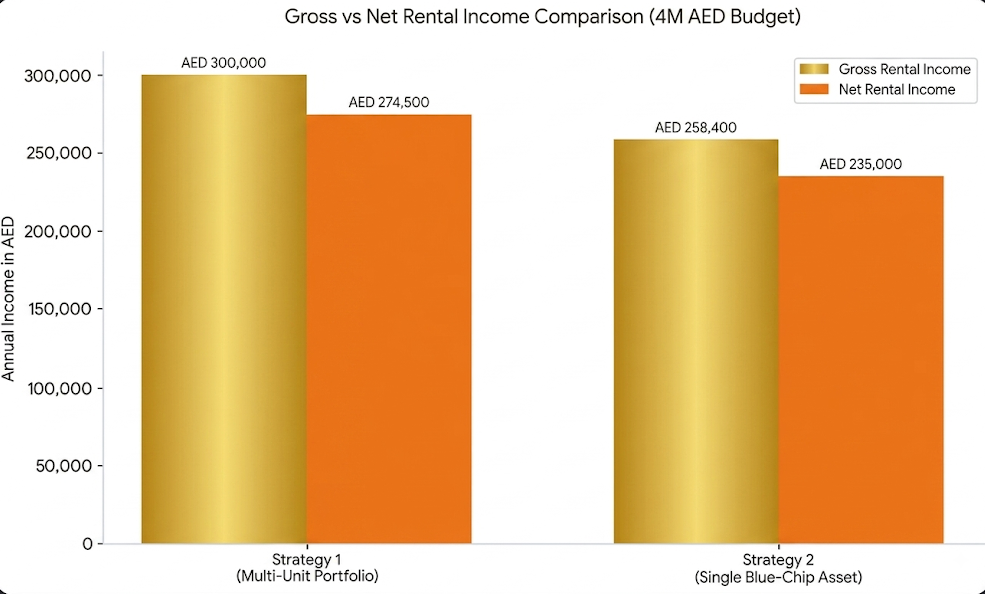
The multi-unit strategy usually wins on cash flow. If AED 4M is split into three properties averaging a 7.5% gross yield, the portfolio could produce approximately AED 300,000 in gross annual rent before costs.
After service charges, maintenance, vacancy and management fees, the net income may be significantly lower, but the diversified structure can still produce a stronger income profile than one premium unit.
A single luxury property at AED 4M with a 5.8% to 6.5% gross yield may generate roughly AED 232,000 to AED 260,000 in gross annual rent before costs. Net income depends heavily on service charges, furnishing, management and vacancy.
The difference is not only financial. The multi-unit strategy requires more management but spreads risk. The single-asset strategy is cleaner but concentrates risk.
Sample AED 4M Multi-Unit Portfolio
Option: Three one-bedroom apartments across JVC, Arjan or Dubai Sports City.
Estimated acquisition: Around AED 1.2M to AED 1.35M per unit, depending on building, size, view and furnishing.
Gross yield target: Around 7% to 8% where the building and entry price support it.
Main advantage: Higher gross income and reduced vacancy concentration.
Main risk: More active management, more maintenance events and more tenant turnover.
This strategy suits investors whose primary objective is income. It is especially relevant for overseas investors who appoint a property manager and want multiple rental streams instead of relying on one tenant.
Sample AED 4M Single Luxury Asset
Option: One premium two-bedroom apartment in Dubai Marina, Downtown Dubai, Business Bay or Palm Jumeirah.
Estimated acquisition: Around AED 3.2M to AED 4M, depending on view, tower, floor, size and furnishing.
Gross yield target: Often around 5.5% to 6.8%, depending on location and rental strategy.
Main advantage: Prestige, liquidity, simpler management and stronger lifestyle resale appeal.
Main risk: Lower yield, higher service charges and full income loss during vacancy.
This strategy suits investors who prioritise brand value, easier oversight, future resale appeal and prime-location exposure over maximum annual cash flow.
Long-Term Rental or Short-Term Holiday Home?
A ready apartment can be leased through a long-term annual tenancy or operated as a short-term holiday home, where permitted. The best choice depends on location, building rules, furnishing, management costs and owner risk tolerance.
Long-term rentals are usually simpler. They provide stable income, lower management intensity and fewer daily operational issues. This route works well in JVC, Arjan, Al Furjan, Dubai Silicon Oasis, Dubai Sports City and family-oriented apartment communities.
Short-term rentals may produce higher gross revenue in tourist and business districts such as Downtown Dubai, Dubai Marina, JBR, Business Bay and Palm Jumeirah. However, they require holiday-home licensing, professional management, furnishing, cleaning, guest communication, seasonal pricing and platform fees.
The short-term route should be judged on net income, not headline nightly rate. A high-revenue holiday home can still underperform if occupancy, fees and operating costs are poorly managed.
Dubai DLD Fees for Ready Property Purchase
Investors should not deploy the full AED 4M only into the purchase price. Ready-property acquisition in Dubai comes with upfront costs that must be budgeted separately.
The main cost is the Dubai Land Department transfer fee, commonly calculated at 4% of the property value. Buyers should also budget for agency commission, trustee fees, conveyancing if used, mortgage registration if financed, valuation fees if applicable, and NOC-related costs.
For a 4M AED ready property, a buyer may need roughly AED 240,000 to AED 280,000 or more in transaction-related cash costs, depending on the exact structure and financing.
This cost affects ROI. If your acquisition cost is AED 4.25M after fees, your yield should be calculated against the full capital deployed, not only the advertised purchase price.
Golden Visa Advantage for AED 4M Investors
An AED 4M real estate investment can also support Golden Visa planning, provided the property ownership structure and eligibility requirements are met. Dubai Land Department’s investor service uses AED 2M property value as a key threshold for real estate investor Golden Visa applications.
This is one reason Dubai remains attractive to international investors. A ready apartment portfolio can provide rental income while also supporting long-term residency planning.
However, investors should not buy property only for visa eligibility. The property must still make sense as an asset. Price, yield, service charges, location, title status and resale liquidity remain essential.
For full Golden Visa property guidance, read Dubai Golden Visa Through Real Estate: Ready vs Off-Plan Property Guide.
Net Rental Income After Service Charges
Service charges can decide whether a Dubai investment performs well or disappoints. Premium buildings with large pools, gyms, concierge services and hotel-style amenities may carry higher service charges. Budget buildings may have lower charges but higher maintenance or quality risks.
A simple ROI calculation should include gross rent, annual service charges, property management fees, expected maintenance, vacancy allowance, insurance and furnishing depreciation.
For example, a unit producing AED 250,000 in gross annual rent may look attractive. But after AED 35,000 in service charges, AED 12,500 in management fees, AED 8,000 in maintenance and one vacancy period, the net return can fall materially.
This is why net yield matters more than broker-advertised gross yield. Investors should request the service-charge statement before making an offer.
For a deeper ROI framework, read Dubai Real Estate ROI: How to Target 8% to 15% Returns.
Fast Resale and High Liquidity: Why It Matters
Liquidity is one of the most important parts of Dubai real estate investing. A property can show attractive rent on paper, but if it is hard to sell later, the investor’s capital becomes trapped.
High-liquidity areas usually have broad buyer demand, active rental markets, good infrastructure, strong transaction volume and recognised community identity. JVC is liquid because of affordability and volume. Dubai Marina is liquid because of global recognition and lifestyle demand. Downtown is liquid because of prestige and tourism value.
Low-liquidity properties often share the same problems: weak building reputation, high service charges, poor layout, limited access, unclear title issues, or too many identical competing units.
Before buying, investors should ask one question: if I need to sell in 24 months, who will buy this property and why?
For more on liquidity-focused communities, read Best Dubai Communities for Fast Resale and High Liquidity.
Execution Checklist for International Landlords
Open the right banking setup: Non-resident investors should prepare a UAE banking route for rental collection, service-charge payments and property expenses.
Appoint a property manager: Overseas owners should usually appoint a manager to handle tenant communication, inspections, maintenance and renewal notices.
Check service charges: Request the latest service-charge statement before buying.
Verify title and NOC process: Make sure the seller can obtain NOC and transfer the property cleanly.
Inspect before transfer: Ready property should still be inspected for AC, leaks, appliances, windows, bathrooms and electrical systems.
Understand the 90-day rule: Rental-price or tenancy-term amendments usually require notice before renewal, unless otherwise agreed under the tenancy framework.
Decide long-term or short-term early: Furnishing, licensing and management setup differ depending on the rental model.
What to Avoid With a 4M AED Budget
Do not buy a luxury apartment only because the address sounds prestigious. If the unit has a poor view, weak layout, high service charges or limited rentability, the name alone will not protect returns.
Do not split capital into multiple weak units just to chase high yield. Three poor units can create more problems than one strong asset.
Do not ignore vacancy risk. A high gross yield assumes continuous occupancy. Real net yield must include vacancy allowance.
Do not rely only on short-term rental projections. Holiday-home revenue can change with seasonality, competition, regulations, reviews and management quality.
Do not calculate ROI only on the purchase price. Include DLD fees, agency commission, furnishing, maintenance, service charges and property management.
Best 4M AED Strategy by Investor Type
Pure income investor: Split into two or three ready apartments in JVC, Arjan, Dubai Sports City, Dubai Silicon Oasis or Al Furjan, depending on the exact building and service charges.
Balanced investor: Buy one strong two-bedroom in Dubai Marina, Business Bay or Dubai Hills Estate, or split between one premium unit and one higher-yield mid-market unit.
Capital preservation investor: Focus on a single premium property in Dubai Marina, Downtown Dubai, Palm Jumeirah or a top Emaar master community.
Golden Visa investor: Ensure total eligible property value and ownership documentation support the required threshold while still choosing a property with strong investment fundamentals.
Hands-off overseas investor: Prefer one or two easier-to-manage assets in liquid communities and appoint a professional property manager.
The Final Decision: Portfolio or Trophy Asset?
If the goal is maximum net cash flow, the multi-unit portfolio is usually the stronger route. It spreads vacancy risk, increases rental streams and can achieve higher gross yields in the right mid-market buildings.
If the goal is prestige, simplicity and long-term capital preservation, the single luxury asset is usually stronger. It may produce lower annual income, but it can offer better lifestyle appeal, easier resale and stronger international recognition.
A hybrid strategy may be the most balanced: buy one premium ready apartment for capital preservation and one higher-yield smaller unit for income. This gives the investor exposure to both stability and cash flow.
The right answer depends on whether you want income first, capital preservation first, or operational simplicity first.
FAQ: Investing 4 Million AED in Dubai Real Estate
Question: What is the best way to invest 4 million AED in Dubai real estate?
Answer: If the goal is maximum rental income, consider splitting the budget across multiple ready apartments in high-yield communities. If the goal is capital preservation and simplicity, consider one premium ready apartment in a prime location.
Question: Is a multi-unit portfolio better than one luxury property?
Answer: A multi-unit portfolio usually offers stronger income diversification and higher gross yield. One luxury property usually offers simpler management, stronger prestige and better capital-preservation potential.
Question: Which Dubai communities are best for rental yield?
Answer: JVC, Arjan, Dubai Sports City, Dubai Silicon Oasis, Discovery Gardens, International City and DIP are commonly studied for higher gross yields. Investors must still check service charges, building quality and vacancy risk.
Question: Which Dubai communities are best for a single premium asset?
Answer: Dubai Marina, Downtown Dubai, Business Bay, Palm Jumeirah and selected Emaar master communities are strong options for investors seeking liquidity, prestige and long-term capital preservation.
Question: Should I buy ready property or off-plan with 4M AED?
Answer: Ready property is better for immediate rental income and inspection certainty. Off-plan can work for capital growth and payment flexibility, but it carries delivery and timing risk.
Question: What costs should I budget when buying a ready property in Dubai?
Answer: Budget for DLD transfer fee, agency commission, trustee fees, NOC costs, conveyancing where used, mortgage registration if financed, valuation fees, furnishing, maintenance and service charges.
Question: Can a 4M AED property qualify for the Dubai Golden Visa?
Answer: A 4M AED property can support Golden Visa planning if the ownership and eligibility requirements are met. The key investor threshold is generally AED 2M in qualifying property value.
Question: Is short-term rental better than long-term rental in Dubai?
Answer: Short-term rental can produce higher gross revenue in tourist and business districts, but it has higher operating costs, licensing needs and seasonality. Long-term rental is simpler and more stable.
Conclusion: Deploy 4M AED Based on Strategy, Not Ego
A 4M AED budget gives Dubai real estate investors strong optionality. You can chase higher cash flow through a multi-unit mid-market portfolio, or you can preserve capital in one premium ready apartment in a blue-chip district.
The multi-unit strategy is usually better for yield-driven investors. It creates multiple income streams, spreads vacancy risk and can produce stronger gross rental returns if the buildings are selected carefully.
The single luxury-asset strategy is usually better for investors who want simplicity, lifestyle value, international recognition and stronger long-term resale appeal. It may deliver lower annual yield, but it can be easier to manage and more defensive if bought well.
The smartest approach is not choosing the most impressive address or the highest advertised yield. It is choosing the structure that matches your income target, management capacity, holding period and risk tolerance.
In Dubai’s 2026 market, ready-to-move apartments give investors an advantage because the asset is visible, usable and leasable now. But the numbers must be calculated properly: net yield after service charges, realistic vacancy, property management, acquisition costs and future resale liquidity.
Aurantius Real Estate helps investors compare ready-to-move apartments, multi-unit portfolios, Dubai Marina, Downtown Dubai, JVC, Business Bay, Golden Visa property options and net rental-income strategies across Dubai.
Deploy Your 4M AED With a Clear Rental Strategy: Speak with an Aurantius adviser to compare multi-unit portfolios, single luxury assets, ready apartments, net yields, DLD fees, Golden Visa eligibility and high-liquidity Dubai communities before you buy.
For more Dubai investment insights, visit Dubai Real Estate 2026.