
Milestone For Dubai’s Real Estate: Dh5 billion headquarters near Emirates Towers
Dubai Holding has awarded a AED5 billion construction contract to China State Construction Engineering Corporation Middle East for its new corporate headquarters and Jumeirah Residences Emirates Towers. Announced on 9 September 2026, Dubai Holding describes it as the largest building contract the group has awarded to date. The headquarters is scheduled to open in 2029, while handover of the 754 Jumeirah-branded residences is scheduled for 2030.
For property buyers, the significance is not simply that another luxury project has received a large construction budget. The more important development is that Jumeirah Residences Emirates Towers has moved beyond the launch and marketing stage into a major contracted delivery phase with a named main contractor, defined design teams and a published handover target. That can improve visibility around execution, but it does not eliminate off-plan risk or guarantee future resale performance, rental yields or capital appreciation.
The buyer takeaway: The AED5 billion contract is an important construction milestone and institutional commitment. It makes the project’s delivery story more tangible, but buyers should still assess the unit price, payment exposure, service costs, branded-residence premium, future competing supply and 2030 exit market before treating the contract award as an investment signal by itself.
What Exactly Does the AED5 Billion Contract Cover?
The construction award covers two major assets in the same location: Dubai Holding’s future headquarters and Jumeirah Residences Emirates Towers.
| Component | Confirmed Detail |
|---|---|
| Contract value | AED5 billion |
| Main contractor | China State Construction Engineering Corporation Middle East |
| Dubai Holding HQ designer | Skidmore, Owings & Merrill |
| HQ scheduled opening | 2029 |
| Residential developer | Meraas, part of Dubai Holding Real Estate |
| Residential architect | SCDA Architects |
| Residences | 754 units across two towers |
| Unit mix | One-to-four-bedroom residences |
| Residential handover | Scheduled for 2030 |
The contract therefore represents more than a headline expenditure figure. It formally connects a major international contractor with two significant assets that Dubai Holding plans to deliver in one of the city’s most established business districts.
Why the Main Contractor Matters to an Off-Plan Buyer
A construction contract does not guarantee completion on the exact published date, but the appointment of the main contractor is still an important step in the development cycle.
CSCEC ME has operated in the UAE since 2003. Dubai Holding says the contractor has delivered more than 110 large-scale projects across the Gulf covering residential, commercial, hospitality and infrastructure assets.
For a buyer, that matters because execution risk in a large two-tower branded project depends partly on the ability to coordinate structure, façade, building systems, specialist contractors, interiors, amenities and handover preparation over a multi-year programme.
The AED5 billion award therefore improves clarity around one question: who is responsible for delivering the physical development?
It does not answer every other investment question. Buyers should still verify Dubai Land Department registration, escrow arrangements, construction progress, SPA obligations and the consequences if the completion programme changes.
The Headquarters Is a Separate Asset, but It Strengthens the District Story
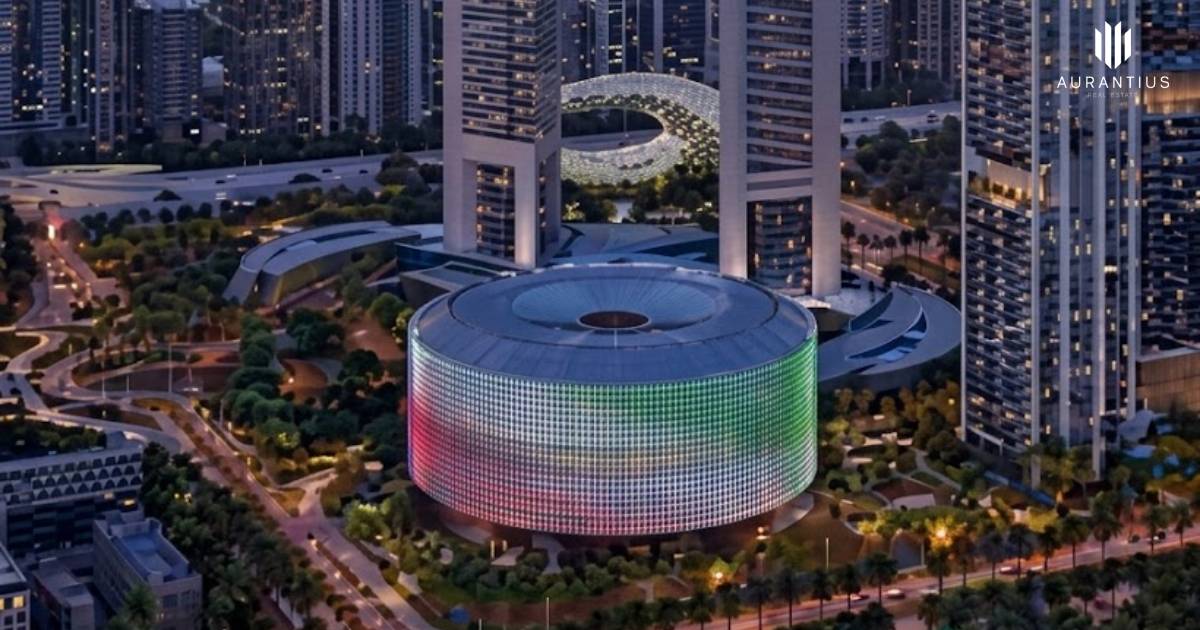
Dubai Holding’s future headquarters is designed by Skidmore, Owings & Merrill and is scheduled to open in 2029. According to Dubai Holding, the building will use a distinctive circular form organised around an open-air atrium and landscaped courtyard, with terraces intended to support collaboration and workplace interaction.
The official design brief places emphasis on employee wellbeing, resource efficiency, technology and sustainability, with an ambition to meet leading international sustainability and wellbeing standards.
That wording matters. It would be inaccurate to describe the headquarters as a confirmed “net-zero building” unless a specific certified net-zero target is officially announced. The current commitment is to resource efficiency, lower-carbon development and recognised sustainability standards.
For residential buyers, the headquarters is relevant because it reinforces the wider commercial importance of the location. But a corporate headquarters next door should not be translated directly into a guaranteed residential price uplift.
Aurantius has covered the wider growth of institutionally backed Dubai real estate in Dubai Real Estate: 5 Landmark Freehold Projects Powering a Major Development Boom.
What Jumeirah Residences Emirates Towers Actually Offers
Jumeirah Residences Emirates Towers was originally unveiled by Meraas in 2025. The project comprises 754 branded residences across two towers, with layouts ranging from one to four bedrooms.
SCDA Architects designed the residential development around a distinctive cantilevered form. Meraas has announced three sky terraces with infinity-edge pools, landscaped lounges and outdoor entertainment areas.
Other announced amenities include:
• fitness facilities and dedicated studios;
• executive co-working spaces;
• a private cinema;
• a resort-style family pool;
• padel courts;
• children’s facilities;
• and social and dining spaces.
Jumeirah-branded services announced for residents include 24-hour concierge support, wellness services, personal fitness support and vehicle-management services, alongside access to private-chef arrangements.
These services are an important part of the project’s positioning because a branded residence is not simply an apartment carrying a luxury name. The investment case partly depends on whether the operating experience, service consistency and long-term brand standards justify the premium paid over comparable non-branded stock.
For broader context, see Luxury Homes With a Name: Why Branded Residences Are Leading Dubai’s Premium Market.
Location Is One of the Strongest Parts of the Investment Thesis
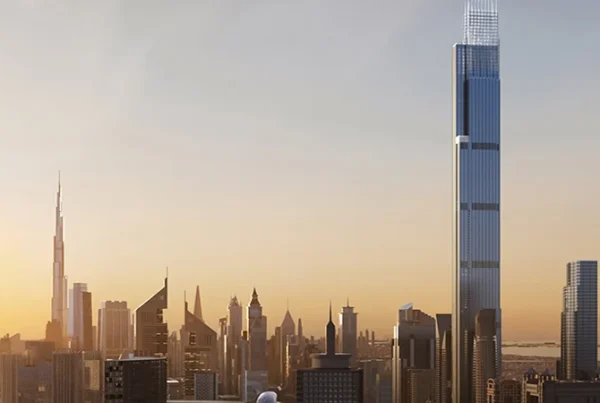
Jumeirah Residences Emirates Towers occupies a central business-district location surrounded by Jumeirah Emirates Towers, the Museum of the Future, DIFC and One Central.
Meraas states that the project has direct access to Sheikh Zayed Road and Al Khail Road, with connectivity toward Downtown Dubai, City Walk and J1 Beach.
For an investor, this gives the project a different demand profile from a resort-led beachfront residence or a suburban branded development. Potential occupiers may include senior executives, international professionals, corporate tenants and buyers who prioritise proximity to Dubai’s financial and business core.
That does not mean rental demand or resale liquidity should be assumed. The completed 2030 market will depend on how much premium supply enters the central Dubai corridor between now and then.
What the AED5 Billion Award Does and Does Not De-Risk
| Issue | What the Contract Award Changes | What It Does Not Guarantee |
|---|---|---|
| Main contractor | CSCEC ME is formally appointed | Exact completion date |
| Capital commitment | AED5bn building contract demonstrates project scale | Buyer ROI |
| Delivery visibility | Construction responsibility becomes clearer | No delay or variation risk |
| Brand positioning | Jumeirah, Meraas and SCDA remain central to product positioning | Permanent branded premium |
| 2030 resale market | Nothing directly | Future sale price or liquidity |
The Biggest Investor Risk May Be the Premium, Not the Project
A high-profile contractor award can improve confidence in project execution while simultaneously encouraging sellers and marketers to justify a larger brand or location premium.
That creates a simple but important distinction:
Strong Project
does not automatically equal
Strong Investment at Any Entry Price
A buyer should compare the purchase price against completed and off-plan alternatives serving the same ultra-prime urban buyer profile.
The premium may be justified where the project offers a combination of location scarcity, Jumeirah service standards, architectural differentiation, strong views and long-term operational quality. It becomes harder to justify if the buyer is paying heavily today for appreciation that has not yet occurred.
Jumeirah Is Expanding Its Branded Residence Strategy Beyond One Project
Jumeirah Residences Emirates Towers is part of a broader expansion of the Jumeirah residential brand rather than an isolated use of the name.
Jumeirah’s portfolio now includes or plans residential offerings across different UAE settings, from central-business-district apartments to coastal and waterfront developments. That strategy can strengthen brand recognition, but investors should also recognise that a growing branded portfolio means future buyers will have more Jumeirah-branded alternatives to compare.
One example is the planned Jumeirah-branded waterfront development on Al Maryah Island, covered by Aurantius in Emirates Developments and Jumeirah Introduce Branded Waterfront Residences on Al Maryah Island.
The lesson for investors is that the brand itself should be evaluated together with location, scarcity and unit economics. A Jumeirah-branded home in a financial district is not economically identical to a Jumeirah-branded waterfront property.
How the Project Fits Dubai’s Wider Urban Shift
The combination of a major corporate headquarters and branded residences in the Emirates Towers district reflects a broader pattern in Dubai: important employment, lifestyle and residential uses are increasingly being integrated within high-value urban districts instead of treated as completely separate zones.
A similar mixed-use evolution is occurring in other strategically important districts. Aurantius has examined this in Dubai Design District’s New Waterfront Mixed-Use Expansion.
For property investors, the relevance is not that every mixed-use district will outperform. It is that proximity to employment, hospitality, culture, retail and transport can create deeper end-user demand than a project whose investment case depends on a single attraction.
What Buyers Should Verify Before Treating the Contract Award as a Buy Signal
1. Your exact entry price.
Compare the unit with relevant branded and non-branded alternatives rather than relying on the overall AED5 billion project value.
2. Payment-plan exposure.
Map every instalment through 2030 and stress-test whether you can hold through handover without depending on a pre-completion resale.
3. DLD and escrow status.
Verify the project and your own off-plan registration through official channels.
4. Service and operating costs.
Branded residences can offer extensive hospitality services, but the ownership-cost structure matters to net returns.
5. Competing 2030 supply.
Compare the project against other luxury residences scheduled to complete before or around the same period.
6. View and unit-specific scarcity.
A branded tower can contain hundreds of units, but resale performance can differ significantly by floor, orientation, layout and protected view.
7. Developer and ownership structure.
Meraas is part of Dubai Holding Real Estate. Buyers comparing major developers can review Aurantius’ Top 10 Real Estate Developers in Dubai 2026 for wider market context.
Who May Find Jumeirah Residences Emirates Towers Most Compelling?
| Buyer Profile | Why It May Fit | Main Caution |
|---|---|---|
| Luxury end-user | Central location, Jumeirah services, amenities and design | Long wait until scheduled 2030 handover |
| Long-term investor | Potential appeal to affluent urban tenants and buyers | Future rent, service charges and resale premium remain uncertain |
| Brand-focused buyer | Jumeirah service proposition and brand recognition | Do not pay an unlimited brand premium |
| Short-term flipper | Potential market interest during construction | Exit price and pre-handover liquidity are not guaranteed |
FAQ: Dubai Holding’s AED5bn Deal and Jumeirah Residences Emirates Towers
Question: How much is Dubai Holding’s new construction contract worth?
Answer: Dubai Holding announced an AED5 billion construction contract with CSCEC ME on 9 September 2026. It is the largest building contract Dubai Holding says it has awarded to date.
Question: What does the AED5 billion contract include?
Answer: The contract covers delivery of Dubai Holding’s new corporate headquarters and Jumeirah Residences Emirates Towers.
Question: When will Dubai Holding’s new headquarters open?
Answer: Dubai Holding currently schedules the new headquarters to open in 2029.
Question: When is Jumeirah Residences Emirates Towers scheduled for handover?
Answer: Dubai Holding’s September 2026 announcement states that residential handover is scheduled for 2030.
Question: How many homes are in Jumeirah Residences Emirates Towers?
Answer: The development comprises 754 Jumeirah-branded residences across two towers, with one-to-four-bedroom layouts.
Question: Who is building Jumeirah Residences Emirates Towers?
Answer: CSCEC Middle East has been awarded the construction package. The project is developed by Meraas and designed by SCDA Architects, with Jumeirah providing the branded hospitality and service proposition.
Question: Does the AED5 billion contract guarantee the property will appreciate?
Answer: No. The contract strengthens the construction and execution story, but future property performance still depends on entry price, luxury supply, rental demand, service costs, market conditions and the premium buyers are willing to pay at resale.
Conclusion: The AED5bn Deal Is a Delivery Milestone, Not an ROI Guarantee
Dubai Holding’s AED5 billion contract is meaningful because it moves two major projects further into their delivery phase and places construction responsibility with an established regional contractor.
For Jumeirah Residences Emirates Towers buyers, the milestone strengthens several parts of the project proposition: a defined 2030 handover target, CSCEC ME as main contractor, Meraas as developer, SCDA as architect, Jumeirah’s branded service model and a highly central location around Emirates Towers, DIFC and the Museum of the Future.
The opportunity is a differentiated branded residence in one of Dubai’s most established commercial districts, supported by a major institutional development programme.
The main risk is overpaying because of that strength. A large contract, globally recognised architects and a hospitality brand can improve confidence and desirability, but they cannot make an excessive purchase price economically attractive.
The project may suit long-term luxury buyers and investors comfortable holding through the 2030 delivery period. Buyers relying on a fast pre-handover resale, aggressive rental assumptions or guaranteed brand-driven appreciation should be more cautious.
The buyer rule: Treat the AED5 billion construction award as evidence that the project’s execution has advanced, not as evidence that every unit is automatically a good investment. Verify the price you are paying, your full payment schedule, official project registration, service-cost assumptions and comparable luxury supply before signing.
Aurantius Real Estate helps Dubai luxury-property buyers compare branded residences using developer quality, project delivery, location, price positioning, payment exposure and future exit conditions. For a project such as Jumeirah Residences Emirates Towers, the right question is not simply whether the development is prestigious, but whether the specific unit and entry price make sense for your holding period and investment objective.
Project and investment note: Project timelines, construction programmes and service arrangements may change before handover. The 2029 headquarters opening and 2030 residential handover are the currently announced targets. Branded status, contractor appointment and infrastructure do not guarantee rental income, resale liquidity or capital appreciation.