
Dubai Real Estate 2026: Are You Paying for a Brand Premium or an Infrastructure Premium?
Dubai property buyers in 2026 are increasingly paying premiums for two very different reasons. One is the brand premium: the extra price attached to a residence carrying a recognised hospitality, fashion, automotive or luxury name. The other is what can be described as an infrastructure premium: value supported by transport access, waterfront scarcity, mature schools, healthcare, retail, employment hubs and established community infrastructure.
The distinction matters because the two premiums do not produce the same investment outcome. A branded residence can command stronger international recognition, service standards and turnkey appeal, but it may also have a higher entry price and higher recurring costs. An infrastructure-led property may lack the same luxury badge while benefiting from deeper end-user demand, practical daily utility and lower operating complexity.
Neither model is automatically superior. The more useful question is whether the premium being paid is supported by something durable enough to remain relevant when market conditions become more selective.
Brand Premium vs Infrastructure Premium
Brand premium: You are paying for design identity, global recognition, operator standards, hospitality-style services and a differentiated ownership experience.
Infrastructure premium: You are paying for accessibility, land scarcity, transport links, schools, hospitals, retail, employment proximity and mature community demand.
Brand risk: The name may not justify the premium if the project is oversupplied, poorly located or expensive to operate.
Infrastructure risk: Buyers can overpay for future roads, rail or community upgrades before the improvement is actually delivered or reflected in real demand.
How Large Is Dubai’s Branded Residence Premium in 2026?
Dubai’s branded-residence market has reached substantial scale. Morgan’s International Realty reported 183 branded developments containing 64,744 units at the end of the first half of 2026. The same report recorded 4,648 transactions worth AED 22.21 billion during H1, with under-construction properties accounting for 82% of transaction volume.
The most important pricing figure is the reported average achieved price of approximately AED 3,662 per sq. ft. (US$997) for branded residences, representing a roughly 56% premium over the comparable non-branded sample used in the report.
That does not mean every branded property in Dubai is worth 56% more than every non-branded home. It is an average across the report’s comparison set. Individual premiums vary materially by brand, neighbourhood, property type, launch timing, view, developer and whether the residence is ready or off-plan.
The figures are still important because they quantify how much capital buyers may be allocating to branding and product differentiation. Before accepting that premium, an investor should identify which part of the higher price is supported by the address and physical asset, and which part depends on the brand itself.
What Are You Actually Buying With a Brand Premium?
A genuine branded residence can offer more than a logo on the entrance. Depending on the project, buyers may receive a clearly defined design language, operator involvement, concierge services, housekeeping options, managed facilities, hospitality standards and a level of international recognition that makes the property easier for overseas buyers to understand.
That recognition can matter in resale. A globally known brand reduces the amount of explanation required when marketing a property to an international buyer. In high-end markets, familiarity can support buyer confidence when it is combined with a credible developer, strong location and high-quality finished product.
It should not, however, be treated as a guarantee of construction quality, capital appreciation or liquidity. The brand may impose standards or review design and operations, but the strength of those controls varies from project to project. Buyers should understand exactly what the brand is responsible for rather than assuming the name itself guarantees every element of delivery.
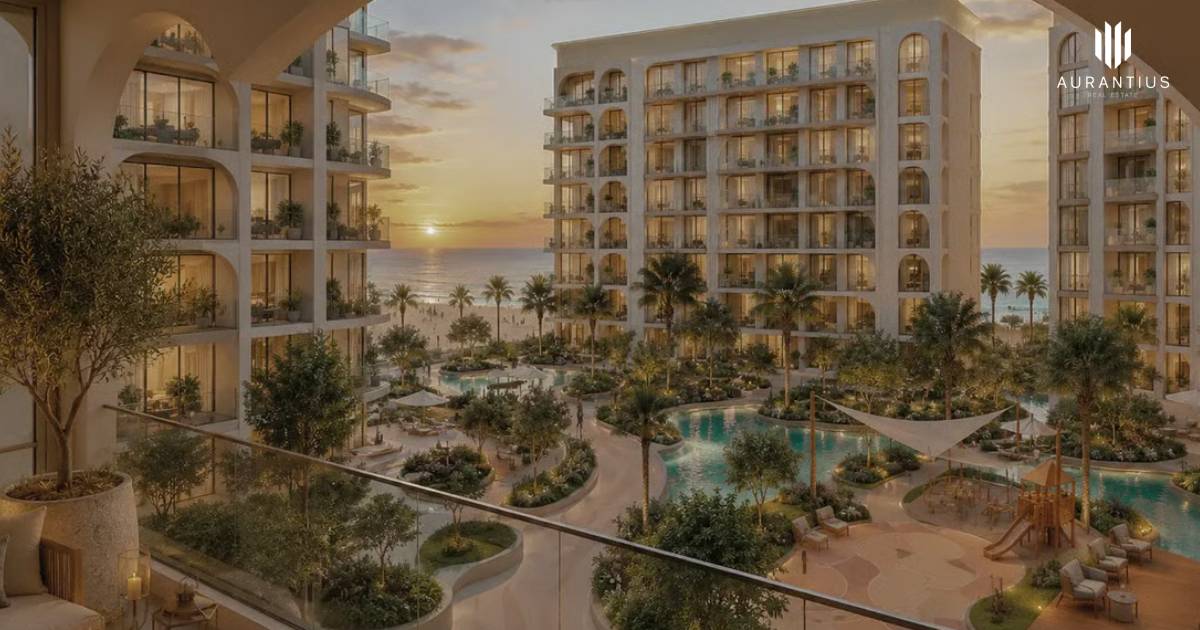
Aurantius’ Armani Beach Residences illustrates the strongest version of the branded proposition: international design recognition combined with a genuinely scarce Palm Jumeirah waterfront location. In that situation, brand and infrastructure premiums overlap rather than compete.
The Best Branded Assets Usually Have More Than the Brand
The strongest branded property thesis is usually not “brand instead of location.” It is brand plus location plus scarcity.
A globally recognised residence on Palm Jumeirah has several layers of demand working together: a limited waterfront setting, international address recognition, established tourism, mature access, beach scarcity and a luxury brand. If one part of the thesis weakens, the others may still support demand.
The risk becomes greater when branding is expected to compensate for an ordinary or heavily supplied location. If dozens of nearby towers offer similar layouts and amenities, the branded building must generate enough additional tenant or buyer demand to justify both the original price premium and potentially higher annual ownership costs.
This is why buyers should compare branded assets against the underlying micro-market rather than another branded project elsewhere in Dubai. A branded one-bedroom in an emerging corridor should be compared with good-quality non-branded one-bedrooms in that same area, not with luxury residences on Palm Jumeirah.
The Aurantius Palm Jumeirah property guide provides useful context for how land scarcity and an established waterfront address can add a second layer of value beyond branding alone.
What Is an Infrastructure Premium?
“Infrastructure premium” is not an official Dubai Land Department metric. It is a useful investment framework for describing the extra value buyers may attach to property because the surrounding environment makes daily life easier, more attractive or harder to replicate.
Infrastructure can include major roads, Metro or rail connections, schools, hospitals, shopping centres, parks, office districts and airports. Waterfront access and limited land can also function as structural value drivers because they cannot be manufactured indefinitely.
The strongest infrastructure premiums tend to be attached to assets where the utility already exists. A completed school is different from a school shown on a future master plan. An operational Metro station is different from a proposed station. A finished mall with established footfall is different from planned retail.
That distinction is particularly important in off-plan investment. Buyers can pay today’s price for tomorrow’s infrastructure, but construction schedules can change and anticipated benefits may already be reflected in the launch price.
Dubai Hills Estate Shows How Infrastructure Can Support a Premium Without a Trophy Address
Dubai Hills Estate is a useful example of an infrastructure-led value proposition. The community combines Dubai Hills Mall, Dubai Hills Park, healthcare, schools, golf, villas, apartments and established road access within one large master plan.
Families may be willing to pay more to live there even when their property does not carry a hospitality or fashion brand because the location solves practical daily needs. Schools reduce school-run distance. Healthcare is close. Retail is operational. Public spaces already exist. The community also attracts both tenants and end-users rather than relying on one narrow investor profile.
That does not mean every property in Dubai Hills deserves the same premium. Older and newer buildings, golf-facing apartments, villas, branded projects and standard residences can perform differently. Buyers still need building-level transaction and rental evidence.
Aurantius’ Dubai Hills Estate property page shows the range of ready and off-plan inventory currently competing within the community.
Service Charges Can Change the Branded Residence Investment Case
A branded residence can look attractive when analysed only through purchase price and gross rent. The result can change substantially once recurring costs are included.
Hospitality-style buildings may have more staff, concierge services, elaborate shared spaces, branded facilities, premium landscaping or operational standards that cost more to maintain. Service charges vary significantly between projects, so a generic citywide number should not be applied automatically.
For an investor, the correct calculation starts with annual rent and subtracts service charges, maintenance, management fees, vacancy allowance and other recurring costs. The remaining income should then be compared with the total acquisition cost rather than only the advertised purchase price.
A More Useful Yield Calculation
Annual Gross Rent
− Service Charges
− Maintenance
− Management Fees
− Vacancy Allowance
= Estimated Net Income
Estimated Net Income ÷ Total Acquisition Cost = Estimated Net Yield
Aurantius’ Dubai Real Estate 2026 investment analysis compares income and growth strategies across communities and illustrates why entry price and operating costs matter as much as headline yield.
Infrastructure Can Improve Demand — but It Does Not Create Guaranteed Appreciation
Transport infrastructure is one of the most commonly misunderstood property drivers. A new road, Metro station or rail connection can improve accessibility and widen a property’s potential buyer or tenant base. That can support demand.
It does not automatically mean the property will appreciate. If a developer launches at a high price because future infrastructure has already been heavily marketed, the buyer may have paid for much of the expected improvement in advance.
Supply can also offset infrastructure benefits. A new transport node may attract more developers, resulting in additional apartments competing for the same tenants. The right question is therefore not simply, “Is infrastructure improving?” It is, “Is this property priced appropriately relative to the demand that infrastructure can realistically create?”
The same principle applies to Dubai South, Meydan and other growth corridors. Infrastructure can strengthen a location thesis, but the purchase price must still leave room for the buyer to benefit.
Brand Premium vs Infrastructure Premium: Which Is Better for Resale?
Resale liquidity depends on who the next buyer is likely to be.
A globally recognised branded residence may have access to an international buyer pool that already understands the name and lifestyle proposition. This can be particularly useful in ultra-prime markets where wealthy buyers compare trophy assets across several global cities.
An infrastructure-led property can have a different advantage: broader local and resident demand. A family may want Dubai Hills because of schools and healthcare regardless of luxury branding. A professional may prioritise Business Bay because of employment proximity. A commuter may value rail or Metro access more than concierge services.
Liquidity should therefore be assessed by property type. A AED 2 million apartment and a AED 25 million branded waterfront residence do not compete for the same buyer pool. A smaller number of wealthy buyers can support very high prices, but the time required to exit may still be longer.
Off-Plan Branded Residences Require an Extra Layer of Due Diligence
The H1 2026 data shows that under-construction properties accounted for most branded-residence transaction activity. That makes off-plan due diligence particularly important.
A buyer is often paying the brand premium before the completed property, operational service model and final resident experience can be inspected. The assessment therefore depends heavily on the developer, contractual brand relationship, design execution, payment plan and expected handover environment.
Buyers should confirm whether the brand will manage the property after completion, merely license its name, contribute to design, or provide a combination of those functions. Those structures are not interchangeable.
The broader process is explained in Aurantius’ Property Investment in Dubai: The Complete 2026 Investor Guide, which covers project selection, risk, ownership structure and investment planning beyond marketing materials.
A Simple 2026 Decision Framework
A brand premium may be easier to justify when the residence sits in a genuinely prime location, the brand relationship is meaningful, the project is differentiated from nearby inventory, operating costs are acceptable and the buyer values turnkey service or global resale recognition.
An infrastructure premium may be more compelling when the buyer prioritises everyday utility, long-term family demand, tenant depth, lower operating complexity and a location where schools, retail, healthcare and transport are already functioning.
Some of Dubai’s strongest properties combine both. A branded waterfront asset on Palm Jumeirah benefits from international branding and physical scarcity. A branded residence in Dubai Hills can combine hotel-style services with a mature family community. Those hybrid assets may command higher prices precisely because multiple demand drivers overlap.
Before deciding, buyers should benchmark the actual transaction price rather than the brochure price. Aurantius’ step-by-step Dubai property selection guide explains how transaction evidence, price per square foot and building comparisons can be used to test whether a premium is justified.
FAQ: Brand Premium vs Infrastructure Premium in Dubai
Question: How much more do branded residences cost in Dubai?
Answer: Morgan’s H1 2026 report found an average achieved branded-residence price approximately 56% above its comparable non-branded sample. That is a market average, not a fixed premium applicable to every project.
Question: Does a luxury brand guarantee better property quality?
Answer: No. A brand may impose design, service or operational standards, but buyers should verify the exact brand agreement, developer, construction specification and management structure rather than assuming the name guarantees every aspect of quality.
Question: Are branded residences better for rental yield?
Answer: Not automatically. Higher rents can be offset by a higher purchase price and higher recurring costs. Net yield should be calculated after service charges, management, maintenance and vacancy.
Question: What creates an infrastructure premium in Dubai property?
Answer: Factors can include Metro and road access, waterfront scarcity, proximity to employment, established schools, hospitals, parks and retail. The strongest premium usually occurs when the infrastructure is already operational and supports real end-user demand.
Question: Is Palm Jumeirah a brand-premium or infrastructure-premium market?
Answer: It can be both. The island benefits from limited waterfront land, established tourism and international recognition, while individual branded projects add another layer of design and service differentiation.
Question: Is Dubai Hills Estate an infrastructure-premium community?
Answer: It is a strong example because much of its value proposition comes from mature schools, healthcare, parks, retail, golf and road connectivity. Individual buildings and villas still need to be evaluated separately.
Question: Which premium is better for a long-term investor?
Answer: It depends on the property. Long-term performance is more likely to be supported when the buyer avoids overpaying, recurring costs remain manageable, tenant or end-user demand is real and the asset has defensible differentiation.
Conclusion: The Strongest Dubai Properties Usually Combine More Than One Premium
Dubai’s 2026 market shows that buyers are willing to pay substantial premiums for branded residences, but the 56% average pricing gap should not be treated as evidence that branding alone creates equivalent investment value.
A strong brand can improve differentiation, services and international recognition. Strong infrastructure can improve practical demand, accessibility and end-user depth. Neither protects a buyer who pays too much for an asset with weak fundamentals.
The most defensible properties often combine several value drivers: a recognised brand in a scarce waterfront location, a premium building in a mature master community, or a well-priced property in an area where new infrastructure materially improves daily utility.
For investors, the main opportunity is to identify where the market is underpricing those overlapping advantages. The main risk is paying a large premium for a brand, future transport project or luxury narrative that does not translate into stronger rent, resale demand or long-term scarcity.
Aurantius Real Estate helps buyers compare Dubai property through transaction evidence, location analysis, building-level research, service-charge review, developer assessment and realistic return calculations. When assessing a branded or infrastructure-led asset, the objective is to identify exactly what part of the premium is supported by measurable fundamentals and what part is primarily marketing.
2026 buyer test: Compare the target property against a similar non-branded or less infrastructure-rich alternative. Calculate the additional purchase price, annual ownership cost and realistic rent difference. If the extra value is not visible in demand, scarcity, quality or resale liquidity, the premium may be difficult to justify.