
Dubai Real Estate Forecast for the Next 5 Years: Growth Outlook, Rental Demand, and Long-Term Investment Strategy
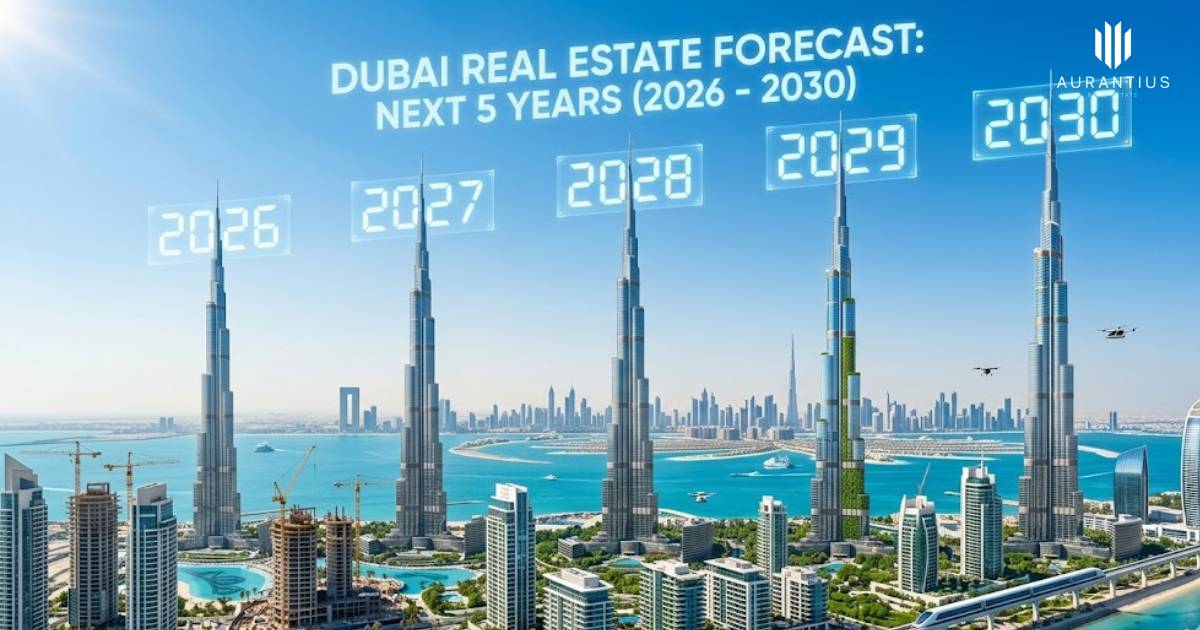
Dubai’s real estate market over the next five years is expected to remain on a long-term growth path, driven by population expansion, sustained foreign investment, infrastructure development, and the emirate’s position as a globally competitive property market. The market is no longer being viewed only as a short-cycle trading environment. It is increasingly seen as a structured investment destination where residential, commercial, and luxury segments can all perform for different reasons. This matters because investors entering Dubai today are not evaluating only immediate appreciation. They are looking at long-term rental demand, residency advantages, taxation efficiency, and the quality of underlying communities. Established locations such as Dubai Marina, Downtown Dubai, and Business Bay continue to attract buyers because they combine strong visibility, tenant demand, and resale liquidity, all of which are relevant when building a five-year property strategy.
Why the Five-Year Outlook for Dubai Remains Positive
The next five years are likely to be defined by moderate but sustained expansion rather than by uncontrolled price spikes. This is a healthier setup for investors because it supports disciplined buying and reduces dependence on short-term speculation. Dubai’s population continues to grow, tourism remains a major economic driver, and international investors are still attracted by the city’s legal clarity, safety, and tax efficiency. The market also benefits from long-term government planning, which gives investors more confidence in future value creation. This is especially important in communities that combine residential appeal with liveability and infrastructure quality. Areas such as Dubai Hills Estate and Jumeirah Village Circle remain central to medium-term growth discussions because they align with end-user demand, while Palm Jumeirah continues to represent scarcity-led premium value for buyers focused on capital preservation and ultra-prime positioning.
Residential, Commercial, and Luxury Segments Will Not Move at the Same Pace
One of the most important realities for the next five years is that Dubai should be analyzed as a collection of submarkets rather than as one uniform market. Residential demand is expected to remain strong, especially in communities that appeal to families, professionals, and overseas buyers seeking stable living environments. Commercial property is also evolving, supported by free zone activity, logistics expansion, and continued demand for high-quality office space in strategic locations. The luxury segment is likely to remain one of the standout performers because Dubai continues to attract international wealth looking for branded residences, waterfront homes, and high-service lifestyle assets. This segmentation means investors need to match asset type with investment objective. Some will prioritize rental income, others will aim for appreciation, and others will focus on preserving capital in premium inventory. A five-year strategy works best when it is built around this distinction.
Rental Demand and ROI Will Continue to Anchor Investor Confidence
Strong rental performance remains one of Dubai’s biggest advantages over many international cities. Even when price growth moderates, rental demand can keep investor returns attractive and help support pricing across well-located assets. Yield-driven communities remain relevant because they offer lower entry prices and broader tenant pools, while premium districts can deliver lower percentage yields but stronger long-term value retention. Investors are increasingly becoming more analytical in how they assess returns, which is why tools such as Calculate ROI Dubai Property are important for understanding net income after service charges, maintenance, vacancy periods, and management costs. Over a five-year period, the strongest investments are often not those with the highest headline yield, but those that combine stable tenancy, realistic operating costs, and resilient resale demand. That shift toward disciplined underwriting is making Dubai’s market more mature and more sustainable.
Off-Plan, Infrastructure Growth, and Developer Quality Will Shape the Next Cycle
Off-plan developments are likely to remain one of the most important growth channels over the next five years because they allow investors to enter the market at earlier pricing stages with structured payment plans. Yet off-plan performance will depend heavily on location quality, handover timing, and developer credibility. Projects such as Breez by Danube, Pearl House 4, Golf Verge, Sera at Rashid Yachts & Marina, and Marina Cove represent the kind of launch-driven inventory that can attract both local and international buyers when product positioning is strong. Other schemes including Peace Lagoons, Rove Home Marasi Drive, Twilight by Binghatti, Samana Resorts, and Iconic Tower show how broad the off-plan market has become across different price points. Investors are also paying closer attention to major developers such as Emaar, DAMAC, Sobha Realty, Nakheel, Meraas, and Select Group because delivery record, community planning, and brand trust matter more over a five-year holding period than launch marketing alone.
Dubai’s Global Positioning Supports the Long-Term Case
When Dubai is compared with major international cities, it still offers a compelling mix of lower entry cost, stronger rental yields, and higher perceived upside. This is one of the reasons global investors continue to evaluate Dubai as a practical alternative to more mature but lower-yield markets. Over the next five years, smart technology, sustainability, and better community planning are also expected to become more important. Buyers will increasingly favor assets that combine efficiency, modern infrastructure, and long-term usability rather than relying only on location branding. For those following broader market positioning, Dubai Real Estate 2026 and the Dubai Real Estate Blog help place these five-year expectations into a wider investment context. The next phase of Dubai real estate is likely to reward patient capital, stronger asset selection, and a clearer understanding of how different communities will evolve as infrastructure and demand continue to expand.
Conclusion
Dubai’s real estate forecast for the next five years remains positive because the market is supported by population growth, global capital inflows, strong rental demand, infrastructure expansion, and increasingly mature investment behavior across residential, commercial, and luxury segments.
FAQs
Q: What is the real estate forecast for the next five years in Dubai?
A: The market is generally expected to grow at a steady pace, with stronger performance in established, premium, and infrastructure-backed communities rather than uniform gains across every area.
Q: Will Dubai property prices keep rising over the next five years?
A: Prices are likely to continue rising in many key locations, though the pace is expected to be more moderate and sustainable than during earlier high-growth phases.
Q: Which property segments are expected to perform best?
A: Luxury villas, branded residences, family-focused communities, and well-located off-plan developments are among the segments most likely to perform strongly over a five-year horizon.
Q: Why does rental demand matter so much in a five-year forecast?
A: Rental demand supports pricing, improves cash flow, and reduces holding risk, making it one of the most important factors for long-term investors evaluating Dubai property.
Q: What should investors focus on when planning for the next five years?
A: Investors should focus on location quality, developer credibility, rental strength, infrastructure growth, and realistic ROI assumptions rather than relying on broad market hype.
Aurantius Real Estate helps investors identify Dubai property opportunities built for long-term growth and stronger returns.