

Top Areas to Buy Property in Dubai for High Rental Yields in 2026: Where Returns Are Strongest and What Investors Should Evaluate
Buying property in Dubai for rental income remains a core strategy for residents and international investors who want measurable returns in a market with relatively low tax drag and strong tenant demand. In 2026, the discussion around “best yields” is not only about picking the highest percentage figure. It is about aligning yield with occupancy stability, tenant profile, service-charge realities, and exit liquidity. A high yield estimate can be reduced quickly by weak occupancy, high operating costs, or poor building management. A slightly lower yield in a stronger community can produce better risk-adjusted performance over a multi-year hold.
Dubai continues to attract buy-to-let demand because rental yields are frequently higher than many global hubs, wh
ile ownership structures allow foreign participation in designated freehold areas. For many investors, the practical appeal is simple: rental income can be modeled with more clarity when tax friction is lower and when population inflows keep leasing demand active. The market also offers multiple strategies. Some investors target short-term rentals in lifestyle and tourist corridors, while others prioritize long-term leasing in resident-driven communities where tenancy duration is longer and operational workload is lighter.
Investors evaluating 2026 opportunities usually need a framework before choosing a district. The most relevant inputs are the expected tenant base, seasonal occupancy patterns, the building’s management and maintenance standard, service charges, and the quality of competing supply within the same corridor. Properties in prime zones can have higher purchase prices, which compress yield, yet they can offer stronger liquidity and lower vacancy risk. Mid-market zones can offer higher gross yields, yet they can be more sensitive to supply waves and tenant price negotiation.
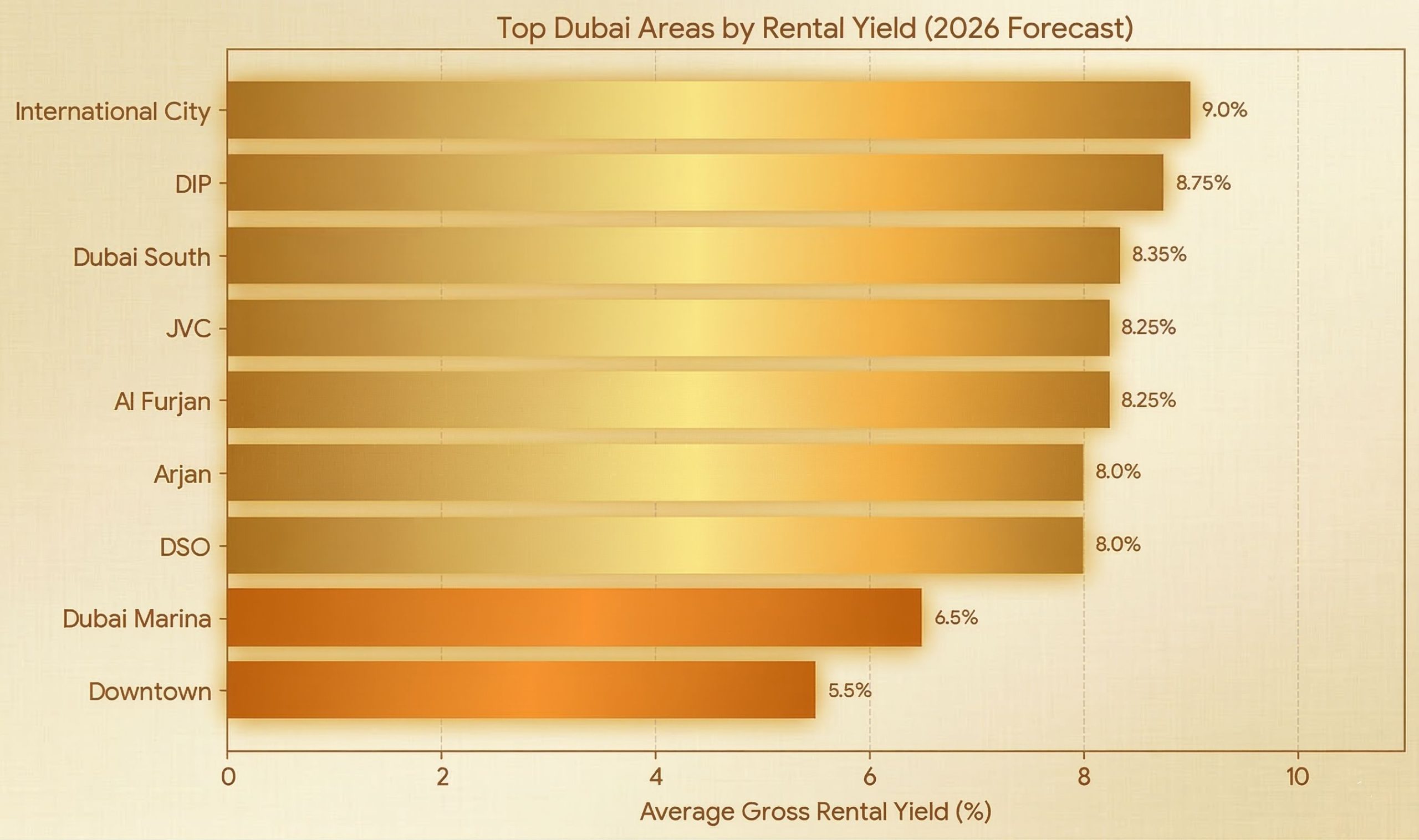
| Area | Market Segment | Yield Range (Gross) | Key Driver |
|---|---|---|---|
| International City | Affordable | 8.0% – 10.0% | Exceptionally low entry prices |
| DIP | Affordable | 8.0% – 9.5% | Proximity to logistics & industrial hubs |
| Dubai South | Emerging | 7.5% – 9.2% | Al Maktoum Airport expansion |
| JVC | Mid-Market | 7.0% – 9.5% | High demand for studios & 1-beds |
| Al Furjan | Mid-Market | 8.0% – 8.75% | Strong Metro connectivity |
| Arjan / DSO | Mid-Market | 7.0% – 9.0% | Tech & education community focus |
| Dubai Marina | Luxury | 6.0% – 7.0% | Tourist demand & short-term stays |
| Downtown Dubai | Luxury | 5.0% – 6.0% | Premium brand & high resale value |
Jumeirah Village Circle: Yield-Driven Demand With Broad Tenant Depth
Jumeirah Village Circle is often referenced as one of the strongest yield corridors in Dubai because entry prices are typically lower than prime districts while tenant demand remains broad. Yield ranges commonly quoted for JVC fall in the high single digits for smaller units and remain competitive for larger layouts. This corridor is frequently selected for buy-to-let because it tends to attract long-term tenants, including professionals and families seeking value, building variety, and access to multiple roads.
From an investor perspective, JVC requires careful building selection. The area includes a large volume of buildings, which means asset performance can vary widely. A high-yield corridor can still deliver weak outcomes if the building has high service charges, poor maintenance, or weak parking and access. Investors typically improve results by selecting buildings with proven occupancy history and stable property management. For location research, use Jumeirah Village Circle as a base to compare building clusters and tenant demand patterns.
Downtown Dubai: Premium Entry Pricing With Strong Liquidity and Corporate Demand
Downtown Dubai is usually positioned as a prime district with high entry prices and strong global visibility. Yield ranges can vary significantly by unit size, with smaller apartments often producing better yield outcomes than larger units. The investor case for Downtown is frequently built on liquidity, stable corporate demand, and long-term positioning rather than on maximum yield. In prime zones, tenant demand is supported by landmark proximity, lifestyle infrastructure, and employment density.
Downtown can suit both long-term leasing and short-term models depending on building policy and unit positioning. Investors should model service charges carefully and evaluate how seasonal demand patterns influence income if short-term rentals are allowed. For deeper area context and listing research, review Downtown Dubai.
Business Bay: Mixed-Use Density and Consistent Tenant Turnover
Business Bay functions as a central business district with a large supply of residential towers near commercial corridors. Yield ranges are often competitive, with smaller units producing stronger yield profiles than larger apartments due to tenant preference and affordability. Business Bay can offer stable demand from professionals working in finance, consulting, technology, and services, which supports long-lease occupancy in many towers.
The corridor is also highly segmented. Some towers perform strongly due to access, views, and management standards. Others can face competition from newer supply or suffer from weak maintenance. Investors should compare tower-level service charges and vacancy patterns rather than using area-level averages alone. For research and market comparisons, see Business Bay.
Dubai Marina: Lifestyle Demand, Short-Term Potential, and Yield Compression in Premium Stock
Dubai Marina is a globally recognized lifestyle district where demand is often driven by waterfront living, walkability, and entertainment access. Yield ranges tend to be higher for studios and smaller units and lower for larger apartments due to higher entry prices. Investors targeting the Marina often do so because liquidity is typically stronger and because the short-term rental potential can be meaningful when occupancy is stable and operational execution is strong.
Marina investing requires disciplined selection. Tower quality, service-charge levels, building age, and maintenance practices have a direct impact on net yield. Short-term strategies also require professional operations, consistent guest experience, and careful cost control. Investors seeking long-term stability can still target long leases in buildings with strong tenant demand. Use Dubai Marina to compare properties and evaluate building performance signals.
Prime Coastal Premium: Palm Jumeirah and the Yield Versus Scarcity Tradeoff
Palm Jumeirah is often chosen for scarcity-driven holding strategy rather than for maximum yield. Entry prices are higher and yields can compress, yet demand is supported by global recognition, waterfront scarcity, and premium lifestyle positioning. Investors in Palm often prioritize capital preservation, long-term desirability, and liquidity within the ultra-prime segment. Short-term rental potential can exist, yet operational costs, management requirements, and service charges can materially influence net outcomes.
For most yield-focused investors, Palm is usually a secondary allocation rather than a core yield corridor. It can work when the investor’s objective includes trophy positioning or premium tenant demand. For area research, see Palm Jumeirah.
How Investors Should Evaluate “Best Yield” Claims in 2026
Yield estimates are only one part of performance. Investors should translate gross yield into realistic net yield by including service charges, maintenance provisions, management fees, vacancy assumptions, and furnishing costs for short-term strategies. A unit showing 8% gross yield can fall sharply if vacancy rises or if service charges are high. A 6% gross yield in a better-managed building can produce better net stability and lower operational stress.
Tenant profile matters. A long-term rental strategy typically offers smoother cash flow and lower operational workload. It can be appropriate in resident-driven corridors where tenant demand is stable and lease renewals are common. A short-term strategy can produce higher income in peak periods, yet it requires stronger operations and is more exposed to travel sentiment. Investors should choose strategy first, then select location that matches the strategy.
Building policy also matters. Some buildings restrict short-term rentals or impose operational requirements that change the economics of holiday home strategies. Investors should verify building rules and licensing requirements before underwriting short-term income. In uncertain periods, realistic underwriting is more important than optimistic projections.
Conclusion
Dubai in 2026 continues to offer multiple corridors for rental yield strategies, with mid-market communities often delivering stronger gross yields and prime districts offering stronger liquidity and lifestyle-driven demand. Areas such as Jumeirah Village Circle are commonly selected for yield-driven buy-to-let strategies due to entry affordability and tenant depth. Prime districts such as Downtown Dubai and Business Bay offer stable demand and stronger liquidity, while lifestyle districts such as Dubai Marina and premium coastal zones such as Palm Jumeirah trade higher pricing for scarcity and global recognition. The strongest outcomes typically come from aligning location with strategy, selecting high-quality buildings, and underwriting net yield with realistic cost and vacancy assumptions.
To compare Dubai districts, track market context, and evaluate investment options using a structured approach, use Aurantius Real Estate for research across locations, pricing context, and investor-led decision frameworks.