

Dubai Rent vs Buy Real Calculator: At What Monthly Rent Does Ownership Become Cheaper?
Deciding whether to rent or buy a home in Dubai is no longer just a lifestyle choice. It is a high-stakes calculation against a fast-moving property market.
While writing a monthly rent cheque can feel like throwing money away, rushing into ownership based only on a low advertised mortgage rate can expose buyers to major front-loaded sunk costs. Dubai Land Department fees, broker commission, mortgage registration, trustee charges, valuation fees, service charges, maintenance, interest and future selling costs all change the equation.
To understand when buying becomes cheaper than renting, you must look beyond the monthly mortgage instalment. The real question is not “Is my mortgage lower than rent?” The real question is: after all unrecoverable costs, principal paydown, opportunity cost and capital appreciation, which option leaves you wealthier?
This guide breaks down the Dubai rent vs buy calculator logic using hard numbers, realistic ownership costs and the financial crossover point where buying starts to outperform renting.
For a wider UAE comparison, read UAE Rent vs Buy.
The Core Formula: Renting Is Simple, Buying Is Layered
Renting is financially simple. Every dirham paid as rent is an unrecoverable cost. You receive housing utility for that period, but you do not build equity in the asset.
Buying is more layered. Your mortgage payment includes two components: interest and principal. Interest is a sunk cost paid to the bank. Principal is equity because it reduces your outstanding loan balance. Over time, the principal portion increases while the interest portion gradually declines.
Ownership also creates potential capital appreciation. If the property value rises, the owner benefits. But ownership also carries upfront transaction fees, ongoing service charges, maintenance and exit costs.
That is why a proper Dubai property break-even calculator must separate money that is permanently gone from money that turns into equity or capital gain.
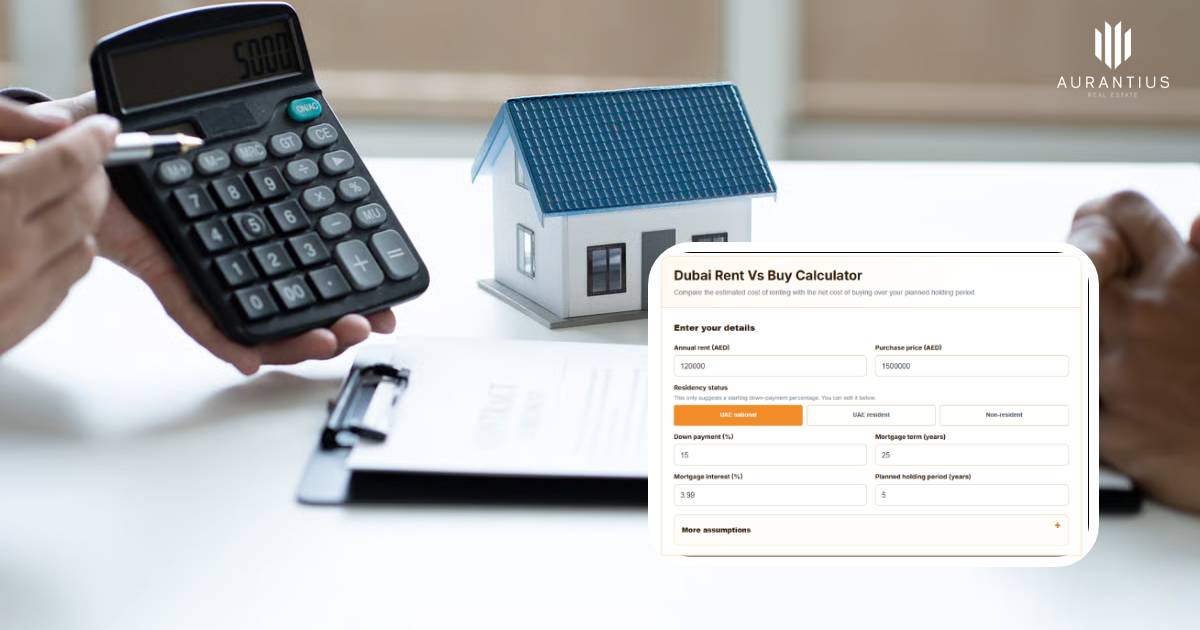
Dubai Rent vs Buy Calculator
Dubai Rent vs Buy Calculator
Compare the estimated cost of renting with the net cost of buying over your planned holding period.
More assumptions
Calculating…
View buying cost breakdown
| Down payment | AED 0 |
| Acquisition costs | AED 0 |
| Mortgage interest paid | AED 0 |
| Service + maintenance | AED 0 |
| Estimated future property value | AED 0 |
| Mortgage balance at exit | AED 0 |
| Net sale proceeds after selling costs | AED 0 |
Estimates only. Actual mortgage rates, DLD/broker/trustee/valuation costs, service charges, insurance, maintenance and mortgage rules may vary. This calculator is for general information and is not financial, legal, tax or investment advice.
The Crossover Benchmarks: When Buying Starts to Win
Using a 5-year holding period, 20% down payment, 25-year mortgage tenure and a model fixed mortgage rate of 3.99%, the ownership break-even point becomes surprisingly clear.
For an entry-level AED 1.5 million property, buying starts to beat renting when a comparable home rents for more than approximately AED 3,713 per month, or AED 44,556 per year.
For a mid-tier AED 2.5 million property, buying starts to beat renting when comparable rent exceeds approximately AED 5,872 per month, or AED 70,464 per year.
For a premium AED 4 million property, buying starts to beat renting when comparable rent exceeds approximately AED 9,236 per month, or AED 110,832 per year.
These numbers do not mean buying is always better. They mean that once rent crosses those thresholds, the long-term financial case for ownership becomes stronger because rent becomes a larger unrecoverable cost than the net unrecoverable cost of buying.
Benchmark Table: Rent vs Buy in Dubai
| Property Price | 20% Down Payment | Monthly Mortgage | 5-Year Sunk Ownership Costs | 5-Year Expected Appreciation | Buying Wins If Rent Exceeds |
|---|---|---|---|---|---|
| AED 1,500,000 | AED 300,000 | AED 6,327 | AED 461,716 | AED 238,911 | AED 3,713 / month |
| AED 2,500,000 | AED 500,000 | AED 10,546 | AED 750,527 | AED 398,185 | AED 5,872 / month |
| AED 4,000,000 | AED 800,000 | AED 16,873 | AED 1,191,242 | AED 637,096 | AED 9,236 / month |
This model assumes an 80% loan-to-value mortgage, a 25-year tenure, 3.99% fixed interest, 7.2% upfront acquisition costs, 2.1% selling friction, total loan interest over five years, and annual service or maintenance costs.
The numbers should be treated as a framework. Your actual result depends on the property price, rent, mortgage rate, loan tenure, service charges, maintenance, capital growth and how long you plan to stay in Dubai.
Why the Monthly Mortgage Is Not the Full Story
A common mistake is comparing monthly rent directly against monthly mortgage payment. That comparison is incomplete.
A mortgage payment is partly a cost and partly forced savings. In the early years, more of the payment goes to interest. Over time, a larger portion goes to principal repayment.
For example, on a AED 2.5 million property with a AED 2 million mortgage, the monthly mortgage may be around AED 10,546 in this model. But not all of that is “lost.” A portion reduces the loan balance and becomes owner equity.
Rent, by contrast, is simpler. If you pay AED 10,000 per month in rent, AED 10,000 is gone every month. There is no principal paydown and no ownership stake created.
This is why ownership can beat renting even when the mortgage payment looks higher than rent. The correct comparison is unrecoverable cost versus unrecoverable cost.
The Hidden Sunk Costs of Buying in Dubai
Buying property in Dubai has heavy upfront costs. These are the costs that buyers must understand before they assume ownership is automatically cheaper.
The main upfront cost is the Dubai Land Department transfer fee, commonly calculated at 4% of the property value. Buyers must also account for broker commission, mortgage registration, trustee charges, valuation fees and bank-related charges.
In practical terms, acquisition friction can often reach around 6.5% to 7.5% of the purchase price before considering furnishing, moving, renovation or maintenance reserves.
This matters because upfront costs must be recovered over time through rent savings, equity creation and capital appreciation. If you sell too quickly, those costs can make renting the better financial decision.
Dubai Land Department Upfront Fees: What Buyers Must Budget
A serious rent vs buy calculation must include all acquisition costs, not only the down payment.
For a ready property purchase, buyers should normally budget for the 4% DLD transfer fee, trustee office fee, title deed issuance fee, valuation fee, broker commission and mortgage registration if financing is used.
Mortgage registration is especially important because it is calculated separately on the loan amount. A buyer using an 80% mortgage on a high-value property should not ignore this cost.
The practical lesson is clear: buying a AED 2.5 million property does not mean you only need AED 500,000 for a 20% down payment. You need the down payment plus transaction costs, moving costs, service charges and a liquidity buffer.
For financing details, read Mortgage Loans in Dubai for Residents and Non-Residents: 2026 Guide.
Service Charges: The Cost Most Buyers Underestimate
Service charges can materially change the rent vs buy equation in Dubai.
When you rent, the landlord usually carries the main ownership obligations. When you own, you become responsible for service charges, building maintenance contributions and unit-level upkeep.
Premium high-rise communities such as Dubai Marina, Downtown Dubai and JBR may carry higher service charges because of amenities, lifts, common areas, pools, gyms, cooling systems, security and building management.
Mid-tier communities such as JVC, Al Furjan and Dubai Silicon Oasis can sometimes produce a faster ownership break-even because purchase prices and service charges may be more manageable relative to rent.
Villa and townhouse communities may show lower service charges per square foot, but owners must budget for private maintenance such as gardens, pools, roofs, AC systems and exterior repairs.
The 4-to-7-Year Rule
Because buying has large upfront costs, renting usually makes more sense if your stay horizon is short.
If you may leave Dubai, relocate to another community, change job location or upgrade family requirements within one to three years, renting often preserves flexibility and avoids transaction friction.
Buying becomes more compelling when you plan to hold or live in the property for at least four to seven years. This gives enough time for rent savings, principal repayment and potential capital appreciation to offset upfront and exit costs.
The longer you hold, the stronger the ownership case can become, assuming the asset is well chosen and the mortgage remains affordable.
Granular Example: AED 2.5M Property Over 5 Years
A mid-tier AED 2.5 million property is a useful example because it reflects a common Dubai buyer profile: a resident or investor considering a standard two-bedroom apartment or family-ready unit.
Assume a 20% down payment of AED 500,000 and an 80% mortgage of AED 2 million over 25 years. At a model interest rate of 3.99%, the monthly mortgage payment is approximately AED 10,546.
Over five years, the buyer faces acquisition fees, mortgage interest, service charges, maintenance and eventual exit costs. But the buyer also builds equity through principal paydown and may benefit from capital appreciation.
This is why the break-even rent is not AED 10,546 per month. It is much lower, because part of the mortgage payment is not lost; it becomes equity.
AED 2.5M Property: Sunk Cost Breakdown
For the AED 2.5 million example, total five-year sunk ownership costs may include approximately AED 165,280 in upfront acquisition costs, AED 374,527 in mortgage interest, AED 120,000 in service charges and maintenance, and AED 50,000 in future selling fees.
That creates a total ownership sunk-cost base of around AED 709,807 before accounting for appreciation.
If the property appreciates at a conservative 3% compounded annually, the estimated capital appreciation over five years is approximately AED 398,185.
The net sunk cost of buying then becomes:
AED 709,807 total sunk costs – AED 398,185 appreciation = AED 311,622 net unrecoverable buying cost
Dividing AED 311,622 across 60 months creates a true break-even rent of approximately AED 5,194 per month in this more granular example. If renting a comparable property costs more than that, buying starts to win financially.
Mortgage Amortization: Where Your Monthly Payment Goes
Mortgage amortization is one of the main reasons ownership can outperform renting over time.
At the start of a mortgage, a larger share of the payment goes to interest. For a AED 2 million loan at 3.99%, the first monthly payment may include around AED 6,650 in interest and AED 3,896 in principal repayment.
By month 60, the interest portion may fall to around AED 5,745 while principal repayment rises to about AED 4,801. By year 10, the principal portion can become even larger, accelerating equity accumulation.
This means ownership improves with time. The buyer is not just paying for shelter. The buyer is gradually shifting more of the monthly payment into personal net worth.
Opportunity Cost: The Missing Link in Most Rent vs Buy Calculators
A serious calculation must also include opportunity cost.
If you buy a AED 2.5 million property, you may deploy AED 500,000 as down payment plus more than AED 160,000 in upfront costs. That is a large amount of capital locked into property.
If you rent instead, that same capital could remain invested elsewhere. It could be held in cash, used in a business, invested in public markets, or kept as emergency liquidity.
This matters because buying must outperform not only rent, but also the alternative return your cash could have earned. A property that barely beats rent may still underperform if your down payment could have generated strong returns elsewhere.
The correct question is: after rent savings, appreciation, principal paydown and opportunity cost, which option gives the stronger financial result?
Fixed vs Variable Mortgage Rates in the UAE
Mortgage rate structure can significantly affect the rent vs buy decision.
Many UAE mortgages offer a fixed rate for a specific period, such as one, three or five years. After that, the loan may move to a variable rate linked to EIBOR plus a bank margin.
This creates payment risk. A buyer may qualify comfortably at 3.99%, but if the rate later moves higher, the monthly instalment can rise. On large loans, even a 2% increase can materially change affordability.
That is why every buyer should stress-test the mortgage. Do not calculate affordability only at the teaser or fixed-period rate. Run a scenario where the rate increases after the fixed period and ask whether ownership still beats renting.
For mortgage planning, read Mortgage Loans in Dubai for Residents and Non-Residents.
RERA Rent Hikes: Why Renters Feel Pressure
Dubai renters often focus on flexibility, but rent volatility can become a serious financial burden.
If rents rise every renewal cycle, the cost of renting can compound quickly. This is especially important in popular communities where demand remains strong and comparable market rents move higher.
Ownership creates a different risk profile. Mortgage payments may be more stable during the fixed-rate period, but ownership introduces service charges, maintenance and interest-rate risk after the fixed term.
The trade-off is clear. Renting offers flexibility but exposes you to rent inflation. Buying offers stability and equity, but requires capital, discipline and a longer time horizon.
Location Matters: Dubai Marina, JVC, Villas and Service Charges
The rent vs buy equation changes sharply by location.
In premium high-rise areas such as Dubai Marina, Downtown Dubai and JBR, service charges can be higher, but rental demand and liquidity may also be strong. Buying usually makes more sense if the buyer plans to stay longer or expects meaningful capital appreciation.
In mid-tier communities such as JVC, Al Furjan and Dubai Silicon Oasis, lower purchase prices and strong rental demand can accelerate the break-even timeline, especially if service charges are controlled and the unit is efficiently priced.
In villa and townhouse communities, service charges may be lower per square foot, but owners should budget more for personal maintenance. Gardens, roofs, AC systems, pools and exterior repairs are the owner’s responsibility.
This is why a rent vs buy calculator must be community-specific. A general Dubai average can mislead buyers.
For yield and area analysis, read Best Dubai Areas for Rental Yield and Capital Growth in 2026.
Ready Property vs Off-Plan: Which Works Better for Rent vs Buy?
For end-users comparing rent and buy, ready property usually gives clearer math than off-plan.
A ready property can be inspected, valued by a bank, financed, transferred and occupied. The service charges are known, the building exists, and the buyer can compare actual rent or resale data.
Off-plan property can work for investors seeking staged payments and future growth, but it does not solve the immediate rent-vs-buy problem unless the buyer is willing to continue renting during construction.
For a resident trying to stop paying rent now, a ready property or vacant-on-transfer unit usually provides the cleanest ownership pathway.
For ready-home strategy, read Buy Ready Property in Dubai 2026: The Secondary Market Blueprint for End-Users.
When Renting Is the Better Choice
Renting is better if your Dubai stay is uncertain, your job location may change, your family size may change, or you expect to relocate within one to three years.
Renting may also be better if paying the down payment and acquisition costs would leave you with no emergency savings. Property ownership should not remove your liquidity buffer.
Renting can also make sense if you expect a local property correction, if service charges are very high, or if the property you would buy is not strong enough to justify its price.
Financially, renting is not always “wasted money.” It can be the price of flexibility, liquidity and lower operational risk.
When Buying Is the Better Choice
Buying is better if you plan to stay in Dubai for at least four to seven years, have sufficient upfront capital, and can handle maintenance, service charges and mortgage stress tests.
Buying is also stronger when your current rent is high relative to the purchase price of a comparable property. The higher your rent, the faster ownership can become financially superior.
Ownership can be especially attractive for families who want housing stability, freedom to renovate, protection from rental increases and long-term exposure to Dubai property appreciation.
For investors, buying can make sense when the property offers strong net yield, realistic capital appreciation and clear exit liquidity.
The Rent vs Buy Decision Matrix
| Factor | Buying Is Better If… | Renting Is Better If… |
|---|---|---|
| Timeline | You plan to stay or hold for 4+ years. | You may relocate within 1 to 3 years. |
| Liquidity | You have down payment, fees and emergency savings. | Buying would use all available cash. |
| Monthly Cost | Rent exceeds the ownership break-even threshold. | Rent is far below comparable ownership cost. |
| Market Outlook | You expect stable or positive capital growth. | You expect local price stagnation or correction. |
| Lifestyle | You want control, renovation freedom and housing stability. | You want mobility and no maintenance responsibility. |
Tax and Exit Strategy: What Expats Must Consider
Dubai does not impose local capital gains tax on standard property sales for individual owners, but expats must consider their home-country tax rules.
A buyer who later returns to the UK, Europe, the US or another jurisdiction may face tax obligations depending on residency, citizenship, reporting rules and timing of sale.
This is especially important for US citizens, who are generally taxed on worldwide income, and for buyers who remain tax resident elsewhere while owning Dubai property.
A proper rent vs buy decision should therefore include not only mortgage and rent math, but also exit planning, tax advice and future liquidity.
Aurantius View: Use Hard Math, Not Emotion
The phrase “stop paying your landlord’s mortgage” is emotionally powerful but financially incomplete.
Buying property in Dubai can be an excellent long-term decision, but only when the numbers work. The buyer must calculate upfront fees, interest, service charges, opportunity cost, holding period, mortgage stress and capital appreciation.
For many residents, buying becomes stronger when they plan to stay for at least four to seven years and when comparable rent is high enough to exceed the true ownership break-even threshold.
For short-term residents, uncertain job situations or buyers without liquidity buffers, renting may remain the safer financial decision.
At Aurantius Real Estate, the goal is not to push every renter into buying. The goal is to help clients compare the real numbers and choose the option that protects their capital.
FAQ: Dubai Rent vs Buy Calculator
Question: Is it cheaper to rent or buy in Dubai?
Answer: It depends on rent level, purchase price, mortgage rate, service charges, upfront fees and how long you plan to stay. Buying usually becomes stronger if you hold for at least four to seven years and your rent exceeds the break-even threshold.
Question: What is the Dubai rent vs buy break-even point?
Answer: In the model used here, buying starts to beat renting at around AED 3,713 per month for a AED 1.5M property, AED 5,872 per month for a AED 2.5M property, and AED 9,236 per month for a AED 4M property.
Question: How long should I stay in Dubai to justify buying?
Answer: A holding period of four to seven years usually gives ownership enough time to offset upfront fees through rent savings, principal paydown and potential capital appreciation.
Question: What are the hidden costs of buying property in Dubai?
Answer: Hidden or additional costs include DLD transfer fee, broker commission, mortgage registration, trustee charges, valuation fees, service charges, maintenance, insurance, furnishing, moving costs and future selling fees.
Question: Is a mortgage payment the same as rent?
Answer: No. Rent is fully unrecoverable. A mortgage payment includes interest, which is a cost, and principal, which builds equity by reducing your loan balance.
Question: Should I choose a fixed or variable mortgage in Dubai?
Answer: Fixed rates provide payment stability during the fixed period, while variable rates can change with EIBOR and bank margins. Buyers should stress-test affordability before choosing either structure.
Question: Is buying ready property better than off-plan for rent vs buy?
Answer: Ready property is usually better for a rent-vs-buy comparison because it can be inspected, financed, transferred and occupied immediately. Off-plan may require the buyer to keep renting until handover.
Question: Can Aurantius help calculate whether I should rent or buy?
Answer: Yes. Aurantius Real Estate can help compare your rent, target property price, mortgage options, service charges, holding period and expected capital growth to determine whether buying or renting makes stronger financial sense.
Conclusion: Buying Wins When the Math, Timeline and Liquidity Align
Dubai’s rent vs buy decision should never be made emotionally. It is a balance sheet decision.
Renting gives flexibility, simplicity and liquidity. Buying gives stability, equity creation and exposure to capital appreciation. Neither option is automatically superior.
Buying becomes financially stronger when your rent is high, your holding period is long, your mortgage is affordable, your upfront costs are manageable, and the property has strong long-term demand.
Renting remains smarter when your stay is short, your job or location is uncertain, your cash reserves are limited, or the property you would buy has weak fundamentals.
The right answer comes from hard math. Calculate the true unrecoverable cost of buying, compare it with rent, stress-test your mortgage and decide based on your actual financial position.
Aurantius Real Estate helps Dubai residents, expats and investors compare rent vs buy scenarios, mortgage options, ready properties, service charges, rental yields and long-term ownership strategies.
Renting or Buying in Dubai? Speak with an Aurantius adviser to calculate your personal break-even point, compare ready properties, review mortgage options and decide whether ownership makes financial sense for your timeline.
Related reading: UAE Rent vs Buy, Buy Ready Property in Dubai 2026, Mortgage Loans in Dubai, Dubai Real Estate Expert Forecast 2026 and Best Dubai Areas for Rental Yield and Capital Growth.