
Dubai Tasreef Phase 3: Which Areas Are Getting New Drainage Infrastructure?
Dubai is moving into the third phase of its AED 30 billion Tasreef stormwater programme, with four new infrastructure contracts worth a combined AED 3 billion covering some of the emirate’s most established residential, commercial, tourism and industrial districts.
Announced by Dubai Municipality on 25 October 2026, the new works involve the construction and extension of approximately 100 kilometres of stormwater drainage lines across nearly 100 square kilometres.
The Phase 3 packages cover areas including Jumeirah, Umm Suqeim, Al Safa, Al Manara, Al Quoz, Al Barsha, Al Wasl, Za’abeel, Al Bada’a, Al Satwa and Al Marmoom.
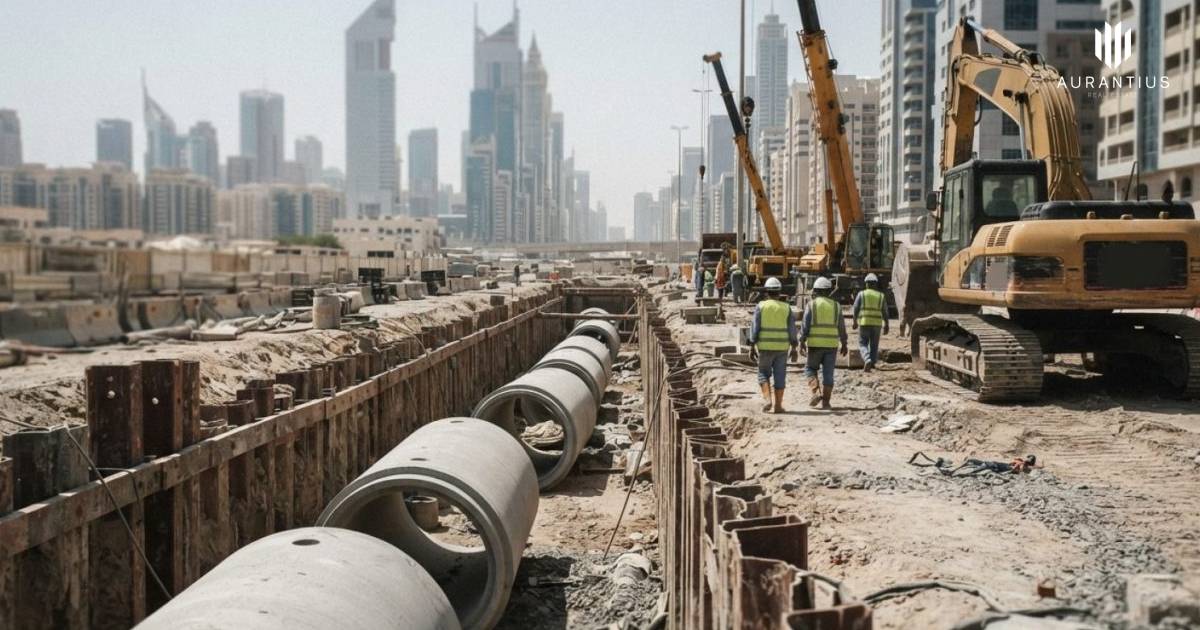
Pipelines will reach diameters of up to three metres and connect local catchments more effectively into Dubai’s wider stormwater drainage system.
For residents and property investors, the immediate story is drainage capacity and climate resilience. The longer-term property question is more nuanced: better infrastructure can improve the reliability and utility of a location, but it does not automatically guarantee higher property prices.
That distinction is important when analysing any major infrastructure investment. Aurantius examines the same principle in its Dubai Real Estate 2026: Brand vs Infrastructure Premium analysis.
Tasreef Phase 3 — Key Numbers
Phase 3 contract value: AED 3 billion
Number of contracts: 4
Drainage lines: Approximately 100 km
Coverage: Nearly 100 sq. km
Maximum pipe diameter: Up to 3 metres
Wider Tasreef programme: AED 30 billion
Programme drainage-capacity target: +700%
Which Areas Are Included in Tasreef Phase 3?
The approximately 100 kilometres of drainage works are divided across four major geographic packages.
| Phase 3 Package | Areas Covered | Approx. Network Length |
|---|---|---|
| Jumeirah & Umm Suqeim | Umm Suqeim 1, 2 & 3, Umm Al Sheif, Jumeirah 3, Al Safa 1 & 2, Al Manara | 42 km |
| Al Marmoom | Al Marmoom sector and surrounding infrastructure | 23 km |
| Al Wasl Road Corridor | Za’abeel 2, Al Wasl, Jumeirah 1 & 2, Al Bada’a, Al Satwa, DWTC 1 & 2 | 21 km |
| Sheikh Zayed Road–Al Khail Road Corridor | Al Quoz Industrial Areas 1, 3 & 4, Al Barsha 1 and connecting strategic roads | 14 km |
1. Jumeirah and Umm Suqeim Get the Largest Phase 3 Package
The largest Phase 3 package is the new stormwater drainage network serving Jumeirah and Umm Suqeim.
Approximately 42 kilometres of main drainage lines will serve Umm Suqeim 1, 2 and 3, Umm Al Sheif, Jumeirah 3, Al Safa 1 and 2 and Al Manara.
These are mature coastal communities rather than newly planned growth districts. That makes the investment notable because the objective is not simply to enable future development; it is also to strengthen infrastructure beneath already-established residential and tourism corridors.
For property owners, improved drainage should primarily be viewed as a resilience and service-quality upgrade. It would be too simplistic to translate AED 3 billion of citywide infrastructure spending directly into a specific percentage increase in villa or apartment values.
2. Al Marmoom Gets 23 km of New Drainage Infrastructure
Al Marmoom represents the second-largest package by network length, with approximately 23 kilometres of new stormwater drainage infrastructure.
Dubai Municipality describes the project as an integrated and sustainable drainage network intended to improve service continuity and support the area’s future urban infrastructure.
The Al Marmoom package is structurally different from the dense coastal works in Jumeirah because it serves a more inland environment with a different development pattern and future infrastructure requirement.
3. Al Wasl Road Network Covers a 25 sq. km Catchment
Another major project will install approximately 21 kilometres of main and secondary stormwater lines along the Al Wasl Road corridor.
Dubai Municipality says this network will cover a catchment of up to 25 square kilometres east of Dubai Water Canal.
The affected districts include:
Za’abeel 2
Al Wasl
Jumeirah 1 and Jumeirah 2
Al Bada’a
Al Satwa
Dubai World Trade Centre 1 and 2
The project includes both main and secondary conveyance infrastructure, giving the system more flexibility when moving large volumes of stormwater through dense urban areas.
4. Al Quoz and Al Barsha Get 14 km Between Sheikh Zayed Road and Al Khail Road
The fourth package focuses on the corridor between Sheikh Zayed Road and Al Khail Road.
Approximately 14 kilometres of main drainage lines will serve Al Quoz Industrial Areas 1, 3 and 4 and Al Barsha 1.
The project also covers important road connections including the Al Khail Road interchange towards Umm Suqeim, Umm Suqeim Road, First Al Khail Street, Al Marabea Street, Al Waha Street, Al Zumurrud Street and connecting secondary roads.
This is particularly relevant to Al Quoz because the area combines warehouses, industrial businesses, commercial destinations, galleries and increasing mixed economic activity. Reliable drainage infrastructure therefore supports not only residential accessibility but industrial and logistics operations as well.
What Is the Wider AED 30 Billion Tasreef Programme?
Phase 3 is only one part of the much larger Tasreef Programme.
Dubai Municipality is implementing Tasreef as a citywide integrated stormwater collection and drainage programme with a total planned investment of approximately AED 30 billion.
The programme is designed to increase Dubai’s stormwater drainage capacity by approximately 700% and reduce costs associated with pumping-station construction, operations and maintenance by around 20%.
Its importance extends beyond individual roads or communities. Tasreef is a long-term city-resilience project intended to support urban expansion while creating a more integrated response to heavy rainfall and changing climate conditions.
This wider infrastructure-led growth story is also visible across transport, aviation, utilities and major public works. Aurantius recently examined the bigger investment pipeline in Dubai’s AED 2.1 Trillion Projects: Property Investor Guide 2026.
How Much Has Dubai Awarded Across the First Three Tasreef Phases?
| Tasreef Phase | Announced Contract Value | Announcement |
|---|---|---|
| Phase 1 | Approx. AED 1.439B | April 2025 |
| Phase 2 | AED 2.5B | February 2026 |
| Phase 3 | AED 3.0B | October 2026 |
| Total Announced Across These Packages | Approx. AED 6.939B | Part of AED 30B master programme |
The AED 6.939 billion figure represents the value of these announced contract packages, not the complete eventual cost of the Tasreef programme.
Which Contractors Are Working on Phase 3?
The four Phase 3 contracts have been awarded across four major infrastructure contractors:
ARIFCO Group
China State Construction Engineering Corporation Middle East
DETech Contracting LLC
Nael Construction & Contracting
Dubai Municipality’s main public announcement names the four contractors but does not provide a complete official contractor-to-package allocation in that announcement. Buyers and businesses should therefore avoid relying on unverified package assignments where exact contractor responsibility matters.
Will Tasreef Phase 3 Increase Property Prices?
Infrastructure investment can improve the long-term utility and resilience of an area, but there is no credible basis for saying that Tasreef Phase 3 will automatically create a specific percentage increase in property values.
Drainage is different from a new Metro station or retail destination. Its main economic benefit is defensive: better stormwater management can reduce disruption, improve service continuity and strengthen the resilience of roads, communities and commercial assets during periods of intense rainfall.
| Potential Infrastructure Benefit | Property-Market Interpretation |
|---|---|
| Improved stormwater capacity | Can strengthen the reliability of established communities |
| Reduced water accumulation risk | Potentially reduces disruption to homes, roads and businesses |
| Higher infrastructure resilience | Can support long-term location quality and occupier confidence |
| AED 3B government investment | Important location signal, but not a guaranteed capital-gain percentage |
Aurantius has previously analysed how infrastructure changes real-estate demand in Dubai Infrastructure Push: Blue Line, Roads & Hubs.
Tasreef vs Metro Infrastructure: Investors Should Value Them Differently
Not all infrastructure creates property value in the same way.
A Metro line can directly reduce commuting time and expand the number of jobs, schools and destinations accessible without a car. That can create an identifiable accessibility premium around individual stations.
Stormwater infrastructure operates differently. Its value is more closely connected to resilience, reliability and the quality of underlying city systems.
Both can matter to real estate, but investors should not price them in using the same assumptions.
For comparison, Aurantius’ Dubai Metro Blue Line Property Prices 2026 guide explains how transport infrastructure can influence demand while still avoiding guaranteed appreciation claims.
What Should Property Owners in the Affected Areas Expect?
The new underground drainage infrastructure requires substantial civil-engineering work.
However, Dubai Municipality’s 25 October announcement does not provide a detailed road-by-road construction schedule or a complete set of traffic-diversion dates for the Phase 3 projects.
Residents and businesses in affected corridors should therefore rely on subsequent Dubai Municipality and Roads and Transport Authority notices for confirmed diversions, lane changes and local access arrangements as construction progresses.
Residents: Monitor local access and traffic notices during construction.
Landlords: Keep tenants informed if works affect building access.
Retailers: Monitor temporary changes to parking and customer access.
Industrial operators: Plan delivery and logistics routes around confirmed construction notices.
Property buyers: Distinguish temporary construction inconvenience from the long-term infrastructure benefit.
Why Tasreef Matters to Dubai’s Long-Term Property Strategy
Dubai’s real estate market is supported by more than new towers and master communities.
Roads, Metro networks, airports, electricity, water, sewage and stormwater drainage all influence how efficiently a city can support additional residents, visitors and businesses.
That is why infrastructure should be part of property due diligence even where it does not produce a direct marketing headline.
The strongest property case is generally not “the government is spending money here, therefore prices must rise.” It is whether the infrastructure makes the location more functional, resilient and competitive relative to the property’s current purchase price.
FAQ: Dubai Tasreef Phase 3
Question: What is Dubai Tasreef Phase 3?
Answer: Phase 3 is the latest set of stormwater infrastructure projects under Dubai’s AED 30 billion Tasreef Programme. Four contracts worth AED 3 billion were announced on 25 October 2026.
Question: Which areas are included in Phase 3?
Answer: The projects cover areas including Jumeirah, Umm Suqeim, Al Safa, Al Manara, Al Quoz, Al Barsha, Al Wasl, Za’abeel, Al Bada’a, Al Satwa and Al Marmoom.
Question: How much drainage infrastructure is being built?
Answer: Phase 3 involves approximately 100 kilometres of new or extended stormwater drainage lines across nearly 100 square kilometres.
Question: Which area gets the largest Phase 3 drainage package?
Answer: Jumeirah and Umm Suqeim receive the largest package, with approximately 42 kilometres of main stormwater drainage lines.
Question: How much does the whole Tasreef Programme cost?
Answer: Dubai Municipality places the total Tasreef Programme investment at AED 30 billion.
Question: How much will Tasreef increase drainage capacity?
Answer: Dubai Municipality says the full programme is designed to increase Dubai’s stormwater drainage capacity by approximately 700%.
Question: Will Tasreef Phase 3 increase house prices?
Answer: There is no guaranteed percentage uplift. Improved drainage can strengthen a community’s resilience and infrastructure quality, but property values still depend on location, property type, supply, demand, condition and purchase price.
Question: Will there be road diversions during construction?
Answer: Large underground drainage works can require local traffic management, but the initial Phase 3 announcement did not publish a full road-by-road diversion timetable. Residents should follow official Dubai Municipality and RTA notices for confirmed changes.
Conclusion: Tasreef Phase 3 Is a Resilience Investment, Not a Property-Price Guarantee
Tasreef Phase 3 is one of Dubai’s largest active urban-resilience investments, directing AED 3 billion into approximately 100 kilometres of stormwater infrastructure across major established communities and commercial corridors.
Jumeirah and Umm Suqeim receive the largest package at around 42 kilometres, followed by Al Marmoom with 23 kilometres, Al Wasl Road with 21 kilometres and the Sheikh Zayed Road–Al Khail Road corridor with 14 kilometres.
For Dubai as a city, the objective is clear: increase drainage capacity, reduce water accumulation risk and build infrastructure capable of supporting future urban growth and more demanding weather conditions.
For property owners and investors, the interpretation should remain disciplined.
Better drainage can strengthen the long-term quality and resilience of a community. It can protect accessibility and improve the reliability of underlying infrastructure. But it does not automatically make every villa, apartment, warehouse or commercial unit in the affected areas a better investment at any price.
Property investor takeaway: Treat Tasreef Phase 3 as an improvement to the underlying quality of the affected locations. Then assess the individual property’s entry price, building quality, flood exposure, accessibility, competing supply and tenant or buyer demand before assigning any infrastructure premium.