
Dubai Metro Blue Line Property Prices: The Data Driving 2026 Investment Decisions
Dubai’s AED 20.5 billion Metro Blue Line is moving from infrastructure announcement to physical construction, making its potential effect on property increasingly relevant to buyers making decisions in late 2026.
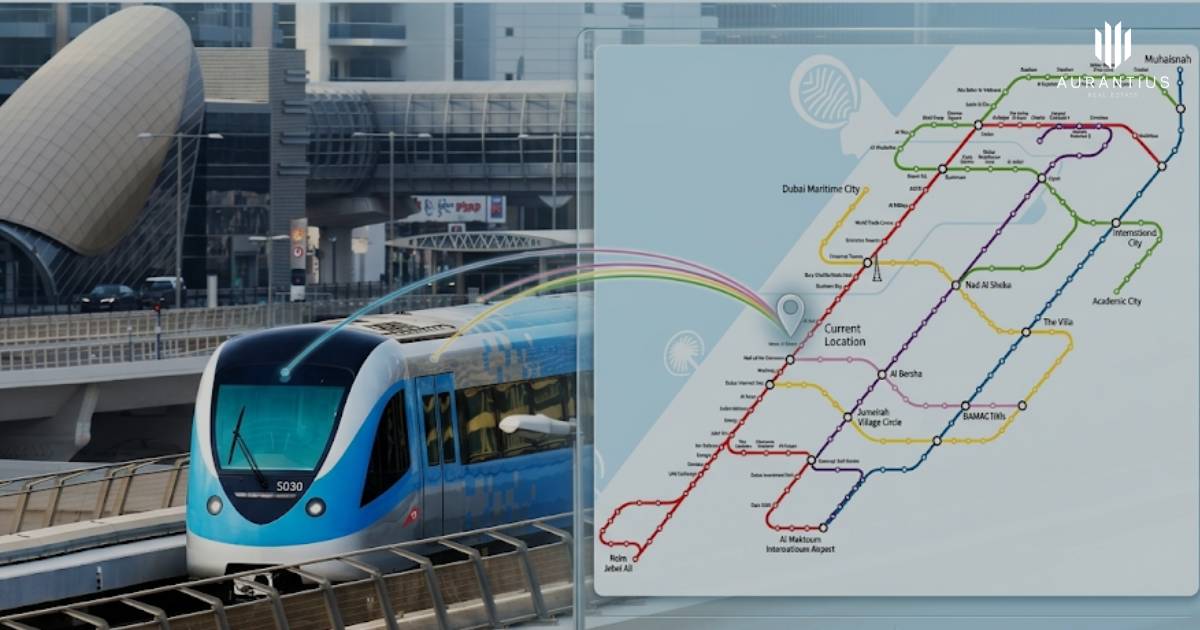
The 30-kilometre network will contain 14 stations and connect the existing Red and Green Metro lines while serving major eastern growth districts including Dubai Creek Harbour, Ras Al Khor, International City, Dubai Silicon Oasis, Academic City, Mirdif and Al Warqa.
The opening remains scheduled for 9 September 2029, while Roads and Transport Authority planning targets construction progress of around 30% by the end of 2026.
For property investors, however, the strongest headline is not simply the construction percentage. RTA has stated that the Blue Line could increase land and property values around stations by up to 25%. That is a network-level planning estimate, not a guaranteed return for every apartment located somewhere along the route.
Aurantius has previously examined the wider network in Dubai New 30km Metro Blue Line to Launch in 2029. The 2026 investment question is now more specific: which properties actually justify paying a Metro premium before the trains begin operating?
Dubai Metro Blue Line: Key Investment Facts
Project value: AED 20.5 billion
Route length: 30 km
Stations: 14
Underground section: Approx. 15.5 km
Above-ground section: Approx. 14.5 km
Target opening: 9 September 2029
2040 population served: Around 1 million people across the serviced districts
Projected daily ridership: Around 200,000 in 2030, rising toward 320,000 by 2040
RTA property-value estimate: Up to 25% uplift around stations
Why the Blue Line Matters More Than a Normal Infrastructure Announcement
Many Dubai property launches are marketed around future roads, schools, retail or transport connections. The Blue Line is materially different because it is an officially funded, contracted and under-construction mass-transit project with a defined route and planned operational date.
That gives investors substantially greater infrastructure certainty than a proposed transport corridor that remains at study or concept stage.
The Blue Line also connects with both existing Metro networks. The route links to the Green Line at Creek, the Red Line at Centrepoint and includes a major interchange at International City 1.
This matters because Metro value is not created by a station in isolation. A station becomes more useful when it gives residents practical access to employment districts, existing transport networks, airports, schools, universities, retail and other daily destinations.
That is why Aurantius distinguishes between paying for marketing and paying for measurable urban utility in Dubai Real Estate 2026: Brand Premium vs Infrastructure Premium.
The 25% Property-Value Estimate Needs to Be Interpreted Correctly
RTA has stated that land and property values around Blue Line stations could increase by up to 25%. This is one of the most important figures associated with the project, but it is also one of the easiest to misuse in real estate marketing.
“Up to 25%” does not mean every property in Dubai Silicon Oasis, International City or Dubai Creek Harbour will appreciate by 25%.
The eventual impact should vary according to actual walking distance, quality of pedestrian access, station importance, existing transport alternatives, property type, supply, purchase price and how much of the Metro benefit has already been priced into today’s transaction.
A building located five minutes from an interchange station can have a materially different investment case from another project marketed as “Blue Line connected” even though residents would still need a car or feeder bus to reach the station.
2026 Is the Construction Phase, Not the Operating Phase
Infrastructure-related property performance usually develops through stages rather than appearing only when the transport system opens.
The announcement stage can generate speculative demand immediately. The construction stage gives buyers increasing confidence that infrastructure is physically being delivered. The final pre-opening and operational stages allow the market to see how residents actually use the network.
Dubai is currently in the construction phase for the Blue Line. That can create an interesting buying window, but calling it a guaranteed “construction discount” would be too simplistic.
Some developments may still be reasonably priced because the full transport benefit is years away. Others may already carry aggressive premiums because developers and sellers have incorporated the future Metro into their asking prices.
The investor’s task is therefore not to buy before 2029 at any price. It is to determine whether today’s purchase price has already absorbed too much of tomorrow’s infrastructure benefit.
Which Areas Will the Dubai Metro Blue Line Serve?
| Area | Current Property Profile | Potential Metro Benefit |
|---|---|---|
| International City | Affordable, high-density apartment market | Major interchange and substantially improved network access |
| Dubai Silicon Oasis | Technology, employment and residential hub | Reduces dependence on private cars and improves commuter access |
| Dubai Academic City | Education-led district | Better connectivity for students, staff and nearby housing |
| Dubai Creek Harbour | Premium waterfront master community | Direct Metro access strengthens an already premium lifestyle location |
| Mirdif / Al Warqa | Established family-oriented communities | Improved end-user mobility and access to the wider Metro network |
| Ras Al Khor / Festival City Corridor | Mixed residential, commercial and growth corridor | Stronger connection between eastern Dubai and existing transport infrastructure |
International City: Potentially the Biggest Accessibility Transformation
International City may experience one of the largest changes in transport utility because the Blue Line gives the district much deeper integration with the wider Dubai Metro network.
International City 1 is planned as a major interchange. This is more significant than simply having a conventional station because an interchange concentrates passenger movement and connects multiple route directions.
The investment case is therefore relatively easy to understand: an established affordable apartment market that has historically relied heavily on road transport gains direct rail connectivity.
But investors still need to compare individual clusters. Not every apartment in International City will have the same walking access to a station, and older buildings may face different maintenance, service-charge and tenant-demand conditions.
A low purchase price and future Metro station can be attractive, but building quality and real rental performance remain essential.
Dubai Silicon Oasis: From Car-Dependent Hub to Metro-Connected District
Dubai Silicon Oasis has a different investment profile. It already functions as a mixed employment, residential, education and technology district.
The Blue Line therefore does not need to create demand from zero. Its potential value is in improving accessibility to an existing employment and residential ecosystem.
That can matter to tenants because commuting convenience forms part of the total cost and practicality of renting a home. An apartment that allows a resident to reduce daily reliance on a car can become more attractive even when two competing buildings offer similar internal specifications.
Investors should still avoid buying solely on the phrase “Silicon Oasis Metro.” The correct question is whether the specific building has practical pedestrian access to the future station and whether its purchase price still produces a sensible rental return.
Dubai Creek Harbour: Metro Utility Meets Premium Waterfront Pricing
Dubai Creek Harbour represents the premium end of the Blue Line property spectrum.
The district will host an iconic 74-metre-high Metro station, designed by Skidmore, Owings & Merrill. RTA describes it as the world’s highest Metro station.
The investment logic differs from International City. Buyers are not purchasing an affordable district waiting for basic connectivity. Creek Harbour already carries a waterfront and master-community premium.
The Metro therefore strengthens an existing premium proposition rather than creating the entire investment case.
That also makes valuation more important. If a buyer pays a significant future-infrastructure premium today, there may be less unpriced upside remaining when the station becomes operational.
Academic City: Rental Demand Could Be More Important Than Prestige
Academic City has a different potential beneficiary: students, university employees, education-sector workers and residents commuting through the eastern corridor.
Better public transport can increase the practical radius from which universities and employers can attract residents and workers. For nearby housing, this can increase tenant choice and reduce dependence on private vehicles.
Investors evaluating student-oriented or compact residential property should nevertheless focus on actual leasing regulations, unit quality and supply. A station can improve demand, but it does not prevent competing projects from entering the market.
The Walkability Rule Matters More Than Straight-Line Distance
One of the biggest infrastructure-investment mistakes is measuring distance to a Metro station on a map rather than testing the route a resident will actually walk.
A building may be geographically close to a future station but separated by a major road, construction plot, inaccessible boundary or uncomfortable pedestrian route.
Another building slightly farther away may have a direct shaded pavement and safe crossings, making it functionally more accessible.
Before Paying a Metro Premium, Check:
Actual station entrance: Not simply the rail alignment
Walking route: Pavements, crossings and barriers
Walking time: Test the practical route rather than straight-line distance
Station type: Normal station or major interchange
Building position: Direct track exposure can affect low-floor noise
Current premium: Determine whether the seller has already priced in the future Metro benefit
Do Not Confuse Nearby Communities With Confirmed Blue Line Stations
Transport-related property marketing can become increasingly aggressive as major infrastructure projects approach completion.
A project may be advertised as “minutes from the Blue Line” even when it does not have a station within the community itself.
Dubai Land Residence Complex is an example where buyers should distinguish road proximity to neighbouring Metro-served districts from having a confirmed Blue Line station inside the community.
This distinction is important because a short drive to Metro is not equivalent to being able to leave an apartment and walk directly to the station.
Infrastructure claims should therefore be checked against confirmed RTA routes rather than developer marketing maps.
Blue Line vs Proposed Rail Projects: Delivery Certainty Matters
Dubai is studying and developing several future transport corridors, but investors should not value all of them equally.
The Blue Line is already under construction with an awarded contract, official route and planned opening date. That gives the infrastructure thesis a much higher level of certainty than an early-stage transport study.
Aurantius’ Dubai Airport Express Line 2026 analysis illustrates the difference. The Airport Express could become highly significant, but the current investment approach should distinguish a line under study from the Blue Line’s much more advanced delivery status.
Metro Infrastructure Is Part of a Much Larger Transport Strategy
The Blue Line should also be understood as one component of Dubai’s wider response to population growth and traffic pressure.
Road expansions, bridges, dedicated public transport infrastructure and additional rail planning are collectively changing how different communities connect to employment and lifestyle destinations.
That broader context is explored in Aurantius’ guide to how Dubai plans to ease traffic congestion as population and property growth accelerate.
For property investors, this matters because infrastructure rarely works in isolation. A successful investment location typically combines multiple elements: roads, rail, schools, employment, retail, healthcare and housing demand.
Infrastructure Is Also Changing the Relative Appeal of Dubai’s Growth Corridors
Dubai’s secondary property market is increasingly comparing mature central locations with emerging infrastructure-led areas.
This does not mean investors are abandoning Downtown Dubai or Business Bay. It means accessibility improvements are making more districts credible alternatives for tenants and buyers who previously needed to remain close to central employment areas.
Aurantius explores this wider rebalancing in Dubai Secondary Market 2026: Dubai South & MBR City Shift, where infrastructure is evaluated alongside entry price, rental demand, future supply and resale liquidity.
The Risk of Buying After the Metro Premium Is Already Priced In
Infrastructure can improve property fundamentals while still producing a poor investment if the buyer overpays.
Suppose two comparable one-bedroom apartments would be worth AED 800,000 based on current rent, building quality and transaction evidence. One seller asks AED 950,000 purely because a Metro station will open nearby in 2029.
The buyer is effectively paying part of the future infrastructure appreciation to today’s seller.
If the eventual Metro effect increases the asset’s fair value to AED 1 million, the investor who paid AED 950,000 has captured very little of that upside.
The correct strategy is therefore not simply to identify a future station. It is to identify a future station where the current property price still leaves a reasonable margin between today’s fundamentals and tomorrow’s potential utility.
Rental Yield vs Capital Appreciation: Different Blue Line Areas Serve Different Goals
Blue Line locations should not be ranked using one metric because they target different buyer and tenant profiles.
International City can appeal to buyers prioritising lower entry prices and rental cash flow.
Dubai Silicon Oasis can appeal to investors seeking a combination of established employment, mid-market housing and improved connectivity.
Dubai Creek Harbour is more likely to attract buyers focused on premium positioning, waterfront scarcity and longer-term capital preservation or appreciation.
Academic City has a more specialised education-linked rental thesis.
The correct area therefore depends on whether an investor prioritises income, resale liquidity, end-user demand, premium positioning or longer-term infrastructure exposure.
A Blue Line Property Investment Checklist for 2026
1. Confirm the station on an official route rather than a developer marketing map.
2. Identify the actual station entrance, not only the rail corridor.
3. Walk or map the pedestrian route from the property to the station.
4. Compare recent transaction prices before paying an infrastructure premium.
5. Calculate current rental yield without assuming future rent increases.
6. Check future competing residential supply before the 2029 opening.
7. For elevated sections, assess potential track exposure and noise.
8. Distinguish an interchange station from a normal station.
9. Stress-test the purchase assuming only modest appreciation.
10. Buy a property that still makes sense even if the eventual Metro premium is smaller than expected.
FAQ: Dubai Metro Blue Line Property Investment
Question: When will the Dubai Metro Blue Line open?
Answer: The Blue Line is scheduled to open on 9 September 2029, coinciding with the twentieth anniversary of the opening of Dubai Metro.
Question: How much does the Dubai Metro Blue Line cost?
Answer: RTA values the 30-kilometre Blue Line project at AED 20.5 billion.
Question: Will property prices near Blue Line stations rise by 25%?
Answer: RTA projects that land and property values around stations could rise by up to 25%. This should not be treated as a guaranteed return for every property. Actual performance will vary by location, walkability, entry price, building quality, supply and market conditions.
Question: Which areas will the Blue Line serve?
Answer: The corridor serves areas including Dubai Creek Harbour, Dubai Festival City, Ras Al Khor, International City, Dubai Silicon Oasis, Academic City, Mirdif and Al Warqa while linking into the existing Red and Green Metro networks.
Question: Is Dubai Creek Harbour getting a Blue Line station?
Answer: Yes. Dubai Creek Harbour is on the confirmed Blue Line route and will host the iconic Emaar Properties Station, designed as a 74-metre-high elevated station.
Question: Does Dubai Land Residence Complex have a Blue Line station?
Answer: DLRC is not listed as a Blue Line station area on the confirmed RTA route. Investors should distinguish access to nearby districts from having a station inside the community.
Question: Is 2026 a good time to buy property near the Blue Line?
Answer: The construction period can offer opportunities before full operation begins, but value depends on the individual property’s current price. Investors should avoid paying a large speculative premium simply because a future station is nearby.
Conclusion: Buy the Utility, Not the Metro Hype
The Dubai Metro Blue Line is one of the strongest confirmed infrastructure catalysts affecting Dubai’s eastern property corridor. It has a funded AED 20.5 billion programme, an active construction schedule, 14 stations, major interchange points and a planned 2029 opening.
That gives investors substantially more certainty than property stories built around transport proposals that are still waiting for final routes or construction approval.
But infrastructure certainty is not the same as investment certainty. RTA’s estimate of up to 25% higher land and property values around stations is a strategic network projection, not a guaranteed appreciation rate for every building.
The strongest opportunities are likely to be properties where the Metro materially improves daily life and where that improvement has not already been fully priced into the purchase.
International City could benefit from a major shift in accessibility. Dubai Silicon Oasis gains stronger integration with the wider city. Academic City receives an important public-transport connection. Dubai Creek Harbour combines premium waterfront positioning with direct Metro access.
Each represents a different investment thesis. None should be purchased solely because the Blue Line appears on a nearby map.
In 2026, the disciplined Blue Line strategy is to verify the station, measure practical walkability, compare recent transaction values, calculate rental income at today’s rates and assess future supply. If the investment works on current fundamentals, the Metro can become meaningful upside rather than the assumption required to make the numbers work.
Blue Line buyer rule: Buy a property that already makes sense on price, rent, building quality and demand. Treat the 2029 Metro connection as an additional infrastructure catalyst — not as a guaranteed 25% return.