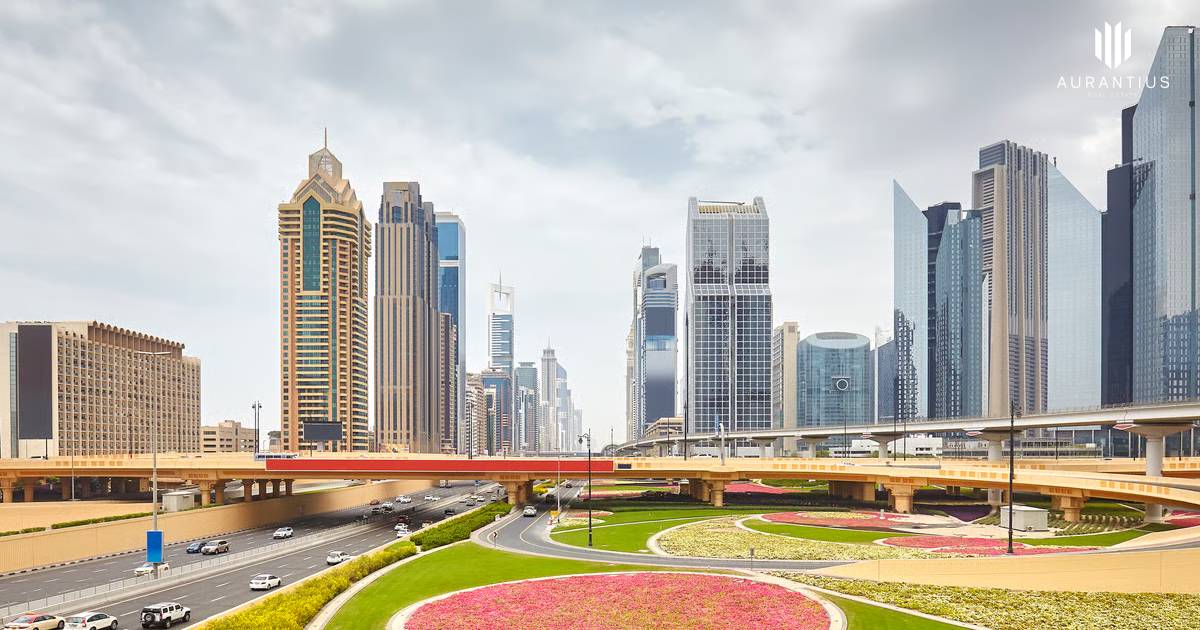

Dubai Secondary Market 2026: Why Some Capital Is Looking Beyond Downtown and Business Bay to Dubai South and MBR City
Dubai’s secondary property market in 2026 is becoming more selective. Established central districts such as Downtown Dubai and Business Bay remain important, liquid real estate markets, but some investors are increasingly comparing them with expansion corridors such as Dubai South and Mohammed Bin Rashid City rather than automatically paying a premium for an established address.
The shift is less about abandoning central Dubai and more about capital efficiency. Buyers are examining how much property they receive for their budget, what realistic rental income is achievable, what future supply may arrive, which infrastructure projects could improve accessibility and how easily the property could eventually be resold.
This reflects a broader change in buyer behaviour discussed in Aurantius’ Dubai real estate forecast for rental, secondary and off-plan trends in 2026: market-wide momentum matters, but individual asset selection is becoming increasingly important.
What Is Driving the Comparison?
Central Dubai: Established infrastructure, international recognition, mature rental demand and deep resale markets, but generally higher entry costs.
Dubai South: Lower entry points in many developments, expanding aviation and logistics infrastructure and a large pipeline of new housing.
MBR City: Newer premium residential stock, larger-scale master planning and stronger appeal to buyers seeking space and modern community environments.
Investor question: Is the premium for today’s established location more attractive than the potential upside and risks of tomorrow’s growth corridor?
The Secondary Market Is Becoming More Price-Conscious
One of the most important themes in Dubai property during 2026 is the concentration of transaction activity in mainstream price bands. The supplied Q3 research indicates that 84.28% of transactions captured in its price-band dataset were below AED 3 million, with 40.24% below AED 1 million and 44.04% between AED 1 million and AED 3 million.
That does not mean premium districts have lost demand. It indicates that the deepest pool of transactional activity is concentrated where more buyers can participate. This naturally benefits communities offering a larger selection of properties within accessible price ranges.
For secondary-market investors, this matters because resale liquidity depends partly on the size of the future buyer pool. A property that can be purchased only by a narrow segment of high-budget buyers may behave differently from an apartment or townhouse positioned within a much larger mainstream market.
Aurantius examines this issue in its guide to the best Dubai communities for fast resale and high liquidity, where exit demand is treated as an investment consideration alongside rental return.
Why Downtown and Business Bay Still Matter
It would be misleading to describe the trend as a wholesale exit from central Dubai. Downtown and Business Bay retain advantages that newer communities cannot immediately replicate.
They offer established employment centres, international recognition, mature hospitality and retail ecosystems, extensive road networks and an existing base of tenants, owners and investors. Ready-property buyers can also inspect a much longer history of completed transactions, rents and building performance.
The challenge is valuation. When an investor pays substantially more for an established address, the property needs to justify that premium through rent, scarcity, building quality, view, tenant demand or resale liquidity.
A prestigious postcode by itself is not an investment calculation. Aurantius explores this distinction in Dubai Real Estate 2026: Brand Premium vs Infrastructure Premium, which examines whether buyers are paying for measurable fundamentals or primarily for positioning and name recognition.
Dubai South: The Infrastructure and Employment Thesis
Dubai South represents a very different investment proposition. Instead of buying into a fully mature central district, investors are positioning around a large economic corridor linked to aviation, logistics, trade, employment growth and long-term urban expansion.
This does not mean every Dubai South property will outperform established areas. The investment case depends on whether infrastructure and employment growth translate into sustained resident demand as increasing volumes of housing are completed.
The infrastructure story is already developing beyond property marketing. Aurantius has covered the AED 636 million infrastructure upgrade improving connectivity in South Dubai, an example of the physical investment supporting the wider southern corridor.
For investors, the important relationship is:
Infrastructure → Employment → Residents → Rental Demand → Resale Demand
The chain only works if each stage develops sufficiently. An airport expansion or road project can improve an investment thesis, but it does not guarantee occupancy, rental growth or appreciation for every nearby development.
Dubai South’s Biggest Opportunity Is Also Its Biggest Risk
Dubai South can accommodate considerable future development. That creates opportunity because buyers can enter new communities at different stages of maturity, but it also means investors need to understand future competing supply.
A property can benefit from strong population growth and still face rental competition if too many similar apartments are handed over simultaneously. Studios and one-bedroom apartments are particularly sensitive to this because multiple projects can target the same tenant and investor profiles.
The correct question is therefore not simply, “Will Dubai South grow?” A more useful question is, “Will this particular building remain competitive as Dubai South grows?”
Building quality, walkability, proximity to employment, transport access, service charges, parking, amenities and the amount of competing stock around the handover period can all affect the answer.
MBR City Appeals to a Different Buyer Profile
Mohammed Bin Rashid City occupies a different position from Dubai South. Its appeal is generally more closely associated with modern residential environments, premium master planning, larger homes, villas, townhouses and newer apartment communities within reach of central Dubai.
That makes MBR City relevant to another 2026 demand trend: households prioritising space, newer stock and integrated communities rather than automatically selecting high-rise living in the traditional urban core.
Infrastructure also contributes to this long-term positioning. Dubai’s wider transport investment, including road programmes and the development of the Metro Blue Line network, is changing the relative accessibility of several growth communities. Aurantius examines this broader trend in how Dubai’s Blue Line, roads and infrastructure hubs are reshaping property demand.
Investors should still avoid assuming that infrastructure automatically produces a predetermined percentage of capital appreciation. The timing of delivery, property entry price, future competing stock and actual end-user demand remain critical.
Yield Alone Is Not Enough to Compare These Markets
A common argument for buying outside central Dubai is that lower acquisition prices can produce stronger rental yields. In principle, that can be correct, but investors need to distinguish between gross yield and net yield.
Gross yield simply compares annual rent with the purchase price. It does not account for service charges, maintenance, management costs, vacancy, furnishing, insurance or other recurring expenses.
Net yield is more useful because it considers the income remaining after relevant property expenses. It should also be compared against the buyer’s total acquisition cost rather than purchase price alone.
A More Useful Investor Calculation
Annual Rent
− Service Charges
− Maintenance
− Management
− Vacancy Allowance
− Other Recurring Costs
Estimated Net Income ÷ Total Acquisition Cost = Estimated Net Yield
Investors working with a larger budget can compare different portfolio structures using Aurantius’ Dubai real estate ROI guide for AED 2 million to AED 4 million budgets.
Ready Property Is Becoming More Important to Selective Buyers
The secondary market also gives buyers something off-plan cannot: immediate evidence.
A ready-property buyer can inspect the exact apartment or villa, understand building maintenance, assess traffic conditions, review service charges, check existing tenant demand and compare actual completed transactions with the seller’s asking price.
That certainty can become more valuable as buyers grow cautious about large future supply pipelines. The Aurantius guide to buying ready property in Dubai in 2026 explains the due-diligence framework end-users can use when evaluating completed properties.
The same trend is visible in the comparison between ready and off-plan stock. Aurantius’ analysis of secondary versus off-plan property in H2 2026 looks at why certainty, immediate occupancy and observable rental economics are becoming more relevant to some buyers.
Downtown vs Business Bay vs Dubai South vs MBR City: The Decision Framework
The right location depends on what an investor is trying to achieve rather than which district has the strongest marketing narrative.
Downtown Dubai
May suit buyers prioritising international recognition, established tourism and hospitality demand, prime central positioning and a mature resale market. Entry pricing and property-level service charges require close attention.
Business Bay
May suit investors seeking a central business location with broad residential and corporate rental demand. Building quality varies considerably, making tower-level analysis essential.
Dubai South
May appeal to investors seeking lower entry prices and exposure to aviation, logistics and long-term southern Dubai expansion. Future supply and project differentiation should be examined carefully.
MBR City
May appeal to buyers seeking newer master-planned communities, premium residential stock, family-oriented living and proximity to central Dubai without relying exclusively on traditional high-rise districts.
What Investors Should Check Before Reallocating Capital
Moving from an established location into a growth corridor should not be treated as a simple yield trade. The investor is exchanging one set of characteristics for another.
A mature central asset may have a higher acquisition cost but provide deeper historical transaction evidence and established demand. An emerging-community asset may offer a lower entry price and greater potential benefit from future infrastructure, but it can also carry more supply and execution uncertainty.
Before buying, investors should compare recent completed transactions, realistic rent, vacancy risk, service charges, building condition, upcoming competing supply, infrastructure timing, tenant profile and likely resale audience.
The objective is not to identify the area with the most ambitious growth story. It is to find the individual property where entry price, income, demand and exit liquidity work together.
FAQ: Dubai Secondary Property Market 2026
Question: Are investors leaving Downtown Dubai and Business Bay?
Answer: It is more accurate to describe the trend as diversification rather than an exit. Established central districts remain important, but some investors are comparing their higher entry prices with emerging communities offering different yield, space and infrastructure profiles.
Question: Why is Dubai South attracting property investors?
Answer: Dubai South combines relatively accessible property prices in many projects with aviation, logistics and infrastructure development. Investors should still assess future residential supply and property-level tenant demand.
Question: Is MBR City better than Downtown Dubai for investment?
Answer: Neither is automatically better. Downtown provides a mature prime market, while MBR City offers newer master-planned residential environments and different property types. The better investment depends on entry price, rent, holding period, property quality and exit strategy.
Question: Does new infrastructure guarantee property appreciation?
Answer: No. Infrastructure can improve accessibility and support demand, but future property performance also depends on the purchase price, supply, tenant demand, building quality and wider market conditions.
Question: Is higher rental yield always better?
Answer: No. Investors should distinguish gross yield from net yield and consider vacancy, service charges, maintenance, management costs and resale liquidity. A higher advertised gross yield can produce a less attractive net result.
Question: Is ready property safer than off-plan?
Answer: Ready property provides more observable information because buyers can inspect the asset and review existing building performance. It still carries valuation, maintenance, tenant and market risk, so it should not be described as risk-free.
Conclusion: Dubai’s 2026 Secondary Market Rewards Selectivity, Not Automatic Location Loyalty
The most important change in Dubai’s secondary market is not that Downtown Dubai or Business Bay have suddenly lost their investment case. It is that buyers now have more credible alternatives and are becoming more disciplined about what they will pay for location prestige.
Dubai South offers exposure to aviation, logistics and long-term infrastructure growth, while MBR City attracts buyers seeking newer, lower-density and family-oriented environments closer to the traditional centre. Downtown and Business Bay offer maturity, established demand and stronger historical transaction evidence.
The opportunity lies in identifying assets where the purchase price has not already absorbed all of the expected upside. The risk lies in buying an emerging location solely because infrastructure is planned, or buying an established location solely because its name is recognised.
In both cases, transaction evidence, achievable rent, ownership costs, competing supply and exit liquidity should determine the investment decision.
Aurantius Real Estate helps investors compare Dubai’s ready and secondary properties using transaction evidence, community fundamentals, realistic rental calculations, infrastructure analysis, building-level comparisons and resale considerations. For investors deciding between established central districts and emerging growth corridors, the objective is not simply to follow where capital is moving, but to determine whether the individual property justifies the price being paid.
Comparing Dubai South, MBR City, Downtown or Business Bay? Test each property against the same criteria: recent transactions, net rental income, service charges, future supply, infrastructure, tenant demand and resale liquidity. A consistent comparison makes it easier to separate genuine value from location hype.