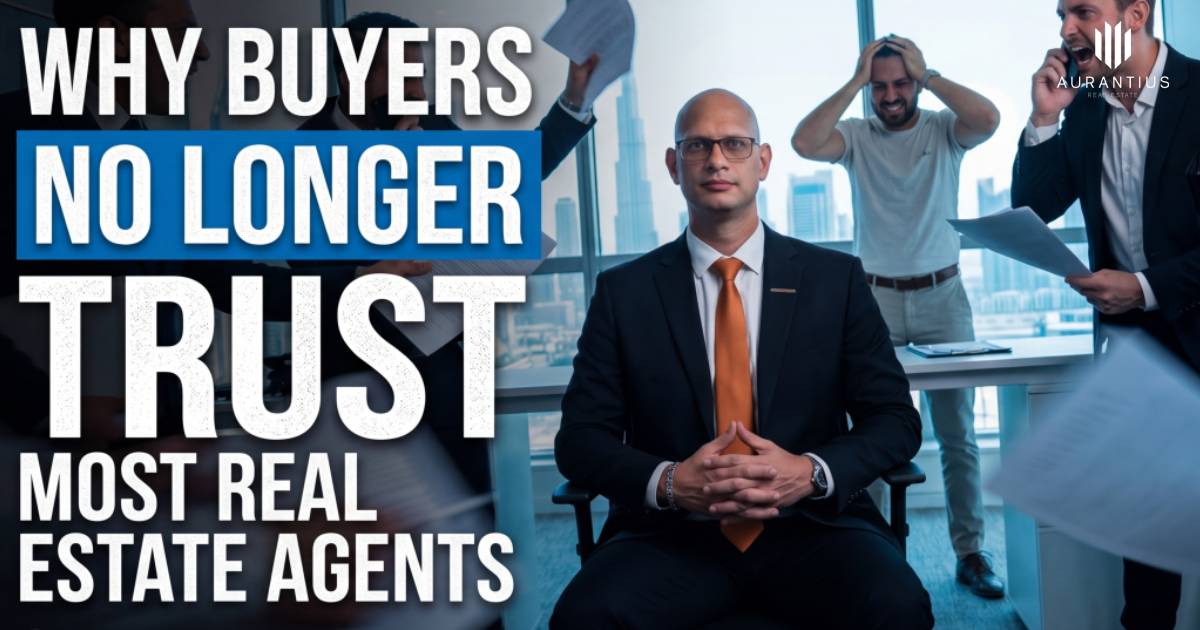

Why Buyers No Longer Trust Most Real Estate Agents (The Ugly Truth Everyone Is Missing)
The Dubai real estate market is undeniably booming, yet beneath the glittering launch events, record-breaking transactions, and endless off-plan announcements lies a growing confidence problem. Buyers are no longer suffering from a shortage of properties. They are suffering from a shortage of trust. In a crowded marketplace dominated by repetitive sales scripts, misleading listings, aggressive follow-ups, and manufactured urgency, property inventory has become abundant while clarity has become rare.
This is the new reality of Dubai real estate trust. Data is easier to access than ever. Buyers can browse listings, compare payment plans, check developer launches, study rental yields, and follow market news in real time. But more information has not automatically created more confidence. In many cases, it has created more noise. The future of Dubai property no longer belongs to the gatekeepers of listings. It belongs to the advisors who can reduce uncertainty, speak honestly, and help buyers make decisions with conviction.
https://www.linkedin.com/pulse/why-buyers-longer-trust-most-real-estate-agents-yzddf
The Market Is Booming, but Buyer Trust Is Under Pressure
Dubai’s property sector continues to attract global investors, residents, developers, and end-users. The market remains active, and the city’s long-term growth story is still powerful. Yet buyer confidence in individual agents can weaken when the customer experience feels chaotic, transactional, or manipulative. A buyer may believe in Dubai as a market while simultaneously distrusting the broker calling them.
This distinction matters. Skepticism toward some agents does not mean skepticism toward the entire real estate sector. It means the buyer has learned to separate Dubai’s investment case from the quality of advice they receive. The strongest agencies and brokers will win precisely because they understand this difference.
When Every Agent Says “Best Investment,” the Phrase Loses Meaning
One of the biggest reasons buyers lose trust is message fatigue. Every project is described as “the best investment.” Every payment plan is “unbeatable.” Every launch is “limited.” Every buyer is told to act “before prices increase.” Over time, these phrases stop sounding persuasive and start sounding interchangeable.
Serious investors do not need constant hype. They need context. They want to understand whether a unit is fairly priced, whether the area has real rental demand, whether service charges will compress returns, whether a developer has delivered similar projects well, and whether the exit strategy is realistic. Agents who replace analysis with buzzwords train buyers to distrust them.
Fake Listings and Ghost Inventory Damage Market Confidence
One of the most frustrating experiences for buyers is contacting an agent about a listing only to be told that the advertised property is no longer available, followed immediately by a pitch for something more expensive or entirely different. This bait-and-switch dynamic is one of the fastest ways to destroy trust. It wastes the buyer’s time and signals that the listing existed mainly to generate a lead rather than to represent a genuine available opportunity.
Dubai’s regulators have already moved to strengthen transparency. The Dubai Land Department’s Trakheesi permit framework and Madmoun QR code service allow buyers to verify real estate advertisements and check the authenticity of approved ads. The existence of these systems makes one thing clear: listing credibility matters, and buyers should no longer accept vague promises when official verification tools exist.
High-Pressure Scarcity Tactics Create Short-Term Leads and Long-Term Distrust
Another major reason buyers become skeptical is manufactured urgency. Some agents push buyers to reserve immediately by claiming a project is almost sold out, that a specific unit will disappear within hours, or that prices are guaranteed to rise after the next launch stage. Scarcity can be real in certain projects, but when urgency becomes the default script, it loses credibility.
Buyers making six- or seven-figure decisions need space to think. They need time to compare, verify, and understand. A broker who pressures a buyer before helping them understand risk may win a booking in the short term, but they damage their long-term reputation. The confidence economy rewards agents who can guide action without creating panic.
Commission Bias Can Make Buyers Question Advice
Buying property in Dubai risks becoming confusing when buyers feel that recommendations are shaped by commission rather than suitability. This concern is especially strong in off-plan sales, where different developers may offer different incentives to brokers. If an agent repeatedly pushes only one project without explaining alternatives, risks, or trade-offs, the buyer may reasonably wonder whether the advice serves the client or the payout.
This is why transparent advisory work matters. A credible agent should be able to explain why a project fits the buyer’s goal and also why other projects may not. They should be willing to say, “This is not the right option for you,” when the numbers or lifestyle fit do not make sense. Trust deepens when the buyer sees restraint, not just enthusiasm.
Buyers No Longer Need Listing Gatekeepers
The old agent value proposition was access. Agents knew what was available, which owner might sell, which project was launching, and which unit had just returned to market. That role still exists, but it is no longer enough. Portals, developer websites, social media, and market platforms have made information widely accessible.
The modern buyer does not need someone to flood their WhatsApp with twenty similar listings. They need someone who can filter the market down to two or three relevant choices and explain the logic behind each one. Clarity is now more valuable than quantity. The advisor who simplifies the decision becomes more useful than the agent who merely forwards options.
How to Choose a Dubai Broker in a Noisy Market
Buyers asking how to choose a Dubai broker should focus less on charisma and more on discipline. A trustworthy broker should communicate clearly, verify information, respect the buyer’s budget, disclose risks, explain fees, avoid unrealistic guarantees, and provide a reasoned comparison between options. They should also be comfortable pointing buyers toward official verification tools and encouraging due diligence.
RERA licensed agents Dubai buyers work with should not hide behind licensing alone. A licence is the baseline, not the full proof of advisory quality. Buyers should assess whether the agent shows market understanding, process knowledge, post-sale commitment, and a clear willingness to protect the client from poor decisions.
Data Is Free. Interpretation Is Premium.
This is the heart of the confidence economy. Property data is increasingly available, but not every buyer knows how to interpret it. A brochure may show an attractive payment plan, but the buyer needs to understand total cost, liquidity risk, service charges, handover timing, rental competition, and future supply. A projected ROI number may look impressive, but the buyer needs to know whether it reflects gross or net returns.
Agents who can interpret information honestly become more valuable as the market becomes more crowded. They are not paid merely to find a property. They are paid to reduce error. In a booming market, avoiding a bad purchase can be just as important as finding a good one.
Trustworthy Agents Explain What Can Go Wrong
Many buyers lose confidence because they hear only the upside. They are told about payment flexibility, projected appreciation, rental potential, and future infrastructure, but they are not told about possible delays, oversupply, weak resale depth, higher service charges, or handover quality issues. This one-sided communication makes the entire pitch feel suspect.
A serious advisor presents both sides. They explain what could go right and what could go wrong. They discuss the exit strategy, not just the entry point. They clarify whether the property is best for income, lifestyle, residency, or long-term appreciation. This balance is what separates real advice from sales theatre.
The Buyer’s Relationship With Agents Is Changing
Dubai’s property market is moving from an information economy to a confidence economy. Buyers are increasingly choosing the person they trust, not just the project they like. Multiple agents may have access to the same listing or developer inventory, but they do not all offer the same clarity, judgment, or after-sales reliability.
This is why post-sale support matters. Buyers remember the agent who remains available through payment milestones, title deed questions, snagging, handover, leasing, and resale strategy. They also remember the agent who disappears once the booking form is signed. In a trust-deficit environment, follow-through becomes a competitive advantage.
Why Some Buyers Try to Sell or Buy Without Agents
The trust problem also explains why some owners and buyers consider bypassing agents altogether. In certain situations, direct transactions may work, especially when both sides are experienced and documentation is clear. But going without professional support can also backfire when pricing, negotiation, legal process, verification, or transaction coordination are misunderstood.
For a balanced view, readers can explore selling a property in Dubai without a real estate agent in 2026. The key lesson is not that agents are unnecessary. It is that low-quality agents are increasingly unnecessary.
Market Maturity Raises the Standard for Advisory Quality
Dubai’s real estate market is no longer defined only by launch excitement and fast speculative momentum. It is maturing into a more long-term ownership environment, where buyers care about capital preservation, rental durability, developer track record, and resale strength. This broader transformation is explored in Dubai real estate market trends from flip market to long-term wealth hub.
As the market matures, buyers become less tolerant of noise. They expect better advice, deeper research, and more integrity. An agent who once survived on urgency and volume may struggle in a market where the buyer is more educated and more cautious. The new market rewards professionalism.
Developer Comparisons Need More Than Brand Names
Buyers also lose trust when agents recommend developers through slogans rather than analysis. Saying one brand is “the best” is not enough. Buyers want to know about delivery history, resale demand, community design, pricing discipline, payment structure, and how one developer compares with another over time.
That is why analytical content such as Emaar vs DAMAC capital appreciation matters. It reflects the level of conversation serious buyers now expect. The broker who can discuss trade-offs intelligently earns more credibility than the broker who only repeats launch talking points.
The Future Belongs to Agents Who Earn Belief
The next generation of successful Dubai brokers will not be defined by who posts the most reels or sends the most mass WhatsApp messages. They will be defined by who earns belief. That means respecting a client’s no, admitting uncertainty when data is incomplete, explaining risk before reward, and refusing to push unsuitable deals.
Buyers do not need more listings. They need more confidence. They need someone who can help them see clearly when the market gets loud. In that environment, trust is no longer a soft value. It is the most valuable currency in Dubai real estate.
Conclusion
Why buyers no longer trust many Dubai real estate agents is not a mystery. The market has become too noisy, too repetitive, and too dependent on high-pressure selling in some corners. Fake listings, weak follow-through, commission bias, urgency tactics, and shallow advice all erode confidence. But this trust problem is also creating a powerful opportunity. The agents who practice radical clarity, genuine advisory work, and long-term client alignment will stand out more than ever. In the confidence economy, integrity is not just ethical. It is commercially decisive.
FAQs
Q: Why do buyers distrust some Dubai real estate agents?
A: Buyers often lose trust because of misleading listings, aggressive sales pressure, unrealistic ROI claims, weak transparency around costs and risks, and poor post-sale follow-up.
Q: Are all Dubai property agents untrustworthy?
A: No. Many brokers operate professionally and ethically. The issue is that poor practices by some agents create skepticism across the wider market, making trust and transparency more important than ever.
Q: How can buyers verify a Dubai property advertisement?
A: Buyers should look for official advertisement verification tools such as Trakheesi permit details and Madmoun QR codes issued through Dubai Land Department systems.
Q: How do I choose a trustworthy Dubai broker?
A: Look for an agent who is RERA licensed, explains risks clearly, respects your budget, verifies claims, compares alternatives objectively, and provides useful guidance beyond simply forwarding listings.
Q: What makes a real estate agent valuable in Dubai today?
A: The strongest agents create confidence. They interpret data, reduce risk, explain trade-offs, simplify the buying process, and help clients avoid poor decisions in a noisy market.
Aurantius Real Estate helps buyers navigate Dubai property with transparency, market clarity, and advice built around long-term confidence rather than short-term pressure.