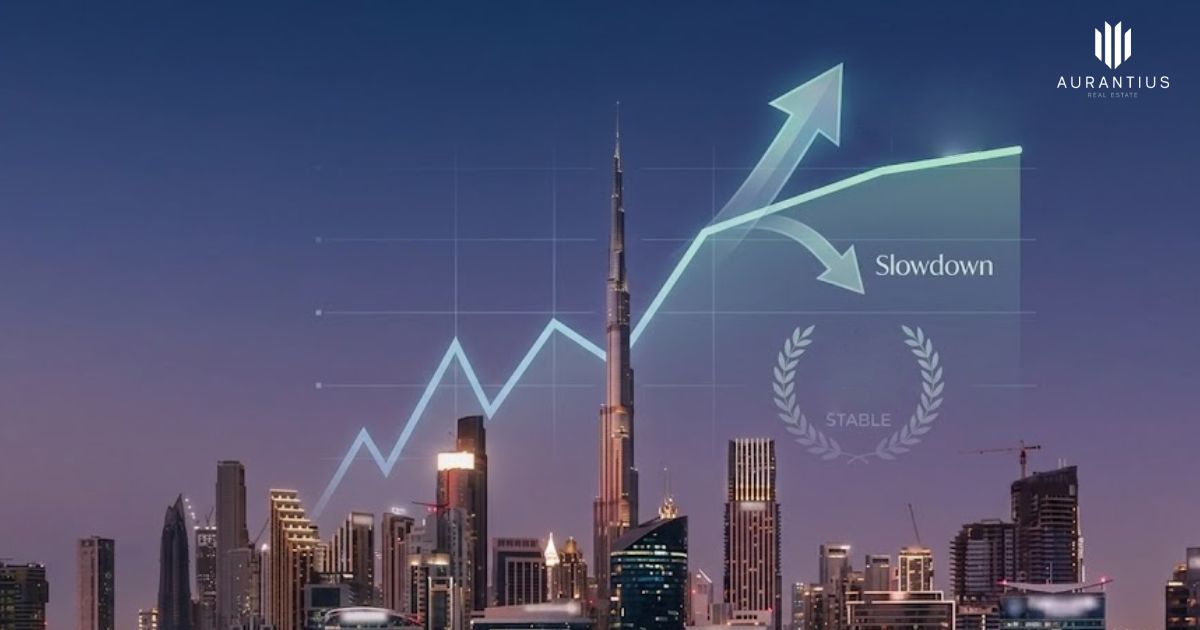

Dubai Real Estate in 2026: Is the Market Slowing Down or Shifting Into a More Mature Growth Phase?
Dubai’s real estate market in 2026 continues to attract global investor attention, yet the core debate has shifted from whether the market is “booming” to whether it is entering a more stable phase after rapid growth. Investors who saw strong price increases and record transaction volumes from 2021 onward are now asking whether the market is going down or simply stabilising. A data-led reading suggests the more accurate framing is a transition toward a more balanced market structure, where demand remains active and price growth becomes more selective and gradual rather than uniformly fast.
Dubai has moved through cycles before. The important context for investors is that the market has repeatedly recovered, strengthened its regulations, and expanded its international participation after each disruption. In mature phases, price movement tends to diverge by segment. Prime assets and scarcity-driven locations often remain more resilient. Oversupplied corridors often see flatter growth or minor corrections. This is typical of a market shifting away from short-cycle behavior and toward fundamentals-led performance.
Record Performance Heading Into 2026: Why Liquidity Signals Matter
Dubai closed 2025 with some of the strongest recorded market activity in its history. Officially cited figures include more than 270,000 real estate transactions worth approximately AED 917 billion during the year, described as roughly 20% year-on-year growth in total transaction value. High transaction value combined with high deal volume is a liquidity signal. Liquidity matters because it supports price discovery, improves exit flexibility, and indicates that the market’s transaction infrastructure is functioning across multiple segments.
The residential segment was described as the primary engine. Figures cited include more than 200,000 residential property sales worth around AED 541.5 billion. This level of residential activity suggests broad participation beyond a narrow luxury band. It also implies that end users and long-duration investors remain active contributors, which can be a stabilizing factor when sentiment becomes more cautious due to external conditions.
The market’s scale becomes clearer when compared across recent years. 2024 was described as recording more than 181,000 transactions worth AED 522.5 billion. Continued strong activity from 2023 through 2025 positioned Dubai among the most active property markets globally. Investors should interpret this as a base condition. A market that enters 2026 with high liquidity and broad participation is more likely to moderate through slower growth rather than collapse through a sharp breakdown.
Is Dubai Real Estate Going Down in 2026?
Current data and market interpretation suggest the market is not collapsing. It is moving into a more balanced phase. After rapid price increases through 2021 to 2024, a moderation phase is a common outcome. In this phase, price growth tends to become more sustainable, transaction behavior becomes more selective, and buyers place greater weight on quality, location fundamentals, and developer credibility. This shift typically reduces speculative churn and increases the share of end-user driven transactions.
Market commentary often notes that Dubai’s residential prices have surpassed prior cycle peaks, including the 2014 peak, reflecting the strength of demand in prime and mid-market segments. A market that has reset above prior peaks is not immune to correction, yet a moderation phase is consistent with markets that have expanded rapidly and then transition into steadier growth patterns. Investors should expect more segmentation, where prime districts can remain firm while certain mid-market pockets experience flatter performance.
Dubai’s Track Record Through Global Shocks: Why Market Structure Has Changed
Dubai’s market has been tested by multiple major shocks over the past two decades, including the global financial crisis in 2008, mid-2010s regional slowdowns, and the COVID-19 pandemic in 2020. Each shock produced some level of correction in pricing, transaction volume, or both. The longer-term pattern has been recovery followed by structural reforms that improved transparency and reduced systemic risk.
Post-2008 reforms strengthened market regulation through improved escrow practices, tighter mortgage frameworks, and enhanced oversight under Dubai Land Department and the Real Estate Regulatory Agency. Investors typically treat these reforms as institutional maturity indicators because they lower execution risk in off-plan and reduce leverage-driven instability. The post-pandemic period further demonstrated resilience, as demand accelerated when Dubai reopened quickly and global mobility improved, driving stronger residential interest, especially from international buyers relocating to the UAE.
These repeated cycles have shifted Dubai from a market that was once perceived as more speculative into a market that is more integrated with global capital flows and more regulated in its transaction mechanics. For investors in 2026, the most relevant implication is that the market’s “shape” has changed. Corrections, when they occur, are more likely to be localized and segment-driven rather than system-wide.
Why Investors Continue to Choose Dubai in 2026
Population growth remains a core demand driver. Dubai’s population is widely described as surpassing 4 million residents, which supports long-term housing demand across multiple price tiers. Population growth increases rental absorption capacity and expands the pool of end-user buyers who convert from renting to ownership. For investors, this matters because resident-led demand tends to be more stable than tourism-only demand, particularly for long-lease residential stock.
Global investor demand is another structural pillar. Dubai remains one of the world’s most international property markets, with buyers participating across Europe, Asia, the Middle East, and Africa. This diversity reduces reliance on any single demand corridor and can stabilize transaction volumes when one buyer cohort slows due to currency movements or external conditions. Demand also remains linked to the UAE’s tax structure, long-term residency pathways, and ownership frameworks that allow foreign participation in freehold areas.
Economic diversification supports real estate demand by expanding employment and business formation. Sectors such as tourism, logistics, finance, aviation, and technology contribute to demand for both residential and commercial property. A diversified economy reduces single-sector dependency risk, which is important for investors assessing long-term occupancy and rental stability.
Rental yields remain a competitive advantage in investor narratives. Typical yield bands referenced for Dubai often range from 5% to 7% depending on property type and location. These yields compare favorably with many mature global cities where yields are lower due to higher entry prices and higher tax drag. Yield competitiveness improves the risk buffer for investors because income can offset modest price moderation and support holding periods through market cycles.
Supply and the Next Phase: Stabilisation Through Delivery and Absorption
Dubai continues to deliver large volumes of new residential supply. Ongoing supply is a normal feature of a city that is expanding and attracting population inflows. Supply can stabilize pricing by preventing extreme volatility, especially when project launches are phased and aligned with absorption capacity. The key investor task is to differentiate between corridors where supply is balanced by demand and corridors where deliveries cluster in segments with price-sensitive tenant pools.
In a more mature phase, a market can expand in volume and infrastructure while price growth becomes more gradual. This is often a healthier long-term dynamic for investors because it supports predictable underwriting and reduces the probability of sharp boom-and-bust patterns. Buyers who focus on asset quality, building management standards, service charge structure, and resale liquidity tend to outperform buyers who rely only on broad market appreciation.
Dubai Real Estate Outlook: What the Evidence Suggests for Long-Term Investors
Most market outlooks referenced in investor summaries suggest continued expansion, supported by population growth, global investor interest, new communities, and infrastructure investment. The market appears to be evolving toward a more mature ecosystem with clearer segmentation and more sustainable growth patterns. For investors, the key question is not whether short-term fluctuations will occur. Real estate markets always fluctuate. The more important question is whether the demand drivers remain intact and whether regulatory and economic frameworks continue to support liquidity.
Based on the transaction scale leading into 2026 and the structural drivers often cited, the market appears positioned for continued activity with a greater emphasis on selection, quality, and patience. Investors planning three to five-year holds typically benefit most in markets where income yield remains competitive and where liquidity remains deep enough to support exits without forced discounting.
Conclusion
Dubai’s real estate market in 2026 is better described as stabilising after rapid growth rather than going down. Record 2025 transaction volumes and value provide a liquidity foundation, while structural drivers such as population growth, global investor participation, economic diversification, and competitive yields continue to support demand. Supply delivery is likely to create more segmentation, with prime assets remaining more resilient and certain mid-market pockets showing flatter growth. For long-horizon investors, the evidence points to a market entering a more mature phase where disciplined selection and fundamentals-led underwriting matter more than headline momentum.
To follow Dubai locations, market context, and research-led summaries in a format designed for decision-making, use Aurantius Real Estate for ongoing coverage across Dubai’s residential markets.