
Dubai home prices decline 2026: Real Crash or Healthy Market Dip?
As of mid-2026, the phrase “Dubai home prices decline” has shifted from speculation to measurable data. After nearly six years of uninterrupted growth, the market has entered a phase of softening, with price indices showing a modest 4% to 7% dip from peak levels earlier in the year. While this adjustment has raised concerns among some investors, the broader context tells a different story. With strong fundamentals such as an 86% to 87% cash-buyer ratio, rising population demand, and stable rental yields, the current movement reflects a maturing market rather than a structural failure.
Dubai Property Price Index March 2026: What the Data Shows
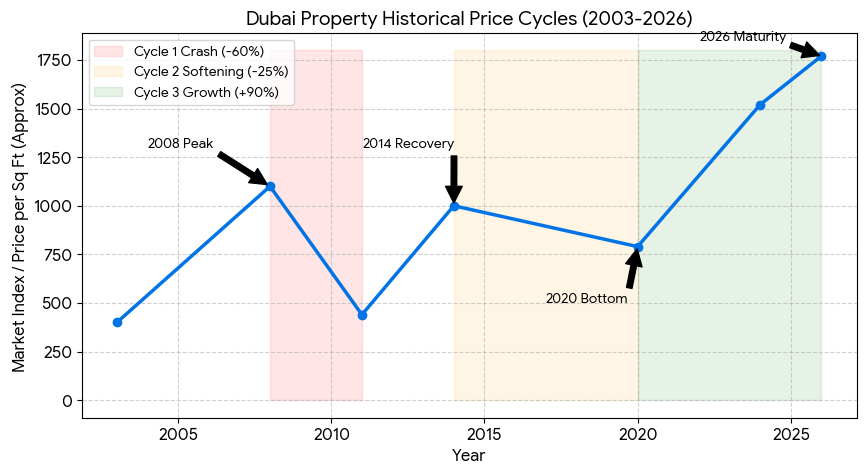
The Dubai property price index March 2026 highlights a nuanced picture. While short-term price softening has occurred, overall market performance remains strong, with total transaction values reaching AED 176.7 billion in Q1, representing a 23.4% year-on-year increase. Median prices per square foot continue to show annual growth of over 12%, confirming that the recent dip is a correction from elevated peaks rather than a reversal of long-term trends.
Historical Market Cycles
| Period | Trend | Typical Drop | Main Reason |
|---|---|---|---|
| 2008–2011 | Sharp Crash | 50% – 60% | Global Financial Crisis & Speculation |
| 2015–2019 | Slow Correction | 25% – 35% | Oversupply & Strong Dollar |
| 2020 (Early) | Pandemic Dip | 5% – 10% | Global lockdowns |
Dubai Real Estate Market Correction 2026: A Healthy Reset
The Dubai real estate market correction 2026 is best understood as a “soft landing.” After a 90%+ price surge between 2020 and early 2026, a 5% to 7% adjustment represents normalization rather than decline. Analysts widely view this phase as necessary to sustain long-term growth, allowing the market to rebalance supply and demand without triggering instability. This perspective aligns with insights from correction analysis, which emphasizes the importance of controlled price moderation.
Segment-Specific Trends and Secondary Market Pressure
The impact of price declines is not uniform across the city. Secondary market price trends show that mid-market areas with higher supply, such as parts of MBR City, have experienced modest declines of around 4%. In contrast, prime locations like Palm Jumeirah and Emirates Hills continue to record growth, driven by limited inventory and strong demand. This segmentation highlights the importance of location-specific analysis when evaluating investment opportunities.
Off-Plan vs. Ready Property
| Feature | Off-Plan | Ready Property |
|---|---|---|
| Primary Goal | Capital appreciation during construction. | Immediate rental income or occupancy. |
| Price Advantage | Often 15%–30% lower than ready units. | Market rates; higher entry threshold. |
| Payment Plans | Flexible; often 1% monthly or post-handover. | Upfront or mortgage-based. |
| Main Risk | Handover delays or final product differences. | Older buildings may need renovation. |
Why This Is Not a 2008-Style Crash
Comparisons to the 2008 market crash are largely misplaced. Unlike the highly leveraged environment of that period, today’s market is predominantly cash-driven, reducing the risk of forced selling. Additionally, regulatory frameworks such as escrow accounts and stricter lending policies provide a strong safety net. Insights from market myth analysis further reinforce the distinction between current conditions and past crises.
The Opportunity Gap: Buying the Dip
The current phase creates an opportunity gap for investors who were previously priced out of the market. A 5% to 7% decline from peak levels allows entry at more favorable valuations while maintaining exposure to long-term growth. This “buying the dip” strategy is particularly relevant in high-supply segments where sellers may be more flexible. However, investors should focus on intrinsic value rather than headline discounts.
Dubai Property Investment Strategy in 2026
A successful property investment strategy in 2026 requires a shift toward data-driven decision-making. Investors are increasingly prioritizing rental yields, infrastructure development, and long-term demand drivers over short-term price movements. Insights from market forecast analysis highlight the importance of aligning investments with future growth corridors and infrastructure projects.
Search Fears vs. Market Reality (Q1 2026)
| The Trending Fear | The Real Data (April 2026) |
|---|---|
| “Market is Crashing” | Total sales hit AED 176.7B in Q1, up 23.4% year-on-year. |
| “Prices are Plummeting” | Physical prices only fell 4-7% from the Feb peak; median price is still up 12.5% YoY. |
| “Investors are Leaving” | Over 29,312 new investors entered the market in Q1 alone. |
| “It’s 2008 Again” | 87% of deals are cash now; in 2008, 80%+ were mortgage-leveraged. |
Off-Plan Dominance and Market Dynamics
Off-plan properties continue to dominate transaction activity, accounting for 70% to 75% of deals in early 2026. This trend reflects investor preference for lower entry prices and flexible payment plans. While the ready market experiences selective softening, off-plan developments are absorbing demand and supporting overall market stability.
Is It a Good Time to Buy Property in Dubai?
The question of whether it is a good time to buy property in Dubai depends on individual objectives. For long-term investors, the current correction offers an attractive entry point, particularly in areas with strong rental demand. For short-term investors, opportunities exist in segments experiencing temporary oversupply. However, waiting for a significant crash may not be a viable strategy, as the market’s fundamentals remain strong.
Risk Considerations and Market Outlook
While the outlook is positive, investors should consider factors such as service charges, supply concentration, and global economic conditions. A balanced portfolio approach that includes both established and emerging areas can help mitigate risks. The emphasis should remain on long-term value rather than short-term price fluctuations.
Conclusion
The Dubai home prices decline in 2026 represents a healthy market adjustment rather than a collapse. Supported by strong fundamentals, regulatory stability, and sustained demand, the market is transitioning into a more mature phase. For investors, this period offers a strategic opportunity to enter at improved valuations while benefiting from long-term growth prospects.
FAQs
Q: Are Dubai home prices really declining in 2026?
A: Yes, but only by around 4% to 7% from peak levels, reflecting a healthy correction.
Q: Is this a market crash similar to 2008?
A: No, the current market is supported by cash transactions and strong regulations, making a crash unlikely.
Q: Which areas are most affected by price declines?
A: Mid-market areas with higher supply are seeing slight declines, while prime مناطق remain stable or growing.
Q: Should investors buy now or wait?
A: Buying during the dip can provide better entry points, especially for long-term investments.
Q: What is driving the current market trend?
A: The trend is driven by market maturation, supply adjustments, and changing investor behavior.
Aurantius Real Estate helps investors identify strategic entry points in Dubai’s evolving and resilient property market.