


What Is Real Estate Tokenization via Blockchain? The Ultimate Guide to Blockchain Property Investment
For decades, prime commercial and residential real estate has been an exclusive playground for high-net-worth individuals, institutional funds and large family offices. Buying a premium property usually required major capital, heavy paperwork, broker coordination, legal checks, slow settlement and long holding periods.
Blockchain technology is now rewriting part of that model. Through real estate tokenization, a physical property can be converted into compliant digital tokens on a blockchain, where each token represents a fractional economic interest in the underlying asset.
This shift allows investors to access real estate with smaller capital tickets, receive potential rental income through automated distribution systems, and participate in a property asset class that was historically difficult to enter without large upfront wealth.
But tokenized real estate is not simply “crypto property.” It is a legal, financial and technological structure that must connect the physical deed, the legal ownership wrapper, investor rights, smart contracts, compliance rules and regulatory approval into one enforceable model.
For Dubai-specific context, read Real Estate Tokenization and the Future of Property Investment.
The Democratic Disruption Angle
The strongest way to understand real estate tokenization is not as a short-term crypto trend. It is better understood as a structural attempt to solve three long-standing problems in property investment: high capital barriers, low liquidity and slow administration.
Traditional real estate is capital intensive. A buyer usually needs a large down payment, transaction fees, legal support and long-term holding capacity. Selling can take weeks or months. Rental income distribution requires manual administration. Ownership records are often fragmented across legal documents, registries and private contracts.
Tokenization tries to improve this by converting property-linked economic rights into programmable digital units. These units can be distributed to multiple investors, tracked on a blockchain ledger and governed by smart contracts.
The result is potentially more inclusive property access. But inclusion does not remove risk. Investors must still understand the property, the legal wrapper, the regulator, the platform, the token contract and the exit route.
How Real Estate Tokenization Works
Real estate tokenization usually begins with an actual physical asset: an apartment, villa, office, retail unit, warehouse, building or income-producing portfolio.
The property is appraised, legally secured and placed inside a legal structure. In many models, the property is not tokenized directly. Instead, a Special Purpose Vehicle, LLC or similar legal entity holds the asset, and investors acquire tokenized interests linked to that entity.
Smart contracts are then deployed on a blockchain network to create digital tokens. These tokens may represent equity, membership interests, economic rights, rental income rights or other structured participation rights depending on the jurisdiction and legal documentation.
Investors buy tokens through a regulated platform or offering. Rental income, if available, can then be distributed according to the token holder’s share, while blockchain records support transparent ownership tracking.
The simple version is this: the property remains physical, the legal structure makes ownership enforceable, and the blockchain records digital participation.
How Real Estate Tokenization Works
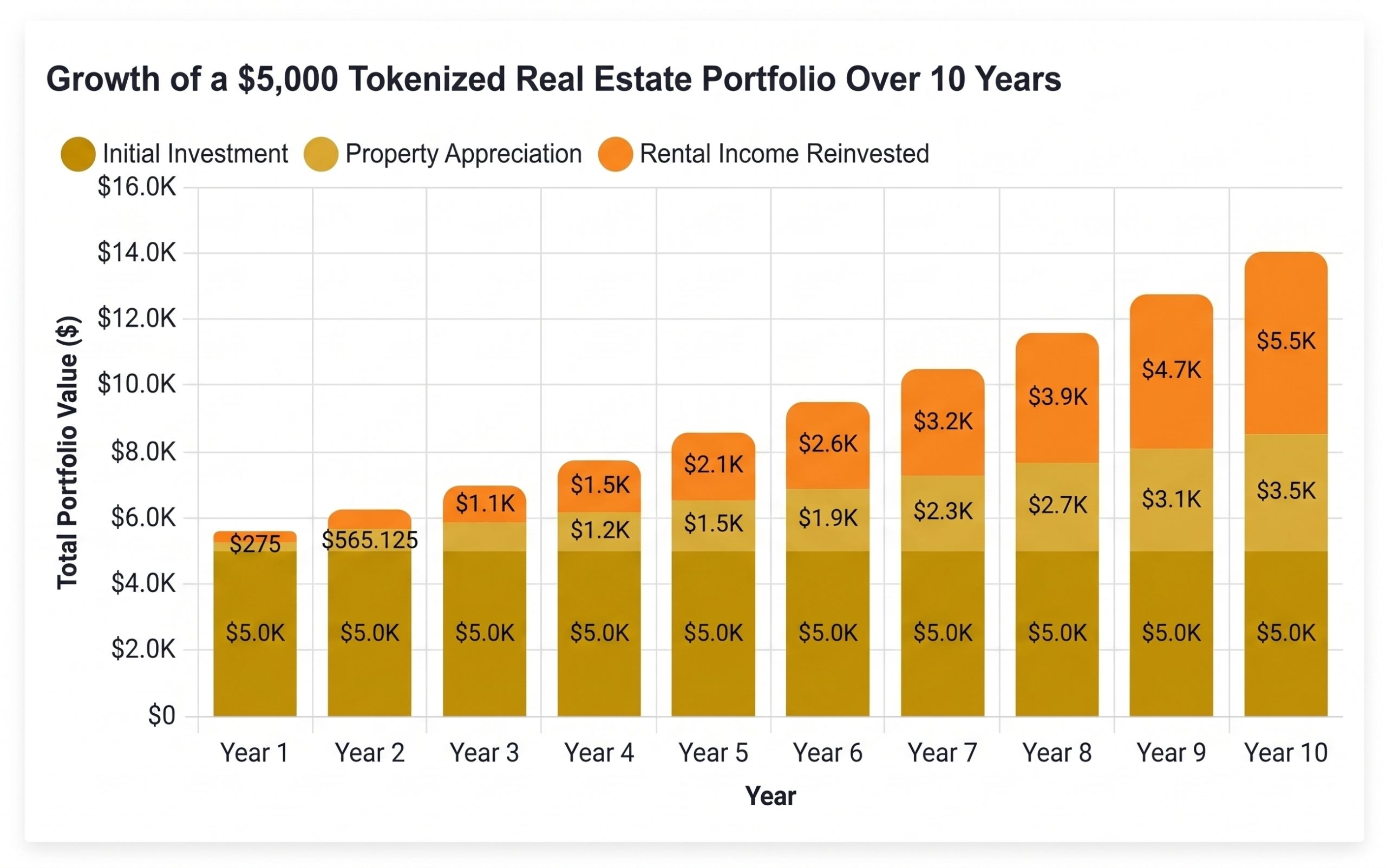
To understand the financial implications of tokenization, consider a simulated $10,000,000 commercial building with an 8% net annual rental yield. Traditional investment requires millions, but tokenization lowers barriers.Below is a 10-year projection of a $5,000 individual investment in this tokenized property, assuming a standard 3% annual property appreciation and reinvested rental yield.
Traditional Real Estate vs Tokenized Real Estate
Minimum investment: Traditional real estate usually requires significant capital. Tokenized real estate can reduce the entry ticket by allowing fractional participation.
Liquidity: Traditional property sales can take months. Tokenized models may enable secondary trading, but actual liquidity depends on platform demand, regulation and market depth.
Settlement: Traditional property settlement requires multiple parties, documents and approvals. Tokenized systems can automate certain steps, but they still need legal and regulatory backing.
Transparency: Traditional records may be spread across brokers, registries, contracts and banks. Blockchain systems can improve visibility, but the legal registry remains critical.
Income distribution: Traditional rental payouts are usually manual. Smart contracts can automate distributions if the platform, payment rails and legal documents are properly designed.
The key point is balance. Tokenization can improve efficiency, but it does not erase the need for legal enforcement, property due diligence and regulatory compliance.
The Legal Wrapper: Why SPVs Matter
One of the most important parts of tokenized real estate is the legal wrapper. A blockchain token alone does not automatically give the holder enforceable ownership of a physical apartment, office or building.
To bridge the gap between digital tokens and physical property, many platforms use a Special Purpose Vehicle or similar corporate structure. The SPV owns the property, and the token represents a defined economic or membership interest connected to that SPV.
This structure matters because the enforceability of token holder rights depends on the corporate documents, offering documents, investor agreements, regulator approval and local property law.
If the SPV is poorly structured, token holders may face serious legal uncertainty. If the platform fails, the SPV defaults, or the property is mortgaged incorrectly, investors may discover that their digital tokens do not give them the protection they expected.
In real estate tokenization, legal engineering is as important as blockchain engineering.
Smart Contracts: Automating Ownership, Payouts and Compliance
Smart contracts are blockchain-based programs that execute predefined rules. In real estate tokenization, they can support investor onboarding, token transfers, rental income distribution, escrow triggers and compliance restrictions.
For example, a smart contract may prevent a token from being transferred to a wallet that has not completed KYC. It may automatically calculate each investor’s rental income share. It may refund funds if a minimum funding threshold is not reached.
This can reduce manual administration. But smart contracts are not magic. They must be audited, maintained and connected to real-world data. If the code is flawed, the platform can suffer hacks, locked funds, distribution errors or compliance failures.
Investors should therefore ask whether the platform’s smart contracts have been independently audited and whether there are clear procedures for disputes, errors and emergencies.
ERC-3643, ERC-1400 and Security Token Standards
Not all tokens are designed for regulated real estate investment. Simple fungible tokens may not include the compliance controls needed for securities, fractional ownership or restricted investor categories.
Security token standards such as ERC-3643 and ERC-1400 are designed to support regulated assets by embedding identity, compliance and transfer restrictions into the token architecture.
In practical terms, this can prevent non-approved wallets from holding or trading tokens. It can help enforce investor eligibility, geographic restrictions, KYC rules and transfer conditions.
This is essential because real estate tokens may fall under securities, collective investment, crowdfunding, virtual asset or financial promotion rules depending on jurisdiction.
A tokenized property platform should not only ask, “Can we mint tokens?” It must ask, “Can these tokens be legally issued, held, transferred and enforced?”
Dubai’s Role in Real Estate Tokenization
Dubai has become one of the most important global testing grounds for regulated real estate tokenization. The city is not treating tokenized property as an informal crypto experiment. It is being developed through official channels involving Dubai Land Department and regulatory partners.
Dubai Land Department launched the region’s first tokenized real estate investment project through PRYPCO Mint, in partnership with PRYPCO and in collaboration with VARA, the Central Bank of the UAE and Dubai Future Foundation through the Real Estate Sandbox.
This matters because real estate tokenization only works at scale when the property registry, regulator, banking partner, platform operator and investor-protection framework align.
Dubai’s approach is important because it links blockchain innovation to the official real estate infrastructure, rather than allowing tokenized property claims to operate in a legal grey zone.
For local market context, read Tokenized Real Estate in Dubai: Blockchain Meets Property Investment.
PRYPCO Mint and Dubai’s Tokenized Property Pilot
PRYPCO Mint is one of the most visible examples of regulated tokenized real estate in Dubai. The platform has been positioned around fractional investment access, allowing investors to participate in Dubai real estate through tokenized ownership structures.
Dubai Land Department also introduced a Property Token Ownership Certificate after the successful sale of the first tokenized real estate project on PRYPCO Mint. This is significant because it shows that tokenization is being connected to official property-recognition infrastructure.
DLD later announced Phase II of the Real Estate Tokenisation Project, enabling resale activity in the secondary market from 20 February 2026. This is a critical development because liquidity is one of the main promises of tokenization.
However, investors should still remain careful. Secondary resale availability does not automatically mean deep liquidity. A token can only be sold if there is buyer demand, a compliant marketplace and clear transfer rules.
For related momentum, read Tokenization Gains Momentum in Dubai’s Real Estate Market.
Investor Benefits: Why Tokenized Property Is Attractive
The main benefit of tokenized real estate is access. Investors who cannot afford an entire property may still gain fractional exposure to income-producing real estate.
This can support portfolio diversification. Instead of putting all available capital into one unit, an investor may spread exposure across several properties, locations or asset classes.
Tokenization can also reduce administrative friction. Rental distributions, ownership records and investor reporting can be handled digitally if the system is properly built.
Another benefit is transparency. Blockchain records can show token transfers and ownership history, while official property-recognition systems can help connect the digital layer to real-world legal rights.
For investors who want property exposure without full ownership complexity, tokenization can be a useful access model. But it must be evaluated like a regulated investment product, not like a casual app purchase.
A Simple Investment Projection Example
To understand how tokenized real estate may work financially, consider a simplified example. Assume an investor places $5,000 into a fractional share of a commercial property that generates an 8% net annual rental yield and grows by 3% per year.
In the first year, the investor could theoretically earn $400 in rental income and $150 in property appreciation, taking the total economic value to $5,550 before platform fees, taxes, FX movement, liquidity costs or transaction costs.
If both rental income and appreciation were reinvested every year under those assumptions, the portfolio value could compound materially over a decade.
However, projections are not guarantees. Real yields can change, property values can fall, tenants can default, service charges can rise, platforms can charge fees and secondary liquidity may be limited.
The correct way to use projections is as a scenario model, not a promise.
Critical Risk 1: Regulatory Compliance
Real estate tokenization sits at the intersection of property law, securities law, virtual asset regulation, crowdfunding rules, banking compliance and investor protection.
This makes regulation the most important risk category. A platform may look technologically advanced, but if it is not properly authorised, investors may face serious legal and operational risk.
VARA has already warned consumers about unauthorised firms making claims around Dubai’s real estate tokenisation pilot. This is an important reminder: investors should verify platform licensing, official partnerships and regulatory status before transferring money.
In Dubai, tokenized real estate platforms must be understood within the correct regulatory route, including DLD, VARA, financial services rules, banking controls and investor eligibility requirements.
Critical Risk 2: Smart Contract Vulnerabilities
Smart contracts can automate token issuance, transfers and income distribution. But if the code contains bugs, the consequences can be severe.
A vulnerability may allow hackers to drain funds, lock distributions, manipulate transfers or disrupt platform operations. In traditional real estate, paperwork errors are slow and visible. In blockchain systems, code errors can move quickly.
That is why investors should ask whether the platform’s smart contracts have been audited by reputable third-party security firms. They should also check whether the platform has insurance, emergency controls, admin safeguards and clear incident-response procedures.
A legally sound SPV is not enough if the smart contract layer is weak.
Critical Risk 3: Liquidity Reality
One of the biggest selling points of real estate tokenization is liquidity. In theory, a tokenized property share can be traded more easily than a traditional property.
But investors must be careful with this claim. Liquidity depends on real buyer demand. If few investors want to buy the token, the seller may still be stuck or forced to accept a discount.
The underlying asset is still real estate, which remains location-specific, income-dependent and market-cycle sensitive. A blockchain wrapper cannot make a weak property instantly liquid.
This is why investors should treat tokenized real estate as a long-term asset unless a deep, regulated secondary market already exists and the platform clearly explains resale mechanics.
Critical Risk 4: Platform Failure and Legal Recourse
Platform risk is another major issue. If the tokenization platform fails, investors need to know what happens to the property, SPV, rental income, token records and investor rights.
The answer depends on legal structure. If the property is held cleanly through an SPV and investor rights are documented properly, investors may have clearer recourse. If the structure is vague, recourse may be difficult.
Investors should ask whether the property is bankruptcy-remote from the platform operator, who controls the SPV, how rental income is collected, what happens if the platform shuts down, and whether investors can vote on major decisions.
In tokenized real estate, the platform is not just a technology provider. It is part of the investment-risk stack.
Critical Risk 5: Stablecoin, Gas Fee and Blockchain Infrastructure Exposure
Some tokenized real estate platforms may use stablecoins or blockchain-native payment rails for distributions. This can create additional risks beyond the property itself.
If payouts rely on a stablecoin, investors may face de-pegging risk, custody risk or payment conversion risk. If the platform uses a public blockchain, gas fees may affect small fractional payouts, especially during network congestion.
A platform may solve this by using regulated banking rails, UAE dirham payments or controlled infrastructure. But investors must understand the actual payout mechanism before investing.
The safest question is simple: how exactly do I receive income, in what currency, through which payment system, and under which regulator?
Critical Risk 6: Mortgage and Foreclosure Complexity
If the underlying property is financed with debt, token holders must understand what happens if the SPV defaults on the mortgage.
In a foreclosure scenario, the lender may have priority over the physical asset. Token holders may be exposed if rental income falls, debt service fails or property value declines.
This is why investors should check whether the asset is debt-free, what leverage is used, who controls refinancing decisions and what rights token holders have if the SPV enters financial distress.
Fractional ownership does not remove capital structure risk. It can make the risk harder to understand unless the documents are clear.
Investor Due Diligence Checklist
Verify the regulator: Is the platform licensed or operating under an official pilot, sandbox or regulatory approval?
Check DLD recognition: In Dubai, confirm how the token connects to the official property registry or ownership certificate structure.
Understand the SPV: Who owns the property, who controls the SPV and what rights do token holders have?
Read the offering documents: Check fees, risk factors, income distribution, exit rules and investor voting rights.
Review the asset: Location, rent, tenant profile, service charges, vacancy, valuation and property condition still matter.
Check smart contract audits: Confirm whether the token and distribution contracts have been independently reviewed.
Assess liquidity: Is there an active regulated secondary market, or are resale claims theoretical?
Clarify payout currency: Will income be paid in fiat, stablecoin or another settlement method?
Stress-test platform failure: What happens if the platform stops operating?
Who Should Consider Tokenized Real Estate?
Tokenized real estate may suit investors who want fractional exposure, diversification, lower entry tickets and digital access to property income.
It may also appeal to younger investors who cannot yet buy a full property, overseas buyers who want access to Dubai real estate, and portfolio builders who want exposure across several assets instead of concentrating capital into one unit.
However, it may not suit investors who need guaranteed liquidity, full control of the property, direct title deed ownership, simple legal structures or low regulatory complexity.
The best investor profile is someone who understands that tokenized real estate is still real estate. It requires patience, risk review and due diligence.
For platform context, read Dubai’s First Tokenized Property Platform.
Aurantius View: Tokenization Is Powerful, But It Must Be Underwritten Properly
Real estate tokenization can open access, automate income distribution and make property investment more flexible. But investors should not confuse access with safety.
A tokenized property investment must be reviewed through multiple lenses: property fundamentals, legal enforceability, platform risk, smart contract security, regulator status, liquidity and income assumptions.
The strongest tokenized models will be those that connect clean legal ownership with official registry recognition, transparent investor documents, strong smart contract controls and real property demand.
The weakest models will be those that use blockchain language to hide poor assets, unclear rights or unregulated structures.
At Aurantius Real Estate, the practical view is clear: tokenization can improve how investors access property, but the underlying asset must still make sense. Technology should strengthen due diligence, not replace it.
FAQ: Real Estate Tokenization and Blockchain Property Investment
Question: What is real estate tokenization?
Answer: Real estate tokenization is the process of converting economic interests in a physical property into digital tokens on a blockchain. Each token can represent a fractional ownership or income participation right, depending on the legal structure.
Question: Does buying a real estate token mean I own the property directly?
Answer: Not always. Many models use an SPV or legal entity that owns the property, while investors hold tokens linked to economic or membership rights. Investors must read the legal documents carefully.
Question: Is tokenized real estate legal in Dubai?
Answer: Dubai has official real estate tokenization initiatives involving Dubai Land Department, VARA, the Central Bank of the UAE and Dubai Future Foundation. Investors should use only authorised platforms and verify regulatory status before investing.
Question: What is PRYPCO Mint?
Answer: PRYPCO Mint is a Dubai-linked tokenized real estate investment platform launched in connection with Dubai Land Department’s tokenization initiative and regulatory partners. It enables fractional access to Dubai property through a regulated digital investment model.
Question: What are the main benefits of real estate tokenization?
Answer: Main benefits include lower capital entry, fractional ownership, potential income distribution, improved transparency, digital recordkeeping and possible secondary-market trading.
Question: What are the risks of tokenized real estate?
Answer: Risks include regulatory uncertainty, platform failure, smart contract bugs, limited liquidity, SPV legal weakness, property vacancy, tenant risk, valuation risk, stablecoin risk and unclear investor rights.
Question: Is tokenized real estate liquid?
Answer: It can be more liquid than traditional property if a regulated secondary market and buyer demand exist. However, liquidity is not guaranteed. A tokenized property share can still become difficult to sell in weak market conditions.
Question: Can Aurantius help investors understand tokenized real estate?
Answer: Yes. Aurantius Real Estate helps investors understand property fundamentals, tokenization trends, Dubai market risks, fractional ownership models and due diligence before making real estate investment decisions.
Conclusion: Tokenization Opens the Door, But Due Diligence Protects the Investor
Real estate tokenization is one of the most important innovations in modern property investment. It can lower entry barriers, support fractional ownership, automate income distribution and connect real estate to blockchain-based transparency.
Dubai’s regulated tokenization initiatives show that the concept is moving beyond theory. With Dubai Land Department, VARA and other institutional partners involved, tokenized real estate is becoming part of the future property conversation.
But investors must stay disciplined. A tokenized property is still a property. It can still be overpriced, poorly located, badly managed, weakly rented or legally complex.
The strongest approach is to combine blockchain innovation with traditional property due diligence. Check the asset. Check the legal wrapper. Check the regulator. Check the smart contract. Check the exit route.
Tokenization may democratize access to real estate, but smart investing still depends on disciplined analysis.
Aurantius Real Estate helps buyers and investors understand Dubai real estate opportunities, tokenized property trends, fractional investment structures and long-term property strategy through clear market analysis and practical due diligence.
Interested in Tokenized Real Estate? Speak with an Aurantius adviser to understand Dubai property fundamentals, tokenization risks, regulated platforms, rental yield assumptions and safer ways to evaluate fractional real estate opportunities.
Related reading: Real Estate Tokenization and the Future of Property Investment, Tokenized Real Estate in Dubai, Tokenization Gains Momentum in Dubai’s Real Estate Market and Dubai’s First Tokenized Property Platform.