

Buyers’ Market, Mid-Tier Developer Scrutiny and the New Off-Plan Reality
The United Arab Emirates property landscape has reached a pivotal evolutionary crossroads in 2026. After several years of aggressive post-pandemic growth, Dubai is no longer a simple sellers’ market where almost every launch sells on hype alone. The market has become more selective, more analytical and more demanding.
As Dubai moves closer to its 1-million-home citywide milestone and a large residential supply pipeline continues to build, leverage is shifting back toward informed buyers. This does not mean every seller is weak or every developer is exposed. It means buyers now have more options, more data and more power to compare quality before committing capital.
This newly found buyer leverage is shining an unforgiving spotlight on mid-tier property developers. In the boom years, many new-build apartment projects sold on glossy brochures, aggressive payment plans and launch-day urgency. In 2026, that is no longer enough. Buyers now want proof: construction progress, escrow compliance, past handover record, service-charge logic, contractor capability and realistic exit value.
The result is a two-speed Dubai property market. Tier-1 developers and scarce premium assets continue to command trust, while weaker mid-market projects face deeper scrutiny and slower buyer absorption. For investors, the opportunity is still real, but the rules have changed.
For a broad market view, read Dubai Real Estate Market Trends.
From Sellers’ Market to Selective Buyers’ Market
Dubai’s 2026 property market is not a broad buyers’ market in every segment. Prime villas, branded residences, waterfront assets, Grade-A offices and high-quality family communities still benefit from scarcity. But in apartment-heavy and mid-tier off-plan districts, buyers are clearly more selective.
The shift is driven by three forces. First, supply is increasing as projects launched during the previous boom move closer to handover. Second, price growth has moderated in several mainstream segments after years of strong appreciation. Third, buyers now have more time and more alternatives, which weakens urgency-driven sales tactics.
That means the market is no longer rewarding every developer equally. Strong developers with delivery history, clear construction progress and trusted brand equity continue to attract demand. Newer or mid-tier developers must work harder to prove execution quality.
This is not negative for Dubai. It is a sign of market maturity. In mature markets, buyers compare fundamentals. They do not simply buy because a project is “new.”
For deeper context, read Dubai’s 2026 Property Market Is Selective, Not a Broad Buyers’ Market.
The Anatomy of Dubai’s Two-Speed Property Market
Dubai’s market is now split between protected scarcity segments and exposed volume segments.
At the top end, ultra-luxury villas, prime waterfront homes, trophy penthouses, golf-community villas and Grade-A commercial offices remain supported by limited supply and strong cash-buyer demand. These assets are harder to replicate and usually sit in locations where land is limited.
In the mid-tier apartment segment, the equation is different. Many projects are competing for the same buyer profile: residents, smaller investors, first-time buyers and yield-focused apartment buyers. When several similar buildings hand over in the same corridor, pricing power becomes weaker.
This creates a clear performance gap. Scarce assets retain pricing strength. Generic supply becomes more negotiable. Buyers who understand this split can use the market more intelligently.
Why Mid-Tier Developers Are Under Pressure
Mid-tier developers are not automatically weak. Many deliver good projects and serve important buyer segments. But in 2026, they face more pressure because the buyer has become more sophisticated.
The market now includes more developers, more launches and more comparable projects. When competition increases, buyers begin asking sharper questions. Who is the contractor? How many projects has the developer delivered before? Were previous handovers on time? What was the post-handover defect rate? How is the escrow account structured? Is the payment plan realistic or simply aggressive marketing?
During the strongest boom phase, payment plans could hide weak fundamentals. In a buyers’ market, weak fundamentals are exposed. A developer that lacks strong capital reserves, construction discipline or brand trust may struggle to convert serious buyers.
Financial Reality: The Mid-Tier Delivery Shift
Financial Reality: The Mid-Tier Delivery ShiftOn paper, a staggering total of 110,000 residential units are scheduled for handover across Dubai throughout 2026. However, real-time data from the Dubai Land Department (DLD) exposes a major bottleneck that fuels buyer scrutiny of mid-tier developers.
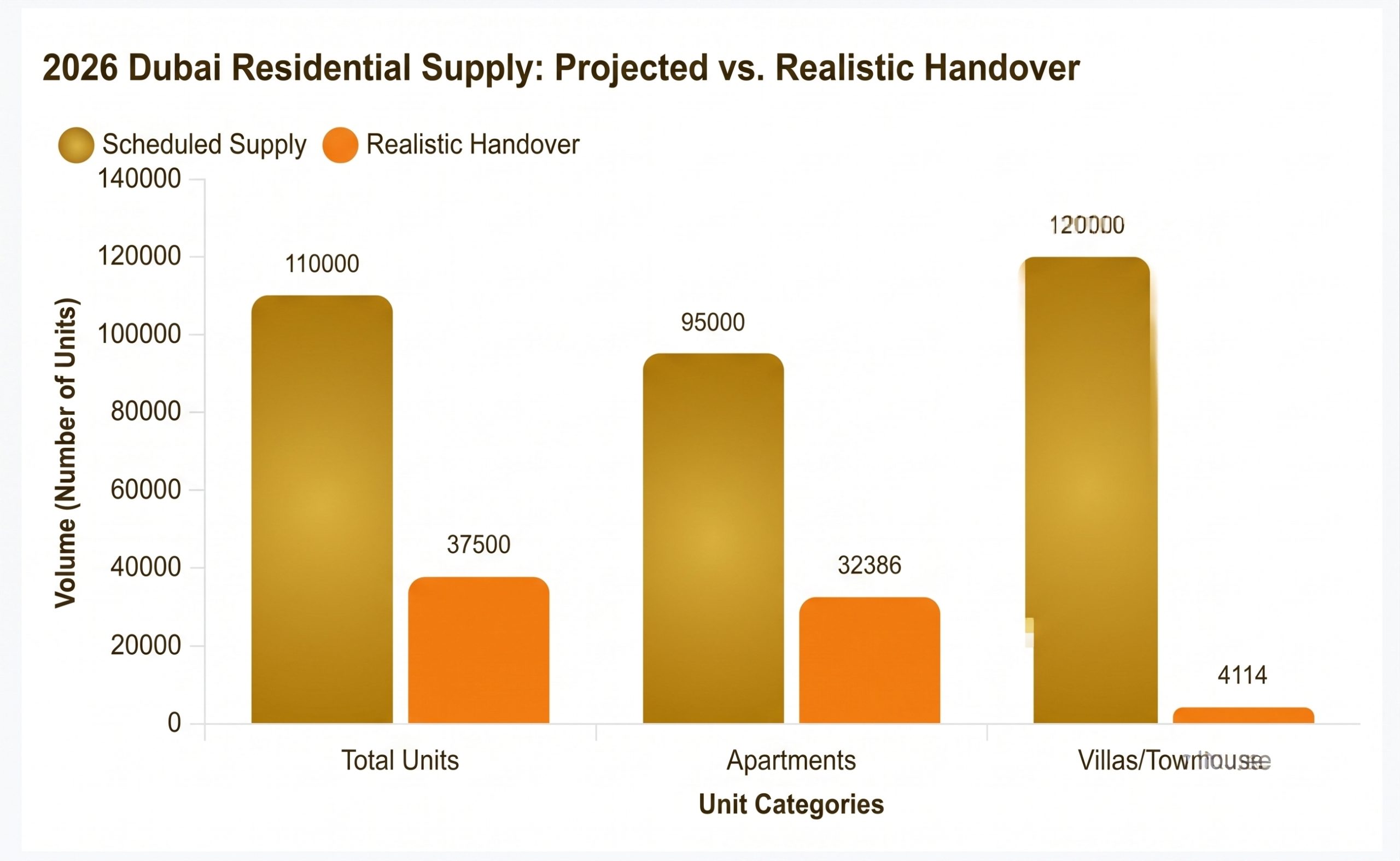
The Residential Supply Pipeline: Headline Risk vs Real Handover Reality
The phrase “supply pipeline” can easily create panic. But investors must distinguish between announced units, scheduled units and actual delivered homes.
Dubai delivered a large number of new homes in H1 2026, but actual handovers remain limited by construction progress, contractor capacity, authority approvals, supply chains and developer execution. This means not every unit scheduled for delivery arrives exactly on time.
That distinction matters. A large paper pipeline can sound dangerous, but market impact depends on actual handover materialization. If projects are delayed, phased or slowed, the supply effect is spread across multiple years instead of arriving all at once.
For buyers, this creates both risk and opportunity. If you buy from a weaker developer, delays may affect your capital timeline. If you buy from a stronger developer, you may benefit from more trust, better delivery certainty and stronger resale confidence.
For supply and correction context, read Dubai Property Market Moderates in Q2 2026: What Investors Need to Know.
JVC Property Prices 2026: Volume Leader, But More Selective
Jumeirah Village Circle remains one of Dubai’s most active mid-market communities. It appeals to investors because of relatively accessible entry prices, strong rental demand, central road connectivity and a large tenant base of young professionals, couples and small families.
But JVC is also a clear example of why buyers must become more selective. The community has seen extensive development activity, with many similar apartment products competing for attention.
This does not make JVC a bad investment. It means the wrong unit, wrong building or wrong developer can underperform. In 2026, investors must evaluate building quality, service charges, parking, layout, handover timeline, developer reputation and realistic rent assumptions.
A well-priced, well-managed JVC apartment can still deliver strong rental utility. A generic off-plan unit bought at an inflated premium may face slower resale and more leasing competition.
Arjan Apartment Handovers: Growth Corridor With Supply Discipline Needed
Arjan has become one of Dubai’s most watched mid-market communities because it offers newer residential stock, growing retail infrastructure and access to Dubai’s wider suburban growth corridors.
For end-users, Arjan can offer modern living at a more accessible price than prime central districts. For investors, it can provide rental demand from professionals and families seeking newer apartments without Downtown or Marina pricing.
The challenge is supply. As more buildings reach handover, buyers and tenants gain more choice. This creates pressure on projects that lack clear differentiation.
In Arjan, investors should focus on developer quality, handover timing, service charges, unit efficiency, road access, parking and building amenities. A project must stand out for a reason. If it does not, future resale and rental performance may become more competitive.
Dubai South: Infrastructure Growth, But Execution Still Matters
Dubai South remains one of the most important long-term growth corridors because of Al Maktoum International Airport, logistics expansion, Expo-linked infrastructure and master-planned development.
For investors, the thesis is clear: if the airport and surrounding commercial ecosystem expand as planned, residential demand may strengthen over time. This makes Dubai South attractive for long-horizon buyers seeking capital appreciation.
But infrastructure potential does not remove developer risk. Buyers still need to check project registration, construction progress, handover assumptions, service charges, access, tenant demand and competing supply.
The best Dubai South investments will likely be those linked to credible developers, real community infrastructure and realistic pricing—not simply the cheapest entry ticket.
Tier-1 Developers vs Mid-Tier Developers: The Trust Premium
In a selective market, trust becomes a form of pricing power.
Tier-1 developers usually benefit from stronger buyer confidence because they have established delivery histories, stronger contractor networks, deeper capital access, better master-planning capability and stronger post-handover management.
Mid-tier developers must compete harder. Some use flexible payment plans. Others focus on boutique design, smart-home features, co-working spaces, premium interiors or aggressive launch pricing.
Those strategies can work, but only if they are supported by execution quality. In 2026, buyers are not rewarding marketing alone. They are rewarding proof.
This is why a project by a trusted developer may command a premium even when another project offers a more attractive payment plan. The lower-risk asset can be worth more because delivery confidence has real value.
How to Check Developer Escrow Account Dubai: What Buyers Should Know
Escrow verification is one of the most important off-plan due-diligence steps in Dubai.
Dubai’s off-plan escrow framework requires buyer payments for off-plan units to be deposited into the relevant project escrow account. This is designed to protect buyer funds and link project disbursements to regulated development processes.
Before signing, buyers should request project registration details, escrow account information, developer documentation, Oqood registration process clarity, construction status and payment routing instructions. Payments should be made only through official approved channels, not informal third-party accounts.
Buyers should also use Dubai Land Department and Dubai REST project-status tools where available to review project completion information. If the buyer is unsure, they should work with a qualified broker, conveyancer or legal adviser before transferring funds.
The simple rule is this: never buy off-plan unless the project registration, escrow route and developer authority are clear.
The Payment Plan Trap: Flexibility Is Not the Same as Value
Mid-tier projects often compete using flexible payment plans. A low booking amount, long post-handover plan or 1% monthly structure can make a property feel affordable.
But investors must be careful. A flexible payment plan does not automatically mean the asset is well priced. Sometimes the payment plan is used to distract from weak location, high price per square foot, uncertain handover risk or low resale demand.
The correct question is not “Can I afford the payment plan?” The correct question is “Will this property be worth the price when I need to rent, live in, refinance or resell it?”
Payment flexibility is useful only when the underlying property fundamentals are strong.
Off-Plan Property Dubai 2026: What Investors Must Vet Before Buying
Off-plan property remains a major part of Dubai’s market. It can still be attractive for investors seeking staged payments, early entry and long-term appreciation.
But in 2026, off-plan investing requires stricter screening. Buyers should review the developer’s track record, construction progress, project registration, escrow route, contractor quality, payment plan, area supply, service-charge estimates and exit restrictions.
Investors should also compare off-plan pricing against ready resale alternatives. If a ready property in the same area is cheaper, rent-ready and physically inspectable, the off-plan unit must justify its premium through superior quality, stronger location, better developer trust or future growth potential.
This is where many buyers make mistakes. They compare monthly payment plans instead of comparing total investment value.
For off-plan and secondary market context, read Dubai Real Estate Expert Forecast 2026: Rental, Secondary and Off-Plan Trends.
Buyer Leverage: What You Can Negotiate in 2026
A more selective market gives buyers leverage, especially in mid-tier apartment projects and supply-heavy communities.
Buyers may be able to negotiate better payment terms, DLD fee support, furnishing packages, post-handover plans, maintenance support, service-charge clarity, parking inclusions, waiver of certain admin fees or more flexible reservation terms.
However, negotiation should not be confused with desperation. Strong projects from trusted developers may still have limited flexibility. Weak projects may offer heavy incentives because demand is soft.
The buyer’s job is to understand why an incentive exists. A discount on a strong asset can be an opportunity. A discount on a weak asset can be a warning.
Mid-Market Property ROI: How to Underwrite Correctly
Mid-market property ROI in Dubai should be calculated conservatively in 2026.
Investors should start with realistic rent, not broker-promised rent. Then deduct service charges, maintenance, vacancy, property management, furnishing, mortgage cost if applicable and resale transaction costs.
For off-plan, investors must also consider zero rental income during construction, potential handover delays, snagging costs, furnishing costs and market conditions at completion.
The best investment is not always the one with the highest advertised gross yield. It is the one with the strongest risk-adjusted net return after real costs and realistic exit assumptions.
For yield and capital growth comparison, read Best Dubai Areas for Capital Growth and Rental Yields in 2026.
The Buyer’s Developer Scrutiny Checklist
Developer track record: How many projects has the developer completed, and were they delivered on time?
Escrow clarity: Is the project escrow account active and properly linked to the off-plan project?
Construction progress: What is the current completion percentage, and is site progress visible?
Contractor quality: Who is building the project, and what is their delivery record?
Payment plan realism: Does the plan support the buyer, or is it hiding an overpriced unit?
Service charges: Are future service-charge assumptions realistic for the building and amenities?
Area supply: How many similar projects are handing over nearby?
Exit liquidity: Who will buy or rent this unit from you after handover?
Brokerage credibility: Is your adviser giving you a full risk picture or only launch-day excitement?
How Mid-Tier Developers Can Survive the Shift
Mid-tier developers can still win in this market, but they must adapt.
First, transparency must become a sales tool. Buyers want visible construction updates, third-party quality checks, clear escrow communication and realistic handover timelines.
Second, product differentiation matters. Generic layouts and repeated amenities are harder to sell when buyers have multiple alternatives. Strong design, efficient layouts, smart-home features, co-working zones, better parking and real community utility can create value.
Third, pricing must be honest. A mid-tier developer cannot price like a Tier-1 brand without offering Tier-1 trust, location or execution strength.
Fourth, partnerships matter. Reputable brokerages, strong contractors, better project management and transparent after-sales service can help rebuild buyer confidence.
End-User Strategy: How to Use Buyer Leverage Safely
End-users have more leverage in 2026, but they should use it carefully.
If buying off-plan, prioritise credible developers, strong locations, realistic handover timelines and payment plans that match your income. Avoid buying only because the monthly instalment looks comfortable.
If buying ready property, compare resale options against off-plan launches. A ready home may offer immediate occupation, real inspection, known service charges and mortgage clarity.
End-users should also consider long-term lifestyle value. Schools, commute, road access, retail, building management and community maturity matter more than launch incentives.
A buyer’s market does not mean you should buy carelessly. It means you have the power to say no until the property, price and risk profile make sense.
Investor Strategy: Where Risk and Opportunity Meet
For investors, Dubai’s 2026 buyers’ market is not a reason to exit. It is a reason to become more disciplined.
Avoid generic oversupply. Buy into scarcity where possible. Compare off-plan against ready resale. Stress-test rents. Check developer delivery. Review exit demand. Understand whether the project is truly differentiated or simply marketed aggressively.
The opportunity is strongest where pricing has become more reasonable but demand remains real. This may include selected ready apartments with strong yields, family communities with lower supply risk, credible off-plan projects in infrastructure-backed corridors, and premium assets where scarcity protects value.
The danger is buying mid-tier product without enough discount, enough developer trust or enough future tenant demand.
Aurantius View: Mature Markets Reward Better Due Diligence
Dubai’s 2026 property market is not broken. It is becoming more rational.
The market is no longer rewarding every launch, every brochure and every aggressive payment plan equally. Buyers are asking better questions, and that is healthy.
Strong developers will continue to attract capital. Weak developers will face scrutiny. Prime communities will remain supported by scarcity. Oversupplied mid-tier projects will need to compete on real value.
For investors, the message is simple: do not fear a buyers’ market. Use it. Negotiate harder, verify deeper, compare better and buy only when the risk-adjusted value is clear.
FAQ: Dubai Buyers’ Market and Mid-Tier Developer Scrutiny
Question: Is Dubai a buyers’ market in 2026?
Answer: Dubai is becoming a selective buyers’ market in certain segments, especially mid-tier apartment and high-supply off-plan areas. Prime villas, waterfront assets and Tier-1 developer projects remain more resilient.
Question: Why are mid-tier developers facing more scrutiny?
Answer: Buyers now have more project options and more market data. They are checking developer track records, escrow accounts, construction progress, contractor quality, handover timelines and service-charge assumptions before buying.
Question: Is off-plan property in Dubai still safe in 2026?
Answer: Off-plan property can still be safe when the project is registered, escrow is clear, the developer has a strong record and pricing is realistic. Risk increases with weak developers, oversupplied locations and unrealistic payment-plan marketing.
Question: How can I check a developer escrow account in Dubai?
Answer: Request official project registration and escrow details, verify project status through Dubai Land Department or Dubai REST tools where available, ensure payments go only to approved project accounts, and use a qualified broker or legal adviser for document checks.
Question: Are JVC and Arjan risky in 2026?
Answer: JVC and Arjan are not automatically risky, but they require careful selection because supply is active. Investors should focus on developer quality, pricing, service charges, building management, layout efficiency and real rental demand.
Question: Should I buy from a Tier-1 developer only?
Answer: Tier-1 developers often provide stronger delivery confidence, but some mid-tier developers can still offer good value. The key is to verify delivery history, escrow, construction progress, contractor quality and pricing before buying.
Question: What is the biggest off-plan risk in Dubai in 2026?
Answer: The biggest risks are developer delays, weak construction execution, oversupply in the same location, inflated launch pricing, unclear service charges and buying based only on payment-plan affordability.
Question: Can Aurantius help buyers evaluate developer risk?
Answer: Yes. Aurantius Real Estate helps buyers compare developers, verify project fundamentals, assess supply risk, review ready versus off-plan options, calculate ROI and negotiate from a stronger position.
Conclusion: In 2026, Buyer Discipline Is the Real Edge
Dubai’s 2026 property market is not defined by collapse. It is defined by selection.
Buyers have more leverage in mid-tier and high-supply segments. Developers face more scrutiny. Payment plans are being judged more carefully. Escrow, construction progress and delivery history are now central to the buying decision.
This is good for serious investors. A mature market rewards discipline. It allows buyers to avoid weak projects, negotiate better terms and focus on assets with real long-term value.
The best opportunities in 2026 will not come from chasing hype. They will come from comparing micro-markets, checking developer strength, calculating true net ROI and buying only where the fundamentals support the price.
Aurantius Real Estate helps buyers and investors navigate Dubai’s selective property market with developer due diligence, off-plan project review, escrow awareness, resale comparison and market-backed investment strategy.
Buying Off-Plan in 2026? Speak with an Aurantius adviser before you commit. Compare developer risk, escrow structure, handover timeline, area supply, payment plan value and ready-market alternatives before signing.
Related reading: Dubai Real Estate Market Trends, Dubai Real Estate Expert Forecast 2026, Dubai Property Market Moderates in Q2 2026, Best Dubai Areas for Capital Growth and Rental Yields and Dubai’s 2026 Property Market Is Selective.