
Dubai Homebuyers Get a New Mortgage Route for Nakheel, Meraas and Dubai Properties Homes
Dubai homebuyers now have another structured route for financing qualifying off-plan and completed homes. Dubai Holding Real Estate and Commercial Bank of Dubai have introduced a home financing programme covering selected villas and apartments developed under Nakheel, Meraas and Dubai Properties.
The programme is significant because it brings bank financing into the property journey before handover. Traditionally, many off-plan buyers depended heavily on developer instalments during construction and arranged a mortgage only when the property was close to completion. This created uncertainty for buyers facing a large final payment without knowing whether a bank would approve their loan.
Under the new CBD framework, eligible buyers can access financing once the development reaches 30% construction progress and the buyer has met the required 50% developer-payment threshold. The programme is available to qualifying UAE nationals and UAE residents, including salaried applicants, entrepreneurs, SME owners and other self-employed buyers.
This is not a zero-deposit mortgage or an automatic approval. Buyers must still contribute substantial capital, meet CBD’s affordability criteria, pass credit and income checks, and receive approval for the specific property. The real value is earlier financing visibility, allowing buyers to plan liquidity before reaching the final handover stage.
How the New Commercial Bank of Dubai Financing Programme Works
The programme combines Dubai Holding Real Estate’s residential portfolio with Commercial Bank of Dubai’s mortgage assessment, digital onboarding and lending support. It covers qualifying off-plan properties that meet the required construction stage, as well as selected completed homes that are ready for occupation or investment.
The most important condition is the relationship between construction progress and buyer payments. The development must have reached at least 30% construction progress. The customer must also have met a 50% payment threshold under the developer’s payment schedule before CBD financing becomes available.
This should not be interpreted as the bank financing the property after the buyer has paid only 30%. Construction progress refers to the physical completion of the project, while the 50% threshold refers to the buyer’s financial contribution under the sale agreement. Both conditions must be considered separately.
The final financing amount, repayment term and applicable rate will depend on the applicant’s income, existing debts, credit history, residency status, property valuation and CBD’s internal lending criteria. The bank may also apply a lower valuation than the developer’s selling price, requiring the buyer to provide additional cash.
Who Are Nakheel, Meraas and Dubai Properties?
Nakheel, Meraas and Dubai Properties operate within Dubai Holding Real Estate, one of the emirate’s largest integrated master-development and asset-management groups. Their combined portfolio includes waterfront destinations, urban lifestyle districts, family communities, villas, apartments and large master-planned developments.
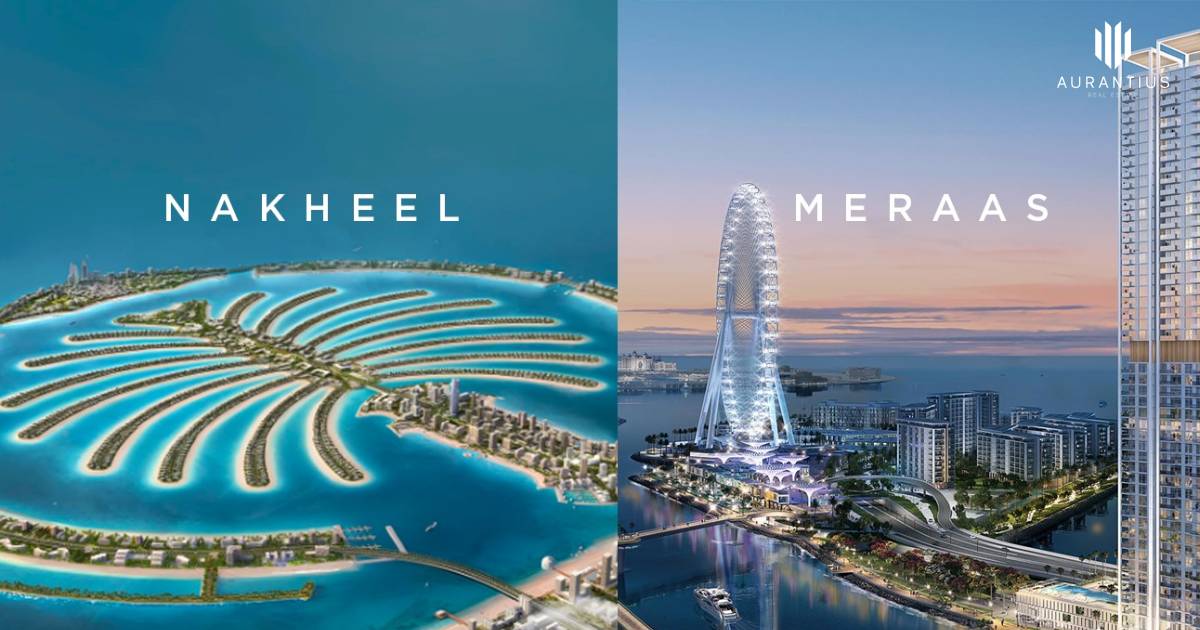
Nakheel is best known for large-scale waterfront and residential communities. Its portfolio includes Palm Jumeirah, Palm Jebel Ali, Dubai Islands, Jumeirah Islands, Al Furjan and Jumeirah Village Circle. Nakheel properties can serve several buyer profiles, ranging from mid-market apartment investors to families seeking villas and high-net-worth buyers targeting waterfront homes.
Meraas focuses more heavily on design-led urban districts and premium lifestyle destinations. City Walk, Bluewaters, Jumeira Bay Island, Port de La Mer, Madinat Jumeirah Living and Nad Al Sheba Gardens reflect its emphasis on architecture, walkability, retail integration and luxury positioning.
Dubai Properties adds large residential communities and urban developments to the portfolio, including projects designed for families, professionals and long-term residents. The combined scale gives buyers access to different budgets, property types and investment strategies through one broader developer ecosystem.
Government-linked ownership and large-scale development capacity can strengthen delivery confidence, infrastructure coordination and community management. They do not make every project risk-free. Buyers must still review the individual development, contract, payment plan, construction progress, expected service charges and future supply.
Why Early Off-Plan Mortgage Access Changes the Buying Strategy
Off-plan buyers usually face a major cash-flow challenge near handover. A developer may require a large final instalment even when the buyer planned to use mortgage finance. If the bank valuation is lower than expected or the mortgage application is rejected, the buyer may need to produce additional cash quickly.
Earlier access to mortgage assessment reduces part of this uncertainty. A buyer can obtain greater clarity about borrowing capacity, likely instalments and documentation requirements before the development reaches completion. This supports more disciplined planning and reduces dependence on last-minute financing.
The programme also connects with the wider shift examined in Why Off-Plan Demand, Flexible Payment Plans and Strategic Growth Continue to Attract Investors. Dubai’s off-plan sector is becoming increasingly connected to regulated banking, project milestones and structured affordability rather than relying only on developer instalments.
Mortgage access should still be treated as a financing tool rather than an investment guarantee. The buyer remains responsible for evaluating whether the final property price, expected rental income, service charges and monthly mortgage obligation support the intended financial strategy.
Conventional and Islamic Financing Options
CBD’s programme includes both conventional and Islamic financing solutions, subject to approval and individual product terms. Buyers can also consider fixed or variable rate structures depending on the options available for their property and financial profile.
A fixed rate can provide repayment stability during the initial agreed period. The buyer knows the applicable rate and monthly instalment for that period, making household budgeting easier. The rate may revert to a variable benchmark after the fixed period ends, so the complete repayment schedule must be reviewed.
A variable rate can move according to the bank’s reference benchmark and agreed margin. It may become cheaper if market rates fall, but monthly repayments can also increase if the benchmark rises. Buyers should test affordability under a higher-rate scenario rather than calculating only the initial instalment.
Islamic home finance follows Sharia-compliant structures rather than a conventional interest-bearing loan. A separate partnership between Dubai Holding Real Estate and Abu Dhabi Islamic Bank also provides Sharia-compliant financing for qualifying off-plan and completed properties across Nakheel, Meraas and Dubai Properties.
The correct choice depends on the applicant’s financial preference, monthly affordability, expected holding period, early-settlement plan and tolerance for changing rates. Buyers should request the bank’s Key Facts Statement and compare total repayment cost rather than judging the product by the advertised rate alone.
What Salaried and Self-Employed Buyers Can Expect
Salaried applicants can use CBD’s digital pre-approval process to receive earlier clarity on borrowing capacity. The bank may assess salary, employment stability, existing liabilities, credit-card limits, personal loans and other monthly commitments before calculating the amount the buyer can afford.
Self-employed buyers, entrepreneurs and SME customers are also included in the programme. CBD has indicated that simplified documentation and flexible eligibility frameworks will support this group, but self-employed applicants should still expect to provide evidence of business activity and sustainable income.
Documents may include trade licences, company bank statements, audited financial statements, personal bank statements, ownership documents and proof of existing liabilities. Requirements will vary according to the business structure, income profile and requested loan amount.
Digital pre-approval improves speed and provides useful early guidance, but it is not the same as final mortgage approval. The property must remain eligible, the valuation must be acceptable and the buyer’s financial position must still meet the bank’s requirements when the financing is completed.
Does the CBD Programme Apply to Non-Resident Buyers?
The announced CBD programme is specifically available to eligible UAE nationals and UAE residents. International investors living outside the UAE should not assume that they automatically qualify under the same terms.
Dubai Holding Real Estate has a separate integrated off-plan mortgage partnership with Emirates NBD that is stated to be available to UAE residents and non-residents, subject to approval. Non-resident buyers may face different loan-to-value limits, income requirements, minimum loan sizes, documentation rules and interest rates.
Foreign buyers should also confirm that the selected property is located in an area where foreign ownership is permitted. The guide to Freehold Areas in Dubai for Foreign Investors in 2026 explains the main ownership zones and how location affects investment options.
Examples of Homes Buyers Can Consider
A buyer seeking an established family location may consider Nakheel communities such as Al Furjan or Jumeirah Islands. These areas can appeal to residents prioritising villas, townhouses, schools, road connectivity and long-term community living.
An apartment investor focused on broad tenant demand may compare JVC with established apartment districts such as Dubai Marina and Business Bay. JVC can offer lower entry prices, while central and waterfront locations may provide stronger established demand at higher acquisition costs.
Buyers prioritising walkable urban living may review Meraas destinations such as City Walk. These properties are often positioned toward professionals, lifestyle buyers and investors seeking premium design, retail access and proximity to Downtown Dubai.
Families seeking newer villa and townhouse communities may examine Nad Al Sheba Gardens or compare alternatives within Dubai Hills Estate. The correct selection depends on commute, schools, property size, handover timing, service charges and financing capacity.
Ultra-prime buyers may evaluate waterfront projects associated with Palm Jumeirah, Palm Jebel Ali, Bluewaters or Jumeira Bay Island. These assets are more dependent on scarcity, lifestyle positioning and long-term capital preservation than on high percentage rental yields.
Nakheel Versus Meraas: What Investors Need to Compare
Nakheel and Meraas should not be compared as though every property under each brand follows one investment pattern. Both developers operate across multiple price points and communities, and individual project performance will depend on supply, unit type, completion quality and tenant demand.
Nakheel’s wider portfolio includes large master-planned communities, waterfront destinations, family areas and mid-market locations. Some Nakheel communities may appeal to long-term tenants and family owner-occupiers, while its Palm developments serve the premium and ultra-luxury markets.
Meraas is more closely associated with design-led, prime urban and lifestyle destinations. Projects in City Walk, Bluewaters and Jumeira Bay can command higher prices per square foot because buyers are paying for location, architecture, scarcity and integrated leisure offerings.
Investors comparing major development companies can review Top 10 Real Estate Developers in Dubai for 2026. The strongest developer for one investor may not be the strongest for another because rental yield, capital growth, personal use and holding period require different asset characteristics.
Other established developers such as Emaar, DAMAC, Sobha Realty and Select Group may also offer competing properties and financing structures. Buyers should compare the complete market rather than selecting a development only because it is included in one bank partnership.
The Costs Buyers Must Calculate Beyond the Deposit
The property price and down payment are only part of the total acquisition cost. Dubai Land Department sale registration charges total 4% of the sale value. The legal allocation is commonly shown as 2% for the seller and 2% for the buyer, though the sale agreement may place the full amount on the buyer.
Registration trustee or service-partner charges also apply. For standard property-sale registration, the applicable service-partner fee generally depends on whether the property value is below or above AED 500,000, with VAT and additional knowledge, innovation, map and title-deed charges potentially added.
Mortgage registration is generally charged at 0.25% of the registered loan amount, together with the applicable title, trustee or service fees. Buyers should also budget for bank processing, valuation, property insurance, life or takaful cover where required, and possible early-settlement charges.
A 2% brokerage commission is common in many secondary-market transactions but is not a universal government fee. Commission depends on the transaction, brokerage agreement and whether the property is ready or purchased directly from a developer.
Off-plan buyers may also pay Oqood registration charges, administrative fees, community service charges after completion and furnishing costs. The final cash requirement should be calculated before signing the reservation form, not after the mortgage has been approved.
How Buyers Can Protect Themselves Before Applying
The first step is to confirm that the property is included in the bank’s qualifying portfolio. Not every Nakheel, Meraas or Dubai Properties unit will automatically qualify for the same financing terms.
The second step is to obtain an affordability assessment before committing to a unit. Buyers should account for existing debts, living expenses, future rate changes, service charges and the possibility that the bank valuation will be below the agreed purchase price.
The third step is to verify the property advertisement and the broker. Dubai’s property-marketing framework requires approved permits and verified advertising practices. Dubai Real Estate Advertising Rules 2026 explains what agents, influencers and property sellers must follow when marketing a development.
The fourth step is to compare the mortgage-supported purchase against the developer’s original payment plan. Bank finance may improve liquidity, but interest or profit costs can increase the total amount paid. A buyer with sufficient cash may find a shorter developer plan more economical.
The fifth step is to test the investment against conservative assumptions. Rental income may be lower than projected, handover may be delayed and variable mortgage rates may rise. A sound property strategy should remain manageable under these conditions.
Buyers comparing ownership strategies can use Best Property Investment Strategies in Dubai for 2026 to assess ready homes, off-plan properties, rental assets and long-term capital-growth opportunities.
FAQ: Dubai Home Financing for Nakheel and Meraas Properties
Question: When can I access CBD financing for a qualifying off-plan property?
Answer: Financing becomes available from 30% construction progress once the buyer has met the required 50% developer-payment threshold. Final financing remains subject to CBD eligibility, valuation and approval.
Question: Does the CBD programme cover ready properties?
Answer: Yes. The programme covers qualifying completed villas and apartments as well as eligible off-plan properties across Nakheel, Meraas and Dubai Properties.
Question: Can a non-resident apply under the new CBD programme?
Answer: The announced CBD programme is for eligible UAE nationals and UAE residents. Dubai Holding Real Estate has a separate Emirates NBD off-plan financing partnership that includes residents and non-residents, subject to approval.
Question: Are Islamic financing options available?
Answer: Yes. CBD’s programme includes conventional and Islamic financing options, subject to eligibility. Dubai Holding Real Estate also has a separate Sharia-compliant financing partnership with ADIB.
Question: Which is better for investors, Nakheel or Meraas?
Answer: It depends on the asset. Nakheel offers large family communities, mid-market locations and iconic waterfront developments. Meraas is more closely associated with premium urban and lifestyle destinations. The project, entry price and demand profile matter more than the brand alone.
Question: Does paying 50% guarantee mortgage approval?
Answer: No. Meeting the payment threshold makes the buyer eligible to seek financing under the programme. CBD must still approve the applicant, property, valuation and final financing structure.
Question: What fees should I include in my buying budget?
Answer: Buyers should account for DLD registration, mortgage registration, trustee and title-deed fees, bank processing and valuation, insurance or takaful, brokerage commission where applicable, service charges and furnishing costs.
Conclusion: Earlier Mortgage Access Improves Planning, Not Investment Certainty
The partnership between Commercial Bank of Dubai and Dubai Holding Real Estate gives qualifying UAE nationals and residents a more structured path to financing selected Nakheel, Meraas and Dubai Properties homes. Its main benefit is earlier clarity, particularly for off-plan buyers who previously had to wait until handover to resolve their mortgage position.
Access from 30% construction progress can help buyers organise cash flow and reduce the uncertainty surrounding a large completion payment. The 50% payment threshold means purchasers still require meaningful capital before bank financing becomes available.
The programme does not remove affordability, valuation, interest-rate, construction or market risk. Buyers must compare the complete purchase cost, bank terms, developer plan, project fundamentals, community demand and expected holding period before proceeding.
Aurantius Real Estate helps buyers compare qualifying off-plan and completed homes across Dubai through developer analysis, community research, payment-plan evaluation and mortgage-aware property guidance. A structured financing route can improve liquidity, but the correct property and purchase price remain the foundation of a successful home or investment decision.